## Diagram: Deep Researcher Agent Workflow
### Overview
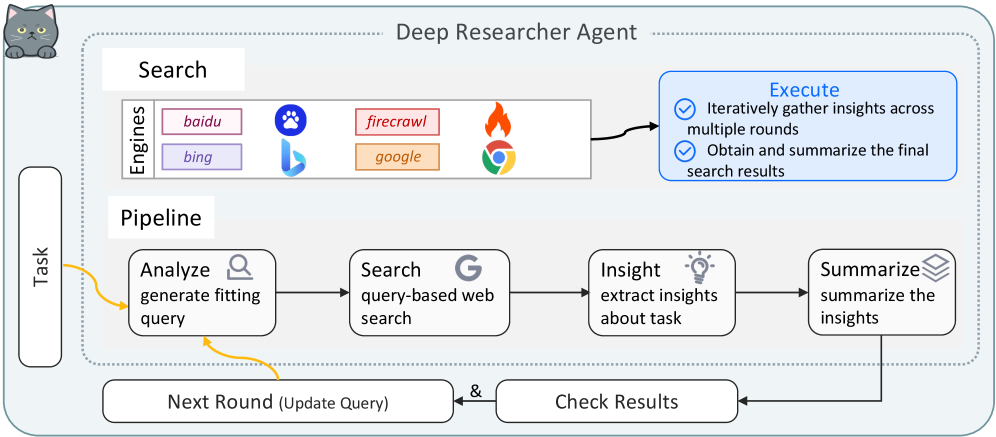
The diagram illustrates the workflow of a "Deep Researcher Agent," depicting a cyclical process for task execution involving search engines, iterative analysis, and result summarization. The flow emphasizes iterative refinement of queries and insights across multiple rounds.
### Components/Axes
1. **Task**: A vertical label on the left side of the diagram, connected to the pipeline via a yellow arrow.
2. **Search Engines**: A horizontal box listing six engines:
- `baidu` (pink), `bing` (purple), `firecrawl` (red), `google` (orange), `chrome` (multicolor), and a pawprint icon (blue).
3. **Pipeline**: A horizontal sequence of four steps:
- **Analyze**: "Analyze generate fitting query" (magnifying glass icon).
- **Search**: "Search query-based web search" (Google "G" icon).
- **Insight**: "Extract insights about task" (lightbulb icon).
- **Summarize**: "Summarize the insights" (stacked papers icon).
4. **Execute**: A blue box on the right with two checkmarked bullet points:
- "Iteratively gather insights across multiple rounds."
- "Obtain and summarize the final search results."
5. **Feedback Loop**: Arrows connecting "Check Results" to "Next Round (Update Query)" and back to "Analyze."
### Detailed Analysis
- **Search Engines**: All six engines are listed in a single row, with no explicit ranking or weighting indicated.
- **Pipeline Flow**:
- The task initiates the process, leading to query generation ("Analyze").
- Queries are used for web searches ("Search"), followed by insight extraction ("Insight").
- Insights are summarized ("Summarize"), then validated via "Check Results."
- If results are unsatisfactory, the query is updated ("Next Round"), restarting the cycle.
- **Execute Section**: Explicitly emphasizes iterative refinement and final result summarization.
### Key Observations
- The workflow is cyclical, with feedback loops enabling adaptive query updates.
- The use of multiple search engines suggests a strategy to diversify data sources.
- The "Insight" and "Summarize" steps imply a focus on qualitative analysis alongside quantitative search results.
### Interpretation
The diagram represents a systematic, iterative research methodology where:
1. **Task Definition** drives the entire process, ensuring alignment with objectives.
2. **Multi-Engine Searching** mitigates bias from relying on a single source.
3. **Iterative Refinement** ("Next Round") allows the agent to adapt queries based on partial results, improving accuracy over time.
4. **Insight Extraction** bridges raw data and actionable conclusions, while "Summarize" ensures clarity in final outputs.
The absence of explicit metrics (e.g., success rates, timeframes) suggests the diagram prioritizes conceptual workflow over quantitative performance. The pawprint icon (Baidu) and pawprint logo (blue) may indicate a focus on pet-related research or a branding choice, though this is speculative without additional context.