TECHNICAL ASSET FINGERPRINT
e7b80acf28272c07f234f771
Click to view fullscreen
Press ESC or click to close
FOUND IN PAPERS
EXPERT: healer-alpha-free VERSION 1
RUNTIME: free/openrouter/healer-alpha
INTEL_VERIFIED
## System Architecture Diagram: AI Assistant with Memory and Self-Evolution
### Overview
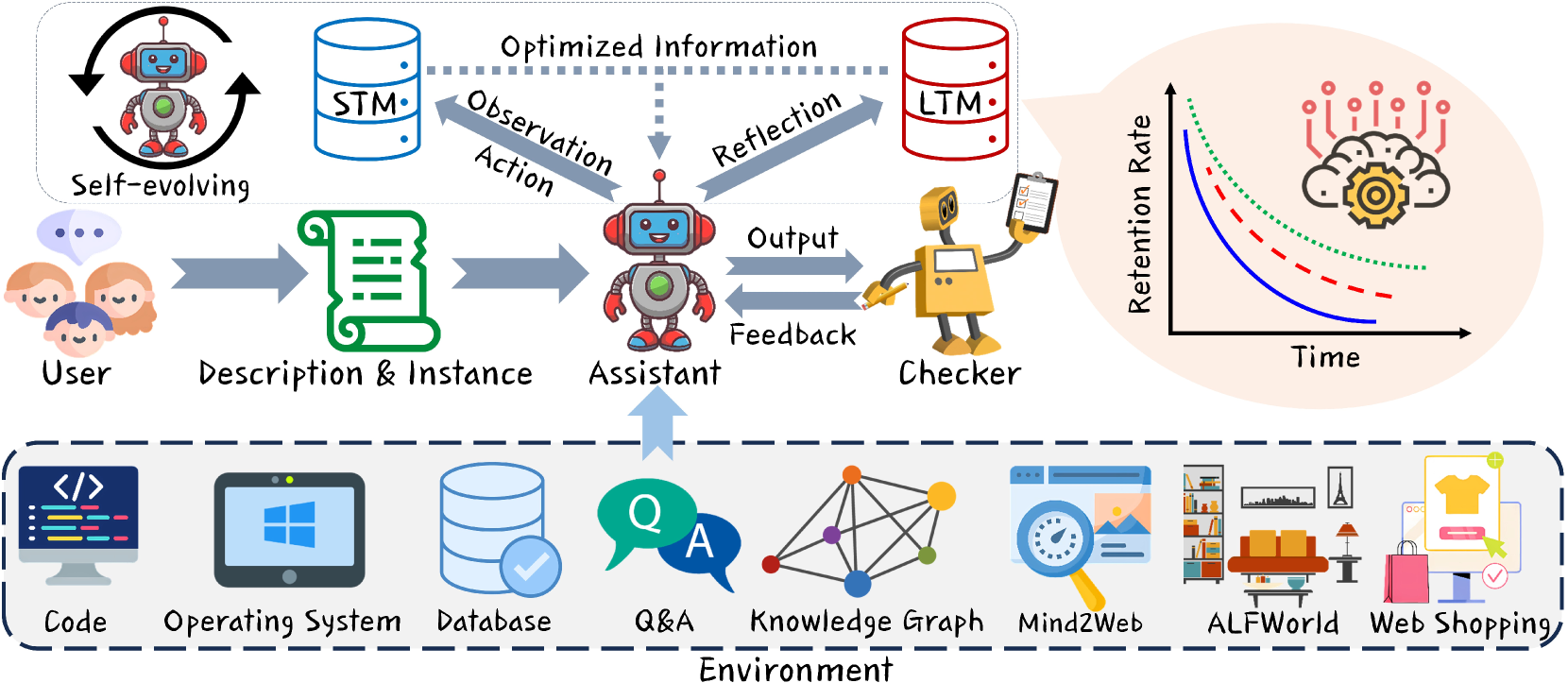
This image is a technical system architecture diagram illustrating the workflow and components of an AI assistant system. The system incorporates user interaction, memory modules (short-term and long-term), a self-evolving mechanism, a feedback checker, and integration with a diverse environment. A secondary chart on retention rate is embedded within the diagram.
### Components/Axes
The diagram is organized into three primary horizontal sections and one embedded chart.
**Top Section (Self-Evolving Loop & Memory):**
* **Self-evolving:** A circular arrow icon with a robot inside, labeled "Self-evolving".
* **STM (Short-Term Memory):** A blue database cylinder icon labeled "STM".
* **LTM (Long-Term Memory):** A red database cylinder icon labeled "LTM".
* **Optimized Information:** A label above a dotted arrow pointing from STM to LTM.
* **Process Arrows:**
* "Observation" and "Action" arrows point from the central Assistant to STM.
* A "Reflection" arrow points from the central Assistant to LTM.
**Middle Section (Core Interaction Flow):**
* **User:** An icon of three people on the far left, labeled "User".
* **Description & Instance:** A green scroll icon, labeled "Description & Instance". A gray arrow points from User to this scroll.
* **Assistant:** A central robot icon, labeled "Assistant". A gray arrow points from the scroll to the Assistant.
* **Checker:** A yellow robot holding a clipboard, labeled "Checker".
* **Interaction Arrows:**
* "Output" arrow from Assistant to Checker.
* "Feedback" arrow from Checker back to Assistant.
* A large, light blue arrow points upward from the "Environment" section to the Assistant.
**Bottom Section (Environment):**
* A dashed box labeled "Environment" at the bottom center.
* **Icons and Labels (from left to right):**
1. A computer monitor with code: "Code"
2. A tablet with a Windows logo: "Operating System"
3. A blue database with a checkmark: "Database"
4. Two speech bubbles (Q & A): "Q&A"
5. A network graph: "Knowledge Graph"
6. A browser window with a magnifying glass: "Mind2Web"
7. A living room scene: "ALFWorld"
8. A shopping interface: "Web Shopping"
**Embedded Chart (Top Right):**
* **Chart Type:** Line graph.
* **Y-axis Label:** "Retention Rate" (vertical text).
* **X-axis Label:** "Time" (horizontal text).
* **Data Series (Lines):**
1. A solid blue line.
2. A dashed red line.
3. A dotted green line.
* **Background Icon:** A brain with a gear inside, positioned behind the chart lines.
### Detailed Analysis
**System Workflow:**
1. The **User** provides input, conceptualized as a "Description & Instance".
2. This input is processed by the **Assistant**.
3. The Assistant interacts with its memory systems:
* It sends "Observation" and "Action" data to **STM**.
* It performs "Reflection" to consolidate information into **LTM**.
* "Optimized Information" flows from STM to LTM.
4. The Assistant generates an **Output** which is evaluated by the **Checker**.
5. The Checker provides **Feedback** to the Assistant, creating a refinement loop.
6. The entire system is under a **Self-evolving** paradigm, suggesting continuous improvement.
7. The Assistant is grounded in and draws capabilities from a broad **Environment** containing tools and knowledge sources (Code, OS, Databases, Q&A, Knowledge Graphs, and specific benchmarks like Mind2Web, ALFWorld, Web Shopping).
**Retention Rate Chart Analysis:**
* **Trend Verification:** All three lines show a decaying trend, starting high on the left (early Time) and decreasing towards the right (later Time). The decay is non-linear, resembling an exponential or power-law decay curve.
* **Line Comparison:**
* The **solid blue line** decays the fastest, ending at the lowest retention rate.
* The **dashed red line** decays at a moderate rate, ending in the middle.
* The **dotted green line** decays the slowest, maintaining the highest retention rate over time.
* **Spatial Grounding:** The chart is positioned in the top-right corner of the diagram, within a light peach-colored oval that also contains the brain/gear icon. The legend (implied by line style/color) is directly on the chart itself.
### Key Observations
1. **Dual Memory Architecture:** The system explicitly separates short-term (STM) and long-term (LTM) memory, with a defined process ("Optimized Information") for transferring knowledge between them.
2. **Closed-Loop Feedback:** The inclusion of a "Checker" that provides "Feedback" creates a closed-loop system for output refinement, which is a key feature for quality control and learning.
3. **Environmental Grounding:** The Assistant is not isolated; it is directly connected to a wide array of practical environments and tools, indicating it is designed for real-world task execution.
4. **Retention Hierarchy:** The embedded chart suggests a hierarchy of information retention. The green dotted line (likely representing "Optimized Information" from the main diagram) shows superior long-term retention compared to the other two lines (which could represent raw observations or unreflected actions).
### Interpretation
This diagram outlines a sophisticated AI agent architecture designed for sustained, evolving performance. The core innovation appears to be the integration of a **self-reflective memory consolidation process** (Observation -> STM -> Reflection -> LTM) with an **external feedback mechanism** (Checker). This structure mimics cognitive theories of human learning, where experiences are encoded, consolidated during reflection, and stored for long-term use, with external validation improving accuracy.
The **Retention Rate chart** serves as a visual hypothesis or result: the process of creating "Optimized Information" (green dotted line) through the system's reflection and consolidation mechanisms leads to significantly better knowledge retention over time compared to unoptimized data streams (blue and red lines). This implies the system's value is not just in performing tasks, but in *learning from them efficiently*.
The broad **Environment** section indicates the system's intended domain is general-purpose problem-solving across digital and simulated real-world tasks (coding, web interaction, database management, household robotics). The architecture suggests a move from a stateless chatbot to a stateful, learning agent that builds a persistent knowledge base (LTM) to improve its future performance in a self-evolving manner.
DECODING INTELLIGENCE...