## Diagram: Dueling Deep Q-Network (Dueling DQN) Architecture
### Overview
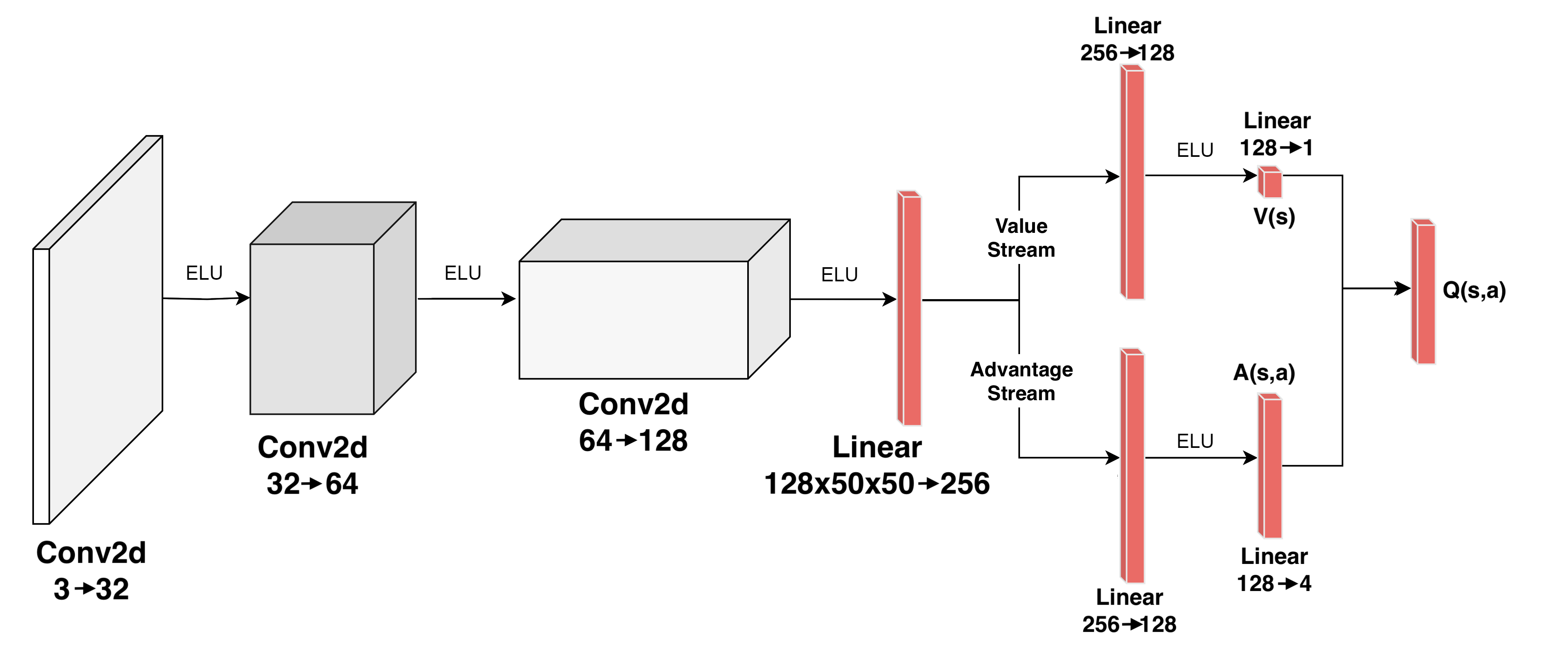
The image illustrates the architectural flow of a Dueling Deep Q-Network (Dueling DQN), a type of reinforcement learning model. The diagram depicts a sequential processing pipeline that begins with an input layer, proceeds through three convolutional layers, flattens the data, and then bifurcates into two distinct processing streams—the "Value Stream" and the "Advantage Stream"—before merging into a final output layer representing the Q-value.
### Components/Axes
The diagram is structured as a left-to-right flow chart.
* **Input/Convolutional Layers:** Represented by 3D blocks of varying sizes.
* **Activation Functions:** Labeled as "ELU" (Exponential Linear Unit) on the arrows connecting the layers.
* **Linear/Fully Connected Layers:** Represented by vertical red bars.
* **Streams:** Two parallel paths labeled "Value Stream" and "Advantage Stream."
* **Output:** The final node labeled "Q(s,a)."
### Detailed Analysis
#### Region 1: Convolutional Feature Extraction (Left)
* **Input Layer:** Labeled "Conv2d 3→32". This is a flat rectangle, suggesting an input image with 3 channels (likely RGB).
* **Transition:** An arrow labeled "ELU" connects the input to the next layer.
* **Second Layer:** Labeled "Conv2d 32→64". Represented as a 3D block.
* **Transition:** An arrow labeled "ELU" connects this to the next layer.
* **Third Layer:** Labeled "Conv2d 64→128". Represented as a larger 3D block.
* **Transition:** An arrow labeled "ELU" connects this to the flattening layer.
#### Region 2: Flattening and Bifurcation (Center)
* **Flattening Layer:** Labeled "Linear 128x50x50→256". This is a tall, thin red vertical bar, indicating the transition from 3D feature maps to a 1D vector.
* **Split:** The flow branches into two parallel paths:
* **Top Path (Value Stream):**
* "Linear 256→128": A vertical red bar.
* "ELU": Activation function.
* "Linear 128→1": A vertical red bar.
* **Output:** "V(s)" (State Value).
* **Bottom Path (Advantage Stream):**
* "Linear 256→128": A vertical red bar.
* "ELU": Activation function.
* "Linear 128→4": A vertical red bar.
* **Output:** "A(s,a)" (Action Advantage).
#### Region 3: Output Integration (Right)
* **Final Merge:** The outputs from the Value Stream (V(s)) and the Advantage Stream (A(s,a)) converge into a final vertical red bar.
* **Final Output:** Labeled "Q(s,a)".
### Key Observations
* **Activation Consistency:** The diagram explicitly uses "ELU" (Exponential Linear Unit) as the activation function between every major layer transition.
* **Dimensionality:** The "Linear 128x50x50→256" label indicates that the feature map entering the fully connected layers has a spatial resolution of 50x50 with 128 channels.
* **Action Space:** The "Linear 128→4" in the Advantage Stream indicates that the environment has a discrete action space of 4 possible actions.
* **Value vs. Advantage:** The Value Stream outputs a single scalar (1), representing the value of the state, while the Advantage Stream outputs a vector of size 4, representing the relative advantage of each action.
### Interpretation
This diagram represents a **Dueling DQN architecture**, which is designed to improve the stability and efficiency of reinforcement learning agents.
* **Why it matters:** In standard DQN architectures, the network estimates the Q-value for every action directly. However, in many states, the choice of action does not significantly impact the outcome. The Dueling architecture addresses this by decoupling the estimation of the state value (V(s))—how good it is to be in a particular state—from the advantage of each action (A(s,a))—how much better one action is compared to others in that state.
* **Peircean Investigative Insight:** The "4" in the Advantage Stream is the most critical variable for the environment's complexity; it implies the agent is navigating a 4-action environment (e.g., Up, Down, Left, Right). The "1" in the Value Stream confirms that the state value is a single scalar, which is then combined with the advantage vector to produce the final Q-values. The use of ELU suggests a preference for handling negative inputs more gracefully than standard ReLU, which is common in deep reinforcement learning to prevent "dying neurons."