## Diagram: Machine Learning/Reservoir Computing Framework
### Overview
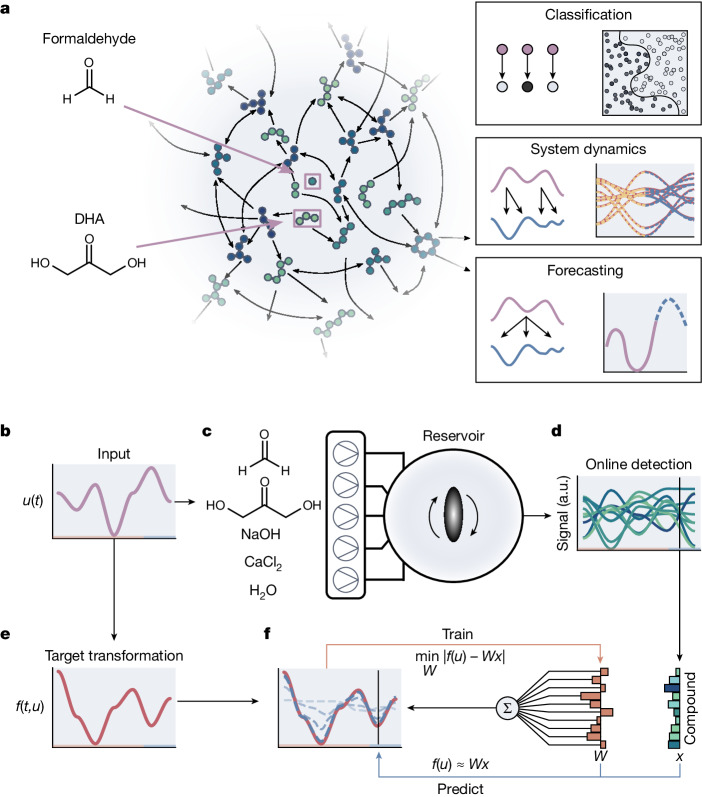
The image depicts a multi-stage technical framework combining chemical processes, neural network dynamics, and signal processing. It is divided into six labeled sections (a-f) illustrating input processing, reservoir dynamics, and predictive modeling.
### Components/Axes
**Section a (Top Left):**
- **Chemical Inputs**:
- Formaldehyde (HCHO) structure with O, H atoms
- DHA (Dihydroxyacetone) structure with O, H, OH groups
- **Network Diagram**:
- Nodes (blue/green circles) connected by bidirectional arrows
- Embedded squares with purple borders (possibly hidden layers)
- **Right Panels**:
1. **Classification**:
- Three vertical purple circles (input/output)
- Scatter plot with clustered data points
2. **System Dynamics**:
- Wavy purple/blue lines with downward arrows
- Oscillating graph with multiple peaks
3. **Forecasting**:
- Similar wavy lines with directional arrows
- Single-line graph with dashed trendline
**Section b (Middle Left):**
- **Input Graph**:
- Sine wave labeled `u(t)` with amplitude ~1.0
- Time axis (t) with blue baseline
- **Chemical Reaction**:
- Reactants: NaOH, CaCl₂, H₂O
- Products: DHA (HO-CH₂-CHO) and formaldehyde
**Section c (Middle Center):**
- **Reservoir**:
- Circular component with rotating ellipse (gray)
- Connected to chemical reaction via pipes
- Labeled "Reservoir" with rotational arrows
**Section d (Middle Right):**
- **Online Detection**:
- Overlapping sine waves (blue/green) labeled "Signal (a.u.)"
- Time axis with amplitude fluctuations
**Section e (Bottom Left):**
- **Target Transformation**:
- Red sine wave labeled `f(t,u)` with higher frequency
- Time axis with amplitude ~1.5
**Section f (Bottom Right):**
- **Training Process**:
- Equation: `min |f(u) - Wx|` (weight optimization)
- Prediction graph: `f(u) ≈ Wx` with dashed line
- Weight matrix (W) represented by vertical bars
### Detailed Analysis
- **Chemical Inputs**: Formaldehyde and DHA are positioned as primary inputs to the network.
- **Network Dynamics**: The central node network shows complex interconnections, suggesting nonlinear processing.
- **Reservoir Function**: The rotating component in section c implies temporal memory or state retention.
- **Signal Processing**: Sections d and e show input-output relationships with phase differences.
- **Training Mechanism**: Section f explicitly links input (u(t)) to target (f(t,u)) via weight adjustment.
### Key Observations
1. **Temporal Relationships**: Input (u(t)) and target (f(t,u)) have distinct frequencies, indicating feature transformation.
2. **Reservoir Role**: The rotating component bridges chemical inputs and neural processing.
3. **Prediction Accuracy**: The training process minimizes error between predicted (Wx) and actual (f(u)) outputs.
### Interpretation
This framework appears to model a **reservoir computing system** where:
- Chemical inputs (formaldehyde/DHA) are preprocessed through a dynamic reservoir.
- The system learns temporal patterns via weight optimization (W) to predict transformed outputs.
- The separation of input, reservoir, and prediction stages mirrors liquid state machine architectures.
- The use of chemical reactions suggests potential applications in bio-inspired computing or sensor networks.
No explicit numerical data or uncertainties are provided in the diagram. The focus is on architectural relationships rather than quantitative metrics.