## Heatmap Analysis: Layer-Head Activation Patterns by Category
### Overview
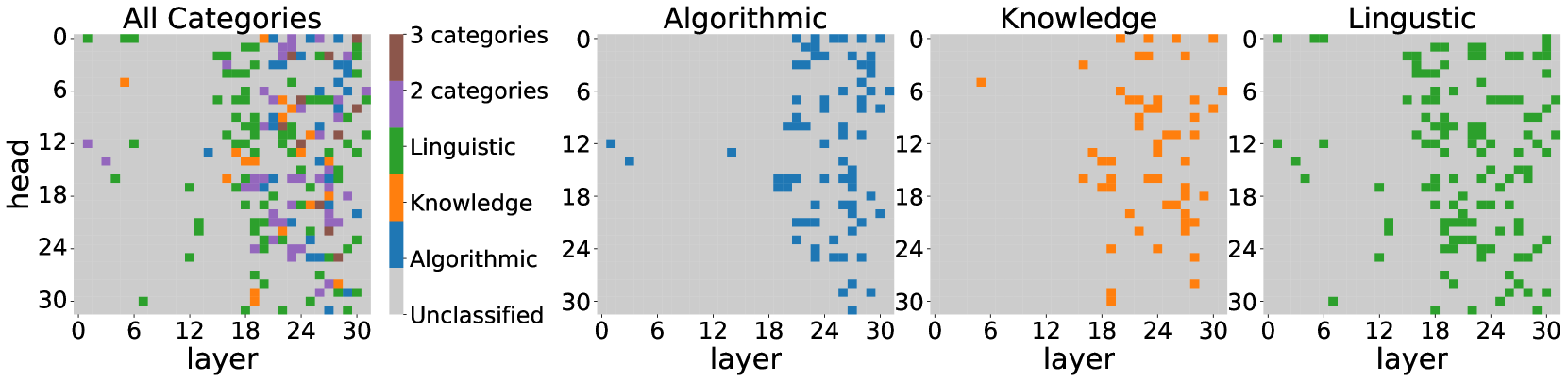
The image displays four horizontally arranged heatmap panels visualizing the distribution of categorized "heads" across "layers" in what appears to be a neural network or similar layered model. The leftmost panel, "All Categories," shows a composite view, while the subsequent three panels isolate specific categories: "Algorithmic," "Knowledge," and "Linguistic." The data is presented on a grid where the x-axis represents "layer" (0-30) and the y-axis represents "head" (0-30). Colored squares indicate the presence of a specific category at a given layer-head coordinate.
### Components/Axes
* **Panels:** Four distinct panels titled (from left to right): "All Categories", "Algorithmic", "Knowledge", "Linguistic".
* **Axes:**
* **X-axis (all panels):** Labeled "layer". Major tick marks at 0, 6, 12, 18, 24, 30.
* **Y-axis (all panels):** Labeled "head". Major tick marks at 0, 6, 12, 18, 24, 30.
* **Legend (in "All Categories" panel, top-right):** A vertical color bar with the following labels and associated colors:
* `3 categories` (Brown)
* `2 categories` (Purple)
* `Linguistic` (Green)
* `Knowledge` (Orange)
* `Algorithmic` (Blue)
* `Unclassified` (Gray - background color of the grid)
* **Spatial Layout:** The legend is positioned in the top-right corner of the first panel. The three category-specific panels are arranged to the right of the composite panel, each showing only one color from the legend.
### Detailed Analysis
**1. "All Categories" Panel (Composite View):**
* **Trend:** Shows a dense, mixed distribution of colored squares, indicating that many layer-head combinations are assigned to one or more categories. The distribution is not uniform.
* **Spatial Distribution:**
* **Green (Linguistic):** Appears most frequently and is widely scattered across the entire grid, with notable clusters in layers 12-30.
* **Orange (Knowledge):** Appears in distinct clusters, primarily in layers 18-30, heads 0-24.
* **Blue (Algorithmic):** Appears in a dense, vertical cluster primarily between layers 18-30, spanning most heads.
* **Purple (2 categories):** Scattered sparsely, often adjacent to or overlapping with other colors.
* **Brown (3 categories):** Very sparse, only a few instances visible (e.g., near layer 30, head 0).
* **Data Points (Approximate):** The grid is 31x31 (961 cells). A visual estimate suggests roughly 150-200 colored squares total, with green being the most numerous, followed by blue and orange.
**2. "Algorithmic" Panel (Blue):**
* **Trend:** Shows a strong, dense vertical band of activity.
* **Spatial Distribution:** Concentrated almost exclusively in the right half of the grid, from approximately layer 18 to layer 30. Within this band, the blue squares are densely packed across nearly all heads (0-30). Very few blue squares exist before layer 18 (e.g., isolated points near layer 0, head 12 and layer 12, head 12).
**3. "Knowledge" Panel (Orange):**
* **Trend:** Shows clustered, patchy activity.
* **Spatial Distribution:** Primarily located in layers 18-30. The distribution is less uniform than the Algorithmic panel, forming distinct clusters. One major cluster is in layers 18-24, heads 6-18. Another cluster appears in layers 24-30, heads 0-12. There are very few orange squares before layer 18 (e.g., one near layer 6, head 6).
**4. "Linguistic" Panel (Green):**
* **Trend:** Shows the most widespread and scattered distribution.
* **Spatial Distribution:** Green squares are present across the entire layer range (0-30) and head range (0-30). While scattered, there is a clear increase in density from left to right (lower to higher layers). The highest concentration appears in layers 18-30, but significant activity exists in earlier layers (e.g., clusters around layer 6, head 0 and layer 12, head 12).
### Key Observations
1. **Layer Specialization:** There is a clear demarcation around layer 18. The "Algorithmic" and "Knowledge" categories are almost exclusively active in layers 18 and above, suggesting these functions are handled by deeper layers of the model.
2. **Category Prevalence:** "Linguistic" processing appears to be a fundamental function distributed across all layers, though it also intensifies in deeper layers.
3. **Co-occurrence:** The "All Categories" panel shows many instances where colors are adjacent or overlapping (e.g., green next to blue), suggesting heads or layers may be involved in multiple functional categories simultaneously. The "2 categories" (purple) and "3 categories" (brown) labels explicitly confirm this multi-functionality for some units.
4. **Head vs. Layer:** For the "Algorithmic" category, the pattern is strongly layer-dependent (a vertical band) but largely head-agnostic within that band. For "Knowledge," the pattern is more cluster-based, suggesting specific combinations of layer and head are important.
### Interpretation
This visualization likely represents a functional analysis of a multi-layer, multi-head neural network (e.g., a Transformer model). The "heads" are probably attention heads, and the "layers" are the model's depth.
* **What the data suggests:** The model exhibits functional specialization across its depth. Early layers (0-17) are predominantly engaged in "Linguistic" processing, which could involve basic syntactic and morphological analysis. Deeper layers (18-30) take on more complex, specialized functions: "Algorithmic" (potentially procedural reasoning, step-by-step logic) and "Knowledge" (retrieval and application of factual information). The widespread "Linguistic" activity suggests that language processing is a continuous, foundational task that underpins the higher-order functions.
* **Relationship between elements:** The composite "All Categories" view is the sum of the three category-specific views. The clear separation of the blue and orange clusters in the deeper layers indicates a potential division of labor between algorithmic and knowledge-based reasoning in the model's final processing stages.
* **Notable patterns/anomalies:** The near-total absence of "Algorithmic" and "Knowledge" functions before layer 18 is a striking architectural insight. It implies a hierarchical processing pipeline where raw linguistic features are first extracted and then used as inputs for more abstract reasoning tasks in the network's later stages. The sparse "2 categories" and "3 categories" markers highlight rare, potentially highly specialized units that integrate multiple functions.