## Heatmap: Category Distribution Across Layers and Heads
### Overview
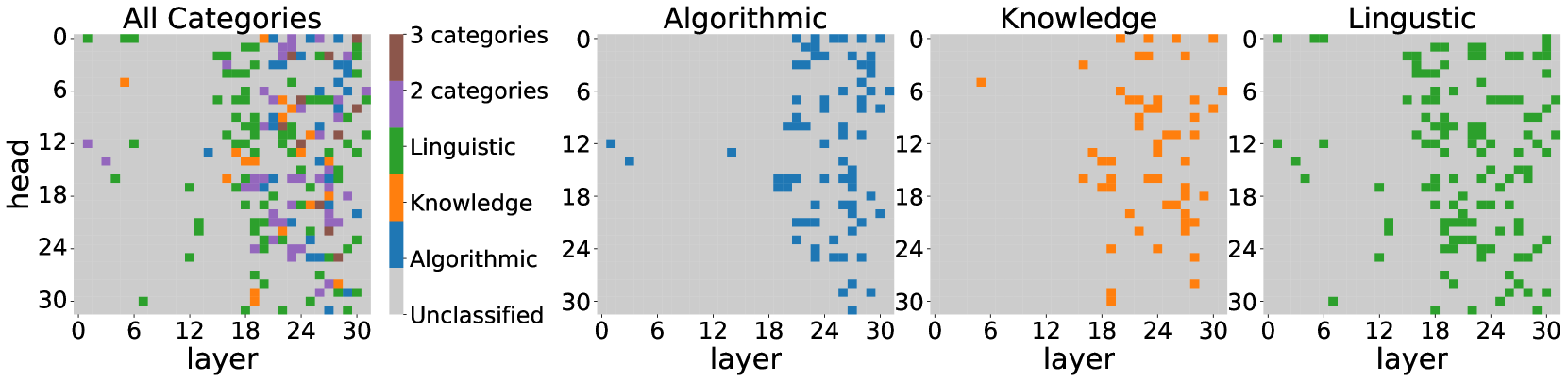
The image presents four heatmaps displaying the distribution of different categories across layers and heads. The first heatmap, "All Categories," shows the combined distribution of all categories, while the subsequent heatmaps ("Algorithmic," "Knowledge," and "Linguistic") show the individual distributions of each category. The heatmaps are arranged horizontally, sharing the same axes.
### Components/Axes
* **Titles:** "All Categories," "Algorithmic," "Knowledge," "Linguistic"
* **Y-axis:** "head," with ticks at 0, 6, 12, 18, 24, and 30.
* **X-axis:** "layer," with ticks at 0, 6, 12, 18, 24, and 30.
* **Legend (located to the right of the "All Categories" heatmap):**
* Brown: 3 categories
* Purple: 2 categories
* Green: Linguistic
* Orange: Knowledge
* Blue: Algorithmic
* Gray: Unclassified (This is the background color)
### Detailed Analysis
**1. All Categories:**
* This heatmap shows a mix of all categories.
* There are instances where 2 or 3 categories overlap, indicated by purple and brown squares, respectively.
* The distribution appears relatively even across layers and heads, with some concentrations in specific areas.
**2. Algorithmic:**
* The "Algorithmic" category (blue) is sparsely distributed.
* There are a few clusters of "Algorithmic" instances, particularly around layer 24 and head 18.
* Most of the heatmap is gray, indicating "Unclassified."
**3. Knowledge:**
* The "Knowledge" category (orange) is also sparsely distributed.
* There are a few clusters of "Knowledge" instances, particularly around layer 18 and head 6.
* Most of the heatmap is gray, indicating "Unclassified."
**4. Linguistic:**
* The "Linguistic" category (green) is more densely distributed compared to "Algorithmic" and "Knowledge."
* There are several clusters of "Linguistic" instances, particularly in the upper-right quadrant (higher layers and lower heads).
* Most of the heatmap is gray, indicating "Unclassified."
### Key Observations
* The "Linguistic" category appears to be the most prevalent among the three categories shown.
* The "Algorithmic" and "Knowledge" categories are sparsely distributed.
* There are instances where multiple categories overlap, as indicated in the "All Categories" heatmap.
* The majority of the heatmap area is "Unclassified," suggesting that these categories do not dominate the overall distribution.
### Interpretation
The heatmaps provide a visual representation of how different categories are distributed across layers and heads. The "Linguistic" category seems to be more prominent, while "Algorithmic" and "Knowledge" are less frequent. The overlapping categories in the "All Categories" heatmap suggest that some layers and heads may be responsible for processing multiple types of information. The "Unclassified" areas indicate that there are other categories or types of information not represented in these heatmaps. This analysis could be used to understand how different types of information are processed within a model or system, and how the processing is distributed across different layers and heads.