\n
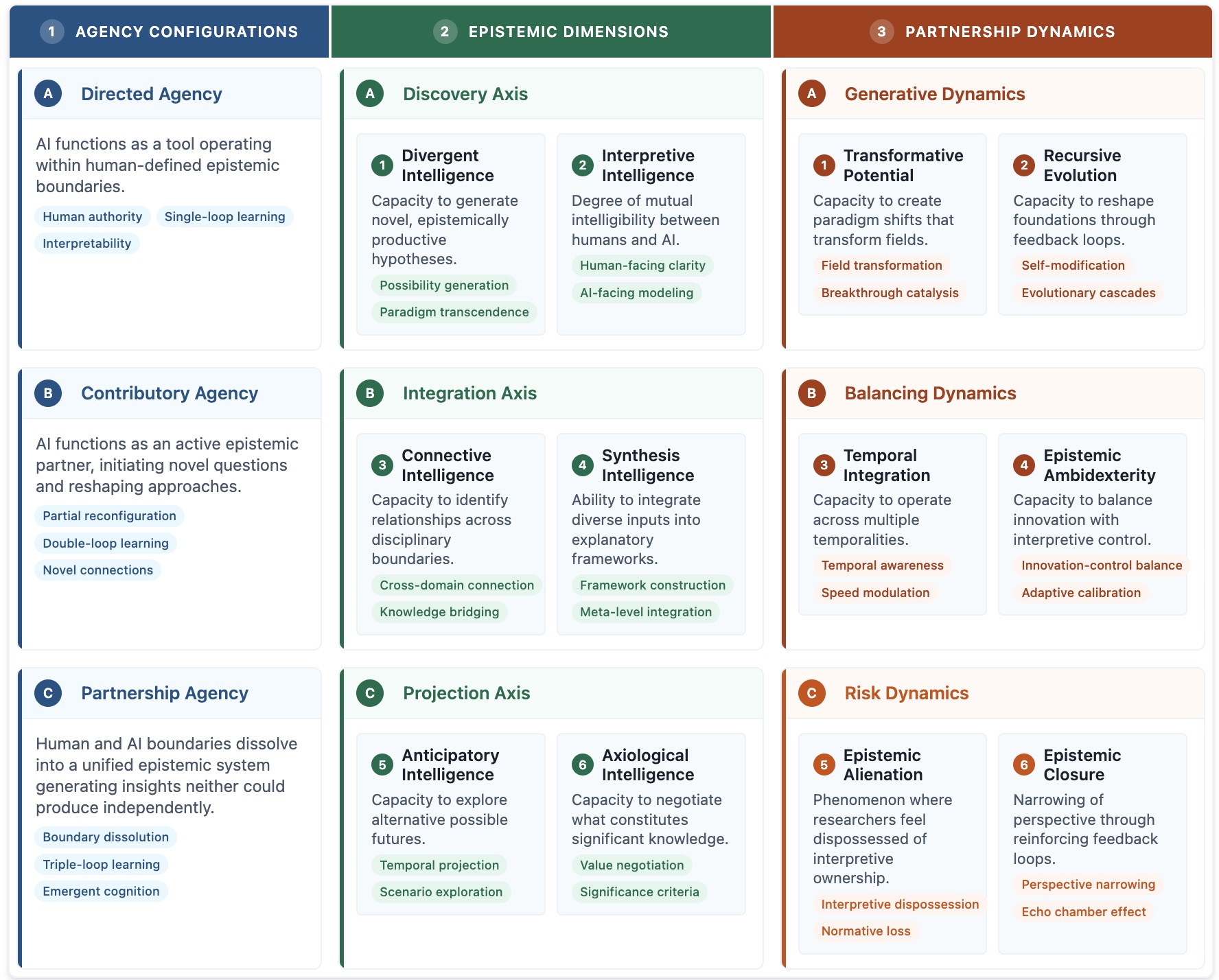
## Diagram: AI Agency, Epistemic Dimensions, and Partnership Dynamics
### Overview
The image presents a conceptual diagram outlining a framework for understanding the interplay between Artificial Intelligence (AI) and human intelligence. It's structured around three main categories: Agency Configurations, Epistemic Dimensions, and Partnership Dynamics. Each category is further divided into sub-categories (A, B, C; 1, 2, 3, etc.) with descriptive text explaining the concepts. The diagram uses a grid-like layout with numbered and lettered sections, and color-coding to differentiate the main categories.
### Components/Axes
The diagram is divided into three main columns:
* **Column 1: Agency Configurations** (Left) - Explores the role of AI as a tool, contributor, or partner.
* **Column 2: Epistemic Dimensions** (Center) - Focuses on different modes of knowing and intelligence.
* **Column 3: Partnership Dynamics** (Right) - Describes the emergent behaviors and challenges in human-AI collaboration.
Each column has three sub-sections labeled A, B, and C. Within each sub-section, there are numbered concepts (1-6) with accompanying descriptions.
The diagram uses a color scheme:
* Agency Configurations: Light Blue
* Epistemic Dimensions: Light Green
* Partnership Dynamics: Light Orange
### Detailed Analysis or Content Details
**Agency Configurations (Column 1)**
* **A: Directed Agency** - "AI functions as a tool operating within human-defined epistemic boundaries." Keywords: Human authority, Single-loop learning, Interpretability.
* **B: Contributory Agency** - "AI functions as an active epistemic partner, initiating novel questions and reshaping approaches." Keywords: Partial reconfiguration, Double-loop learning, Novel connections.
* **C: Partnership Agency** - "Human and AI boundaries dissolve into shared epistemic system generating insights neither could produce independently." Keywords: Boundary dissolution, Triple-loop learning, Emergent cognition.
**Epistemic Dimensions (Column 2)**
* **1: Discovery Axis** - "Divergent Intelligence: Capacity to generate novel, epistemically productive hypotheses." Keywords: Possibility generation, Paradigm transcendence.
* **2: Interpretive Intelligence** - "Degree of mutual intelligibility between humans and AI." Keywords: Human-facing clarity, AI-facing modeling.
* **3: Integration Axis** - "Connective Intelligence: Ability to identify relationships across disciplinary boundaries." Keywords: Cross-domain connection, Knowledge bridging.
* **4: Synthesis Intelligence** - "Capacity to integrate diverse inputs into explanatory frameworks." Keywords: Framework construction, Meta-level integration.
* **5: Projection Axis** - "Anticipatory Intelligence: Capacity to explore alternative possible futures." Keywords: Temporal projection, Scenario exploration.
* **6: Axiological Intelligence** - "Capacity to negotiate what constitutes significant knowledge." Keywords: Value negotiation, Significance criteria.
**Partnership Dynamics (Column 3)**
* **A: Generative Dynamics** -
* **1: Transformative Potential** - "Capacity to create paradigm shifts that transform fields." Keywords: Field transformation, Breakthrough catalysis.
* **2: Recursive Evolution** - "Capacity to reshape foundations through feedback loops." Keywords: Self-modification, Evolutionary cascades.
* **B: Balancing Dynamics** -
* **3: Temporal Integration** - "Capacity to operate across multiple temporalities." Keywords: Temporal awareness, Speed modulation.
* **4: Epistemic Ambidexterity** - "Capacity to balance innovation with interpretive control." Keywords: Innovation-control balance, Adaptive calibration.
* **C: Risk Dynamics** -
* **5: Epistemic Alienation** - "Phenomenon where researchers feel dispossessed of interpretive ownership." Keywords: Interpretive dispossession, Normative loss.
* **6: Epistemic Closure** - "Narrowing of perspective through reinforcing feedback loops." Keywords: Perspective narrowing, Echo chamber effect.
### Key Observations
The diagram presents a highly conceptual framework. There are no numerical values or quantitative data. The diagram emphasizes the increasing complexity of human-AI interaction, moving from AI as a simple tool (Directed Agency) to a collaborative partner where boundaries blur (Partnership Agency). The Epistemic Dimensions highlight different facets of intelligence, while the Partnership Dynamics explore the potential benefits and risks of this collaboration. The use of keywords suggests core concepts within each category.
### Interpretation
This diagram is a thought experiment exploring the future of AI and its relationship with human intelligence. It's not presenting data, but rather a model for understanding the different ways AI can operate and the implications of those operations. The diagram suggests that as AI becomes more sophisticated, the nature of the partnership between humans and AI will evolve, potentially leading to both transformative breakthroughs and significant risks. The concepts of "Epistemic Alienation" and "Epistemic Closure" are particularly noteworthy, as they highlight the potential for AI to disrupt established ways of knowing and create echo chambers of thought. The diagram is a call for careful consideration of the ethical and epistemological implications of AI development. It's a framework for discussion and further research, rather than a definitive statement of fact. The diagram's structure suggests a progression, with each category building upon the previous one, leading to a more nuanced understanding of the human-AI relationship.