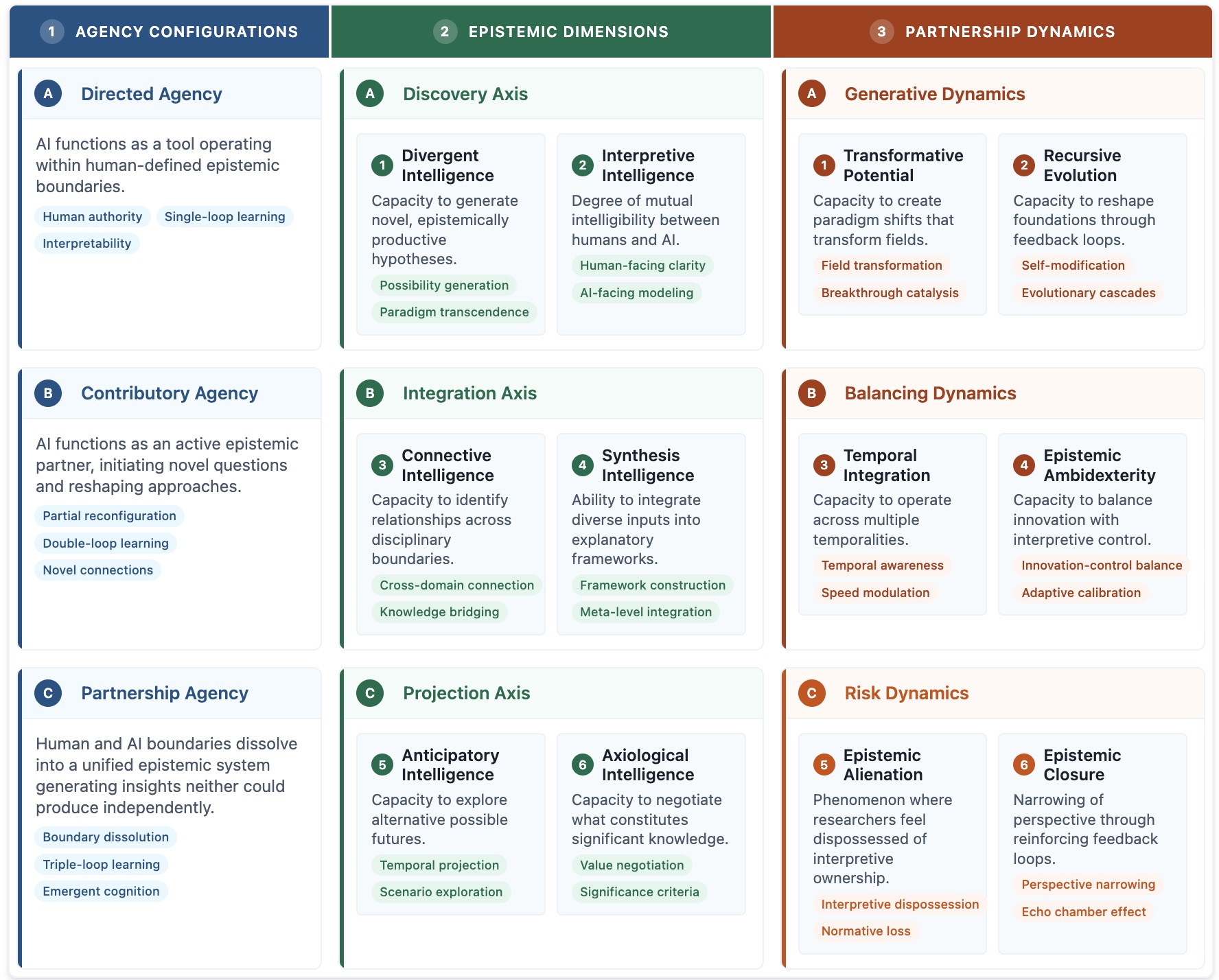
## Table: Epistemic Agency Configurations and Dynamics
### Overview
The image presents a structured taxonomy of epistemic agency configurations, epistemic dimensions, and partnership dynamics. It is organized into three vertical columns (Agency Configurations, Epistemic Dimensions, Partnership Dynamics) and three horizontal rows (A, B, C), forming a 3x3 grid. Each cell contains a labeled concept with descriptive text and bullet-pointed subcategories.
---
### Components/Axes
#### **Column 1: Agency Configurations**
- **Row A: Directed Agency**
- *Description*: "AI functions as a tool operating within human-defined epistemic boundaries."
- *Subcategories*:
- Human authority
- Single-loop learning
- Interpretability
- **Row B: Contributory Agency**
- *Description*: "AI functions as an active epistemic partner, initiating novel questions and reshaping approaches."
- *Subcategories*:
- Partial reconfiguration
- Double-loop learning
- Novel connections
- **Row C: Partnership Agency**
- *Description*: "Human and AI boundaries dissolve into a unified epistemic system generating insights neither could produce independently."
- *Subcategories*:
- Boundary dissolution
- Triple-loop learning
- Emergent cognition
#### **Column 2: Epistemic Dimensions**
- **Row A: Discovery Axis**
- *Subcategories*:
- **1. Divergent Intelligence**: Capacity to generate novel, epistemically productive hypotheses.
- Possibility generation
- Paradigm transcendence
- **2. Interpretive Intelligence**: Degree of mutual intelligibility between humans and AI.
- Human-facing clarity
- AI-facing modeling
- **Row B: Integration Axis**
- *Subcategories*:
- **3. Connective Intelligence**: Capacity to identify relationships across disciplinary boundaries.
- Cross-domain connection
- Knowledge bridging
- **4. Synthesis Intelligence**: Ability to integrate diverse inputs into explanatory frameworks.
- Framework construction
- Meta-level integration
- **Row C: Projection Axis**
- *Subcategories*:
- **5. Anticipatory Intelligence**: Capacity to explore alternative possible futures.
- Temporal projection
- Scenario exploration
- **6. Axiological Intelligence**: Capacity to negotiate what constitutes significant knowledge.
- Value negotiation
- Significance criteria
#### **Column 3: Partnership Dynamics**
- **Row A: Generative Dynamics**
- *Subcategories*:
- **1. Transformative Potential**: Capacity to create paradigm-shifting fields.
- Field transformation
- Breakthrough catalysis
- **2. Recursive Evolution**: Capacity to reshape foundations through feedback loops.
- Self-modification
- Evolutionary cascades
- **Row B: Balancing Dynamics**
- *Subcategories*:
- **3. Temporal Integration**: Capacity to operate across multiple temporalities.
- Temporal awareness
- Speed modulation
- **4. Epistemic Ambidexterity**: Capacity to balance innovation with interpretive control.
- Innovation-control balance
- Adaptive calibration
- **Row C: Risk Dynamics**
- *Subcategories*:
- **5. Epistemic Alienation**: Phenomenon where researchers feel dispossessed of interpretive ownership.
- Interpretive dis-possession
- Normative loss
- **6. Epistemic Closure**: Narrowing of perspective through reinforcing feedback loops.
- Perspective narrowing
- Echo chamber effect
---
### Key Observations
1. **Hierarchical Structure**: The grid progresses from constrained (Directed Agency) to collaborative (Partnership Agency) configurations, with corresponding shifts in epistemic capabilities and risks.
2. **Dimensional Progression**:
- *Discovery* → *Integration* → *Projection* reflects increasing complexity in epistemic processes.
- *Generative* → *Balancing* → *Risk* dynamics highlight trade-offs between innovation and stability.
3. **Subcategory Patterns**:
- Lower rows (B, C) emphasize systemic interactions (e.g., "Triple-loop learning," "Emergent cognition").
- Higher rows (A) focus on foundational capabilities (e.g., "Interpretability," "Human authority").
---
### Interpretation
The taxonomy illustrates a continuum of human-AI collaboration, where:
- **Directed Agency** prioritizes control and clarity but limits innovation.
- **Contributory Agency** introduces co-creation but risks fragmentation.
- **Partnership Agency** enables emergent insights but introduces risks like epistemic alienation.
The **Epistemic Dimensions** (Discovery, Integration, Projection) map to cognitive processes required at each agency level, while **Partnership Dynamics** highlight outcomes (generative potential, balancing acts, risks). The grid suggests that deeper collaboration (Row C) demands higher-order epistemic capabilities but also amplifies systemic vulnerabilities.
**Notable Anomalies**:
- "Epistemic Closure" (Risk Dynamics) directly opposes "Generative Dynamics," emphasizing the tension between innovation and insularity.
- "Triple-loop learning" (Partnership Agency) implies recursive self-reflection, a prerequisite for emergent cognition.
This framework could guide AI system design by aligning agency configurations with desired epistemic outcomes while mitigating risks.