## Histogram: Distribution of Triples per Entity in MetaQA
### Overview
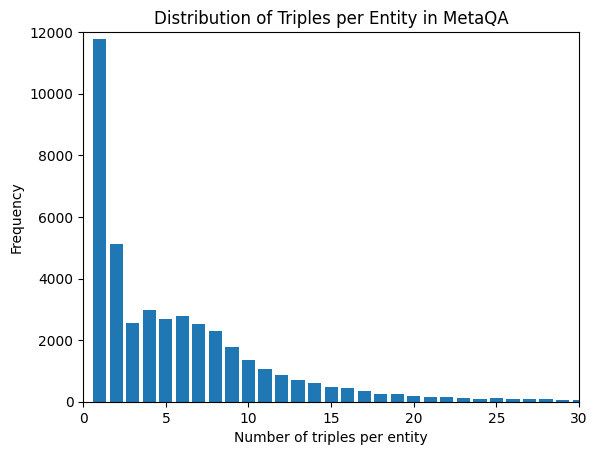
This image is a histogram displaying the distribution of triples per entity in the MetaQA dataset. The x-axis represents the number of triples per entity, and the y-axis represents the frequency (count) of entities with that number of triples. The histogram shows a highly skewed distribution, with a large number of entities having a small number of triples and a rapidly decreasing number of entities as the number of triples increases.
### Components/Axes
* **Title:** "Distribution of Triples per Entity in MetaQA"
* **X-axis:**
* **Title:** "Number of triples per entity"
* **Scale:** Numerical, ranging from 0 to 30.
* **Markers:** 0, 5, 10, 15, 20, 25, 30.
* **Y-axis:**
* **Title:** "Frequency"
* **Scale:** Numerical, ranging from 0 to 12000.
* **Markers:** 0, 2000, 4000, 6000, 8000, 10000, 12000.
### Content Details
The histogram consists of blue bars representing the frequency of entities for each number of triples.
* **0 triples per entity:** The tallest bar, with a frequency of approximately 11,800 (± 100).
* **1 triple per entity:** The second tallest bar, with a frequency of approximately 5,100 (± 100).
* **2 triples per entity:** A bar with a frequency of approximately 2,400 (± 100).
* **3 triples per entity:** A bar with a frequency of approximately 2,700 (± 100).
* **4 triples per entity:** A bar with a frequency of approximately 2,900 (± 100).
* **5 triples per entity:** A bar with a frequency of approximately 2,600 (± 100).
* **6 triples per entity:** A bar with a frequency of approximately 2,500 (± 100).
* **7 triples per entity:** A bar with a frequency of approximately 2,200 (± 100).
* **8 triples per entity:** A bar with a frequency of approximately 1,900 (± 100).
* **9 triples per entity:** A bar with a frequency of approximately 1,700 (± 100).
* **10 triples per entity:** A bar with a frequency of approximately 1,500 (± 100).
* **11 triples per entity:** A bar with a frequency of approximately 1,300 (± 100).
* **12 triples per entity:** A bar with a frequency of approximately 1,100 (± 100).
* **13 triples per entity:** A bar with a frequency of approximately 1,000 (± 100).
* **14 triples per entity:** A bar with a frequency of approximately 900 (± 100).
* **15 triples per entity:** A bar with a frequency of approximately 800 (± 100).
* **16 triples per entity:** A bar with a frequency of approximately 700 (± 100).
* **17 triples per entity:** A bar with a frequency of approximately 600 (± 100).
* **18 triples per entity:** A bar with a frequency of approximately 550 (± 50).
* **19 triples per entity:** A bar with a frequency of approximately 500 (± 50).
* **20 triples per entity:** A bar with a frequency of approximately 450 (± 50).
* **21 triples per entity:** A bar with a frequency of approximately 400 (± 50).
* **22 triples per entity:** A bar with a frequency of approximately 350 (± 50).
* **23 triples per entity:** A bar with a frequency of approximately 300 (± 50).
* **24 triples per entity:** A bar with a frequency of approximately 250 (± 50).
* **25 triples per entity:** A bar with a frequency of approximately 200 (± 50).
* **26 triples per entity:** A bar with a frequency of approximately 150 (± 50).
* **27 triples per entity:** A bar with a frequency of approximately 100 (± 50).
* **28 triples per entity:** A bar with a frequency of approximately 75 (± 25).
* **29 triples per entity:** A bar with a frequency of approximately 50 (± 25).
The bars continue to decrease in height, becoming very small beyond 20 triples per entity.
### Key Observations
* **Dominance of low-triple entities:** The vast majority of entities in MetaQA have a very small number of associated triples. Specifically, entities with 0 or 1 triple constitute a significant portion of the dataset.
* **Power-law-like distribution:** The distribution exhibits a characteristic shape of a power-law distribution, where a few entities have many triples, but most entities have few.
* **Rapid decay:** The frequency of entities drops sharply as the number of triples increases. Beyond 5 triples per entity, the frequency decreases more gradually but consistently.
* **Long tail:** While the frequency is low, there are entities with a relatively high number of triples (up to 29 in the displayed range), forming a "long tail" of the distribution.
### Interpretation
This histogram provides crucial insights into the structure and characteristics of the MetaQA dataset. The highly skewed distribution suggests that MetaQA is a dataset where entities are generally sparsely represented in terms of factual triples.
* **Data Sparsity:** The overwhelming number of entities with 0 or 1 triple indicates that many entities in the dataset are either not well-defined or have very limited factual information associated with them. This is a common characteristic of knowledge graphs and question-answering datasets, where coverage can be uneven.
* **Implications for NLP Models:** For natural language processing models trained on MetaQA, this distribution implies that models need to be robust to handling entities with little or no information. Models might need to rely more on contextual information or external knowledge to infer properties of these entities. Conversely, the long tail suggests that models should also be capable of extracting and utilizing information from entities with a richer set of triples.
* **Dataset Curation and Quality:** The distribution might also reflect the process of dataset creation. It's possible that entities with more triples are more "interesting" or easier to extract, leading to their higher representation. However, the large number of entities with zero triples might also point to potential issues with entity linking or the completeness of the underlying knowledge source.
* **Peircean Investigative Reading:** From a semiotic perspective, the "sign" of an entity in MetaQA is often its associated triples. The distribution reveals that for most entities, this sign is weak or absent. This suggests that the "indexical" relationship between an entity and its factual representation is often tenuous. The "iconic" representation (e.g., entity names or descriptions) might carry more weight for entities with few triples. The few entities with many triples act as strong indices, providing a rich ground for inferential reasoning. The dataset's structure, therefore, presents a challenge and an opportunity: to build models that can effectively navigate this landscape of sparse and rich information, inferring meaning from limited signs and leveraging abundant ones.