## Screenshot: Breakout Game Interface
### Overview
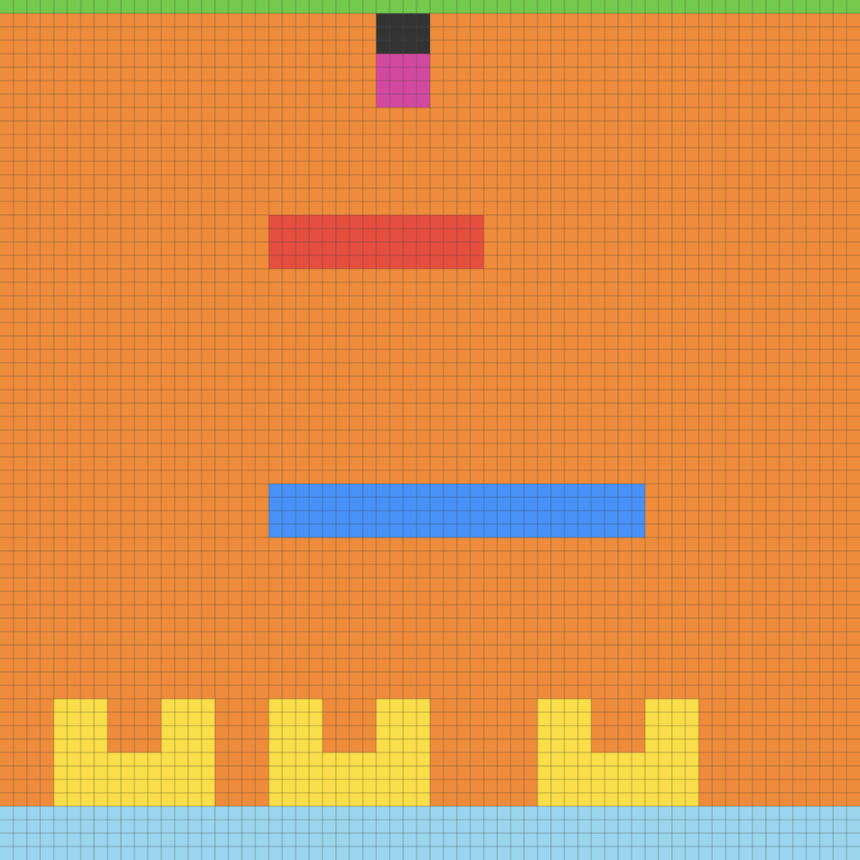
The image depicts a minimalist, retro-style video game interface resembling the classic "Breakout" game. The screen features a grid-based layout with colored geometric shapes against an orange background. No textual labels, legends, or data points are present.
### Components/Axes
- **Background**: Solid orange grid pattern.
- **Top Section**:
- A thin horizontal green line spans the width of the screen.
- Centered above the grid:
- A small black square (1x1 grid unit).
- Directly below the black square: A pink square (1x1 grid unit).
- **Middle Section**:
- A horizontal red rectangle spanning ~1/3 of the screen width, positioned ~1/3 from the top.
- A horizontal blue rectangle spanning ~1/2 of the screen width, positioned ~2/3 from the top.
- **Bottom Section**:
- Three yellow U-shaped blocks (each composed of 3x2 grid units with a central void), spaced evenly across the bottom.
- A thin horizontal light blue line at the very bottom, matching the screen width.
### Detailed Analysis
- **No textual elements** (labels, axis titles, legends, or embedded text) are visible in the image.
- **Spatial grounding**:
- Green line: Top-center, above all other elements.
- Black and pink squares: Vertically aligned above the red rectangle.
- Red and blue rectangles: Horizontally centered, stacked vertically.
- Yellow U-shaped blocks: Horizontally aligned at the bottom, spaced ~1 grid unit apart.
- Light blue line: Bottom edge, grounding the yellow blocks.
### Key Observations
- The layout suggests a game environment where the player likely controls a paddle (blue rectangle) to deflect a ball (pink square) at a brick (yellow blocks).
- The black square may represent a power-up or special item.
- No numerical values, scales, or data-driven elements are present.
### Interpretation
This image represents a static frame from a simplified Breakout-style game. The absence of text or data points indicates it is purely a visual representation of game mechanics rather than a data visualization. The colored shapes likely correspond to interactive elements (e.g., paddle, ball, bricks), but no quantitative analysis can be performed due to the lack of numerical or labeled data.