## Heatmap: R=dynamic (ID 22-hop)
### Overview
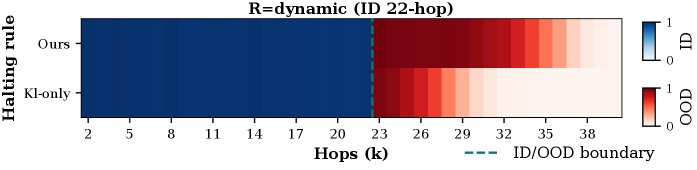
The heatmap displays the performance of two different halting rules, "Ours" and "KL-only," across various hop counts (k) and ID/OOD (In-Distribution/Out-of-Distribution) boundaries. The color gradient represents the correlation between the two rules, with blue indicating a higher correlation and red indicating a lower correlation.
### Components/Axes
- **X-axis (Hop counts, k)**: Ranges from 2 to 38 hops.
- **Y-axis (Halting rule)**: Two categories are present: "Ours" and "KL-only."
- **Color gradient**: Blue represents high correlation (ID), and red represents low correlation (OOD).
- **Legend**: Two colors, blue for ID and red for OOD, with a dashed line indicating the ID/OOD boundary.
### Detailed Analysis or Content Details
- **Ours**: The majority of the heatmap is colored blue, indicating a high correlation between the "Ours" rule and the ID boundary. The correlation decreases as the hop count increases.
- **KL-only**: The heatmap shows a more varied distribution of colors, with some areas colored blue and others colored red. The correlation with the ID boundary is lower compared to "Ours."
- **ID/OOD boundary**: A dashed line runs horizontally across the heatmap, indicating the threshold between ID and OOD data.
### Key Observations
- **High correlation with ID boundary**: The "Ours" rule consistently shows high correlation with the ID boundary across all hop counts.
- **Variable correlation with OOD boundary**: The "KL-only" rule shows a more variable correlation with the OOD boundary, with some areas showing high correlation and others showing low correlation.
- **No clear trend in correlation with hop count**: There is no clear trend in the correlation between the halting rules and hop count, as the correlation varies across different hop counts.
### Interpretation
The heatmap suggests that the "Ours" halting rule is more effective in maintaining a high correlation with the ID boundary across different hop counts compared to the "KL-only" rule. This indicates that the "Ours" rule is more robust and reliable in distinguishing between in-distribution and out-of-distribution data. The "KL-only" rule, while showing some correlation with the ID boundary, does not maintain this correlation as consistently as the "Ours" rule. This could imply that the "Ours" rule is more effective in handling out-of-distribution data, which is a common challenge in machine learning.