## Diagram: Evolution of Consciousness Research and Technology
### Overview
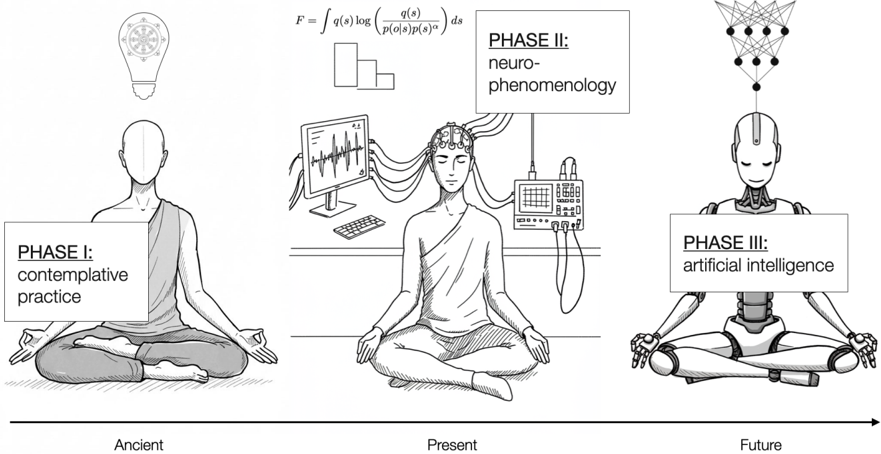
The diagram illustrates a tripartite progression of human consciousness research and technological integration, divided into three phases: Ancient (contemplative practice), Present (neuro-phenomenology), and Future (artificial intelligence). Each phase is represented by a seated figure with distinct symbolic elements, connected by a timeline arrow.
### Components/Axes
- **X-axis**: Temporal progression labeled "Ancient" (left), "Present" (center), and "Future" (right).
- **Phases**:
- **Phase I**: "contemplative practice" (Ancient)
- **Phase II**: "neuro-phenomenology" (Present)
- **Phase III**: "artificial intelligence" (Future)
- **Mathematical Formula** (Phase II):
`F = ∫ q(s) log (q(s)/p(a|s)p(s))^α ds`
(Kullback-Leibler divergence formula for measuring information divergence between probability distributions)
- **Visual Elements**:
- **Ancient**: Meditating figure with a thought bubble containing a geometric symbol.
- **Present**: Figure connected to EEG-like sensors, a computer monitor displaying waveforms, and a data acquisition device.
- **Future**: Humanoid robot with neural network nodes (10 interconnected spheres) above its head.
### Detailed Analysis
1. **Ancient Phase**:
- Figure in lotus position with hands in *dhyana mudra* (meditation gesture).
- Thought bubble contains a mandala-like symbol, suggesting spiritual or metaphysical inquiry.
- No technological elements present.
2. **Present Phase**:
- Figure retains meditative posture but with:
- 4 neural interface cables connecting to a hybrid EEG/fMRI device.
- Computer monitor showing real-time neural activity waveforms.
- Mathematical formula embedded in the diagram, indicating quantitative analysis of consciousness states.
3. **Future Phase**:
- Humanoid robot in identical meditative pose.
- Neural network visualization: 10 interconnected nodes (likely representing artificial neurons) above the head.
- Mechanical joints and synthetic materials distinguish the figure from human forms.
### Key Observations
- **Temporal Symmetry**: All figures share identical meditative posture, emphasizing continuity in contemplative practice across eras.
- **Technological Layering**: Each phase adds new layers of measurement/interface:
- Ancient: Pure subjective experience
- Present: Neuro-technological measurement
- Future: Artificial embodiment
- **Formula Significance**: The KL divergence formula in Phase II suggests a focus on quantifying subjective experience (q(s)) against prior probabilities (p(s)) and action-conditional states (p(a|s)).
### Interpretation
The diagram posits a trajectory where contemplative practices evolve through technological augmentation toward artificial consciousness. The persistent meditative pose across phases implies that core aspects of consciousness remain unchanged despite technological mediation. The embedded formula indicates that neuro-phenomenology seeks to mathematically formalize subjective experience, bridging the gap between first-person reports and third-person measurements. The robot's identical posture to human figures suggests that artificial systems may replicate or extend human contemplative capacities, raising questions about the nature of consciousness in synthetic beings.