## Bar Chart: Multiple-Choice Accuracy by Problem Type for Raven's and Digit Matrices
### Overview
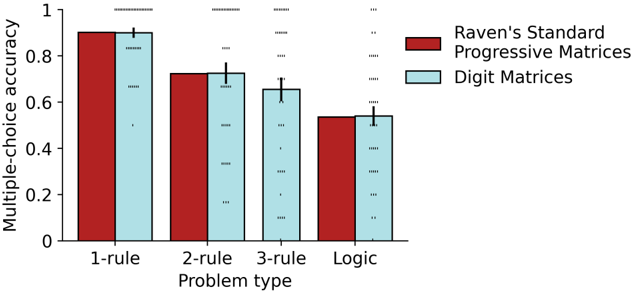
The image is a grouped bar chart comparing the multiple-choice accuracy of two types of matrix reasoning tests—Raven's Standard Progressive Matrices and Digit Matrices—across four categories of problem complexity. The chart includes error bars for each data point.
### Components/Axes
* **Chart Type:** Grouped bar chart with error bars.
* **Y-Axis (Vertical):**
* **Label:** "Multiple-choice accuracy"
* **Scale:** Linear, ranging from 0 to 1, with major tick marks at 0, 0.2, 0.4, 0.6, 0.8, and 1.
* **X-Axis (Horizontal):**
* **Label:** "Problem type"
* **Categories (from left to right):** "1-rule", "2-rule", "3-rule", "Logic".
* **Legend:**
* **Position:** Top-right corner of the chart area.
* **Series 1:** "Raven's Standard Progressive Matrices" represented by a dark red (maroon) bar.
* **Series 2:** "Digit Matrices" represented by a light blue (cyan) bar.
* **Data Representation:** For each problem type category on the x-axis, two bars are placed side-by-side: the left bar (red) for Raven's Matrices and the right bar (light blue) for Digit Matrices. Each bar has a vertical black error bar extending above and below its top.
### Detailed Analysis
**Trend Verification:** For both data series (Raven's and Digit Matrices), the visual trend is a clear downward slope in accuracy as the problem type progresses from "1-rule" to "Logic". Accuracy is highest for the simplest problems and lowest for the most complex.
**Data Points (Approximate Values):**
* **1-rule:**
* Raven's (Red): Accuracy ≈ 0.90. Error bar extends from ≈0.85 to ≈0.95.
* Digit Matrices (Light Blue): Accuracy ≈ 0.88. Error bar extends from ≈0.65 to ≈1.0 (note: the upper bound appears to be capped at the chart maximum of 1).
* **2-rule:**
* Raven's (Red): Accuracy ≈ 0.72. Error bar extends from ≈0.68 to ≈0.76.
* Digit Matrices (Light Blue): Accuracy ≈ 0.73. Error bar extends from ≈0.65 to ≈0.81.
* **3-rule:**
* Raven's (Red): Accuracy ≈ 0.65. Error bar extends from ≈0.60 to ≈0.70.
* Digit Matrices (Light Blue): Accuracy ≈ 0.65. Error bar extends from ≈0.55 to ≈0.75.
* **Logic:**
* Raven's (Red): Accuracy ≈ 0.53. Error bar extends from ≈0.50 to ≈0.56.
* Digit Matrices (Light Blue): Accuracy ≈ 0.53. Error bar extends from ≈0.48 to ≈0.58.
### Key Observations
1. **Performance Parity:** The accuracy levels for Raven's Standard Progressive Matrices and Digit Matrices are remarkably similar across all four problem types. The difference in bar height for any given category is minimal.
2. **Monotonic Decrease:** There is a consistent, stepwise decrease in accuracy for both test types as the problem complexity increases from "1-rule" to "Logic". The drop is most pronounced between "1-rule" and "2-rule".
3. **Error Bar Variability:** The size of the error bars (indicating variability or uncertainty in the measurement) differs between the two test types. Notably, for "1-rule" problems, the Digit Matrices error bar is very large, suggesting high variability in performance on this specific task. For "Logic" problems, the error bars for both are relatively small.
4. **Ceiling Effect:** The "1-rule" accuracy for both tests is near the top of the scale (≈0.9), indicating these problems are relatively easy for the test-takers, with little room for improvement.
### Interpretation
This chart demonstrates that the format of the matrix reasoning problem—whether using traditional abstract shapes (Raven's) or numerical digits—has a negligible impact on measured accuracy across a range of rule complexities. The primary factor influencing performance is the inherent difficulty of the problem type itself.
The data suggests a strong inverse relationship between problem complexity (number of rules/logical steps required) and solution accuracy. The near-identical performance curves imply that the cognitive processes assessed by both test formats are highly similar, or that the digit-based adaptation is a valid and equivalent substitute for the traditional Raven's matrices in measuring this specific aspect of fluid intelligence.
The large error bar for Digit Matrices on "1-rule" problems is an interesting anomaly. It could indicate that while the average performance is high, some individuals found the digit format unexpectedly challenging or easy for the simplest problems, leading to a wider spread of scores. This warrants further investigation into individual differences in processing numerical versus abstract visual stimuli.