## Bar Chart: Multiple-Choice Accuracy by Problem Type
### Overview
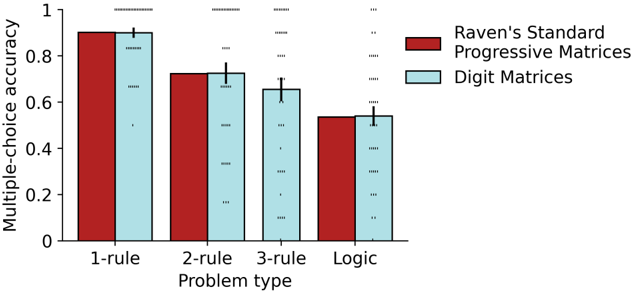
The image is a bar chart comparing the multiple-choice accuracy on Raven's Standard Progressive Matrices and Digit Matrices across different problem types: 1-rule, 2-rule, 3-rule, and Logic. The chart displays the mean accuracy for each condition, with error bars indicating variability.
### Components/Axes
* **X-axis:** Problem type (categorical): 1-rule, 2-rule, 3-rule, Logic
* **Y-axis:** Multiple-choice accuracy (numerical): Ranges from 0 to 1, with increments of 0.2.
* **Legend:** Located in the top-right corner.
* Red bars: Raven's Standard Progressive Matrices
* Light blue bars: Digit Matrices
* Error bars: Represented as black vertical lines extending above each bar.
### Detailed Analysis
Here's a breakdown of the accuracy for each problem type and matrix type:
* **1-rule:**
* Raven's Standard Progressive Matrices (Red): Accuracy is approximately 0.90.
* Digit Matrices (Light Blue): Accuracy is approximately 0.91, with an error bar extending to approximately 0.93.
* **2-rule:**
* Raven's Standard Progressive Matrices (Red): Accuracy is approximately 0.73.
* Digit Matrices (Light Blue): Accuracy is approximately 0.73, with an error bar extending to approximately 0.77.
* **3-rule:**
* Raven's Standard Progressive Matrices (Red): Accuracy is approximately 0.66.
* Digit Matrices (Light Blue): Accuracy is approximately 0.66, with an error bar extending to approximately 0.71.
* **Logic:**
* Raven's Standard Progressive Matrices (Red): Accuracy is approximately 0.54.
* Digit Matrices (Light Blue): Accuracy is approximately 0.55, with an error bar extending to approximately 0.58.
### Key Observations
* Accuracy generally decreases as the problem type increases in complexity (from 1-rule to Logic) for both Raven's Standard Progressive Matrices and Digit Matrices.
* The accuracy for Raven's Standard Progressive Matrices and Digit Matrices are very similar for each problem type.
* The error bars appear to be relatively small, suggesting consistent performance within each condition.
### Interpretation
The data suggests that both Raven's Standard Progressive Matrices and Digit Matrices become more difficult as the complexity of the problem increases. The similar performance on both types of matrices for each problem type indicates that they may be measuring similar cognitive abilities. The decreasing accuracy with increasing problem complexity likely reflects the increased cognitive demands associated with solving more complex problems. The small error bars suggest that the observed trends are reliable and not due to random variation.