## Diagram: Dialogue Flow Comparisons
### Overview
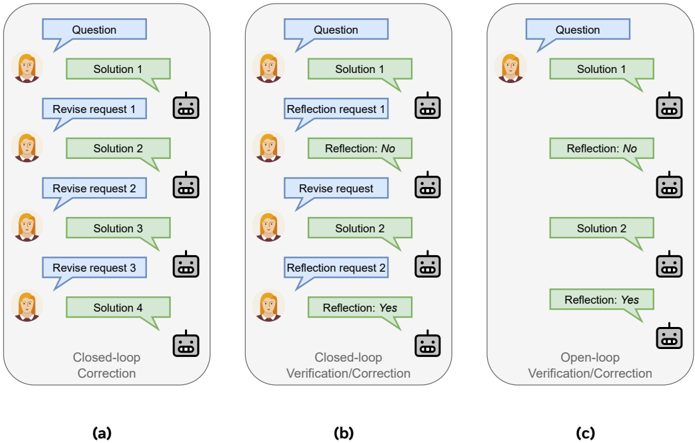
The image presents three diagrams illustrating different dialogue flows between a user (represented by a human avatar) and a system (represented by a robot avatar). The diagrams compare "Closed-loop Correction," "Closed-loop Verification/Correction," and "Open-loop Verification/Correction" strategies. Each diagram depicts a sequence of interactions, with user inputs in blue speech bubbles and system responses in green speech bubbles.
### Components/Axes
* **User Avatar:** Represents the human user in the dialogue.
* **Robot Avatar:** Represents the system or bot interacting with the user.
* **Speech Bubbles (Blue):** Indicate user input, such as questions or requests.
* **Speech Bubbles (Green):** Indicate system responses, such as solutions or reflections.
* **Diagram Titles:**
* (a) Closed-loop Correction
* (b) Closed-loop Verification/Correction
* (c) Open-loop Verification/Correction
### Detailed Analysis
**Diagram (a): Closed-loop Correction**
1. **User:** Question (Blue speech bubble)
2. **System:** Solution 1 (Green speech bubble)
3. **User:** Revise request 1 (Blue speech bubble)
4. **System:** Solution 2 (Green speech bubble)
5. **User:** Revise request 2 (Blue speech bubble)
6. **System:** Solution 3 (Green speech bubble)
7. **User:** Revise request 3 (Blue speech bubble)
8. **System:** Solution 4 (Green speech bubble)
**Diagram (b): Closed-loop Verification/Correction**
1. **User:** Question (Blue speech bubble)
2. **System:** Solution 1 (Green speech bubble)
3. **User:** Reflection request 1 (Blue speech bubble)
4. **System:** Reflection: No (Green speech bubble)
5. **User:** Revise request (Blue speech bubble)
6. **System:** Solution 2 (Green speech bubble)
7. **User:** Reflection request 2 (Blue speech bubble)
8. **System:** Reflection: Yes (Green speech bubble)
**Diagram (c): Open-loop Verification/Correction**
1. **User:** Question (Blue speech bubble)
2. **System:** Solution 1 (Green speech bubble)
3. **System:** Reflection: No (Green speech bubble)
4. **System:** Solution 2 (Green speech bubble)
5. **System:** Reflection: Yes (Green speech bubble)
### Key Observations
* **Closed-loop Correction (a):** Involves iterative revisions based on user feedback, leading to multiple solutions.
* **Closed-loop Verification/Correction (b):** Includes reflection requests from the user to verify the system's understanding, with revisions based on the reflection results.
* **Open-loop Verification/Correction (c):** The system provides reflections without explicit user requests, potentially guiding the dialogue.
### Interpretation
The diagrams illustrate different strategies for handling user-system interactions. The "Closed-loop Correction" method relies on explicit user feedback to refine solutions, while the "Closed-loop Verification/Correction" and "Open-loop Verification/Correction" methods incorporate reflection mechanisms to improve understanding and guide the dialogue. The choice of strategy depends on the specific application and the desired level of user involvement in the correction process. The open-loop system provides reflections without being prompted, which could be useful in scenarios where the user may not know what to ask.