\n
## Diagram: Iterative Solution Refinement with Human-AI Interaction
### Overview
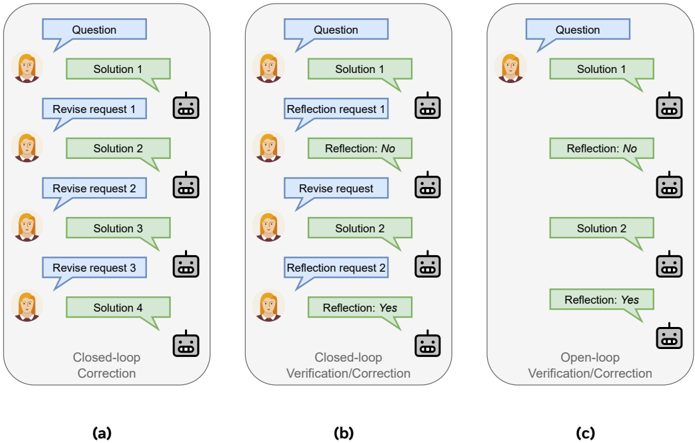
The image presents a comparative diagram illustrating three different iterative processes for refining solutions to a question, involving both human and AI interaction. Each process (a, b, and c) is depicted within a light green rounded rectangle, showing a sequence of steps. The diagrams highlight varying levels of feedback and correction loops between the human and the AI agent.
### Components/Axes
The diagram consists of the following components:
* **Human Representation:** A stylized human icon representing the user.
* **AI Representation:** A robotic head icon representing the AI agent.
* **Question Block:** A light blue rounded rectangle labeled "Question".
* **Solution Blocks:** Light green rounded rectangles labeled "Solution 1", "Solution 2", "Solution 3", "Solution 4".
* **Revise Request Blocks:** Light blue rounded rectangles labeled "Revise request 1", "Revise request 2", "Revise request 3".
* **Reflection Request Blocks:** Light blue rounded rectangles labeled "Reflection request 1", "Reflection request 2".
* **Reflection Blocks:** Light blue rounded rectangles labeled "Reflection: No", "Reflection: Yes".
* **Correction/Verification Blocks:** Light blue rounded rectangles labeled "Closed-loop Correction", "Closed-loop Verification/Correction", "Open-loop Verification/Correction".
* **Arrows:** Green arrows indicating the flow of the process.
* **Labels:** (a), (b), (c) identifying each process.
### Detailed Analysis or Content Details
**Process (a): Closed-loop Correction**
1. Starts with a "Question".
2. The human receives "Solution 1" from the AI.
3. The human sends a "Revise request 1" to the AI.
4. The AI provides "Solution 2".
5. The human sends a "Revise request 2" to the AI.
6. The AI provides "Solution 3".
7. The human sends a "Revise request 3" to the AI.
8. The AI provides "Solution 4".
9. The process concludes with "Closed-loop Correction".
**Process (b): Closed-loop Verification/Correction**
1. Starts with a "Question".
2. The human receives "Solution 1" from the AI.
3. The human sends a "Reflection request 1" to the AI.
4. The AI responds with "Reflection: No".
5. The human sends a "Revise request" to the AI.
6. The AI provides "Solution 2".
7. The human sends a "Reflection request 2" to the AI.
8. The AI responds with "Reflection: Yes".
9. The process concludes with "Closed-loop Verification/Correction".
**Process (c): Open-loop Verification/Correction**
1. Starts with a "Question".
2. The human receives "Solution 1" from the AI.
3. The human sends a request to the AI.
4. The AI responds with "Reflection: No".
5. The human receives "Solution 2".
6. The human sends a request to the AI.
7. The AI responds with "Reflection: Yes".
8. The process concludes with "Open-loop Verification/Correction".
### Key Observations
* Process (a) involves a purely iterative revision loop without explicit reflection.
* Process (b) incorporates reflection requests from the human, with the AI providing feedback ("Reflection: No" or "Reflection: Yes"). This process is labeled as "Closed-loop Verification/Correction".
* Process (c) also includes reflection requests, but is labeled as "Open-loop Verification/Correction", suggesting a less integrated feedback mechanism.
* The number of solution iterations differs between the processes. Process (a) has four solutions, while processes (b) and (c) have two.
### Interpretation
The diagram illustrates different strategies for human-AI collaboration in problem-solving. The key distinction lies in the inclusion and nature of reflection.
* **Closed-loop Correction (a)** represents a traditional iterative refinement process where the human provides feedback to improve the AI's solution. It's a straightforward, but potentially less efficient, approach.
* **Closed-loop Verification/Correction (b)** introduces a reflection step, allowing the AI to assess its own performance and potentially adjust its approach. The "Reflection: Yes/No" responses suggest the AI can self-evaluate and provide insights to the human. This is a more sophisticated approach, potentially leading to faster convergence on a satisfactory solution.
* **Open-loop Verification/Correction (c)** also includes reflection, but the "Open-loop" designation suggests the feedback from the AI is less directly integrated into the refinement process. It might involve the human independently interpreting the AI's reflection and applying it to the next iteration.
The diagram highlights the importance of feedback mechanisms in human-AI interaction. The inclusion of reflection, particularly in a closed-loop system, appears to enhance the efficiency and effectiveness of the problem-solving process. The diagram does not provide quantitative data, but visually demonstrates the conceptual differences between these approaches.