\n
## Image Analysis: Visual Comparison of Ground Segmentation Methods
### Overview
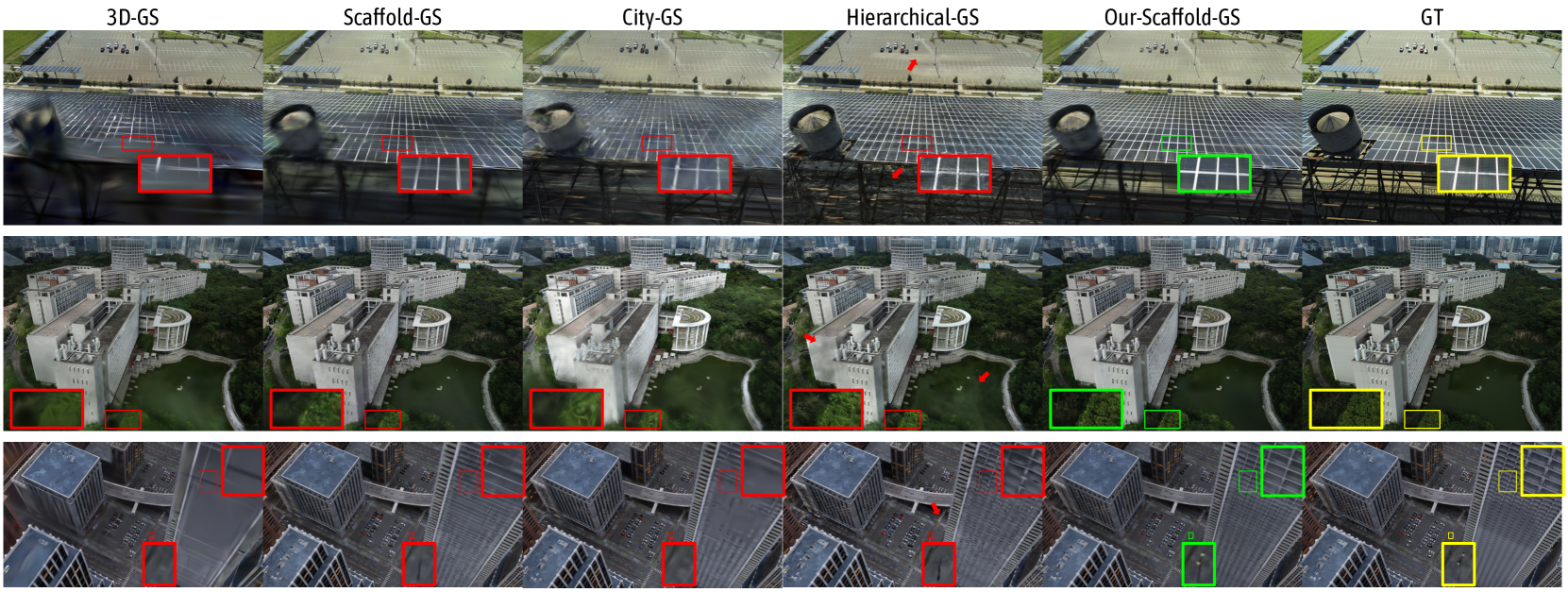
The image presents a visual comparison of six different ground segmentation (GS) methods applied to the same three scenes. The methods are: 3D-GS, Scaffold-GS, City-GS, Hierarchical-GS, Our-Scaffold-GS, and GT (Ground Truth). Each method's output is displayed side-by-side for each of the three scenes, with segmented ground areas highlighted by colored bounding boxes.
### Components/Axes
The image is organized into a 3x6 grid.
- **Rows:** Represent three different scenes.
- **Columns:** Represent six different ground segmentation methods.
- **Bounding Boxes:** Indicate the segmented ground areas.
- Red boxes: Appear in multiple methods, likely representing consistently identified ground areas.
- Green boxes: Predominantly appear in "Our-Scaffold-GS" and sometimes in "Hierarchical-GS", suggesting these methods are more sensitive to these areas.
- Blue boxes: Appear in "Our-Scaffold-GS" and "Scaffold-GS".
- Yellow boxes: Appear in "GT" and "Our-Scaffold-GS".
- **Labels:** Each column is labeled with the name of the segmentation method.
### Detailed Analysis or Content Details
The image does not contain numerical data. The analysis focuses on the visual comparison of the segmented areas.
**Scene 1 (Top Row):**
- **3D-GS:** Shows a large red bounding box covering a significant portion of the scene.
- **Scaffold-GS:** Shows a red bounding box, but it is less extensive than in 3D-GS.
- **City-GS:** Shows a red bounding box, similar in extent to Scaffold-GS.
- **Hierarchical-GS:** Shows a red bounding box, similar to Scaffold-GS and City-GS.
- **Our-Scaffold-GS:** Shows a red bounding box, plus a green bounding box and a yellow bounding box.
- **GT:** Shows a yellow bounding box, plus a red bounding box.
**Scene 2 (Middle Row):**
- **3D-GS:** Shows a red bounding box covering a large area.
- **Scaffold-GS:** Shows a red bounding box, smaller than 3D-GS.
- **City-GS:** Shows a red bounding box, similar to Scaffold-GS.
- **Hierarchical-GS:** Shows a red bounding box, similar to Scaffold-GS and City-GS, plus a green bounding box.
- **Our-Scaffold-GS:** Shows a red bounding box, plus a green bounding box and a yellow bounding box.
- **GT:** Shows a yellow bounding box, plus a red bounding box.
**Scene 3 (Bottom Row):**
- **3D-GS:** Shows a red bounding box covering a large area.
- **Scaffold-GS:** Shows a red bounding box, smaller than 3D-GS, plus a blue bounding box.
- **City-GS:** Shows a red bounding box, similar to Scaffold-GS.
- **Hierarchical-GS:** Shows a red bounding box, similar to Scaffold-GS and City-GS, plus a green bounding box.
- **Our-Scaffold-GS:** Shows a red bounding box, plus a green bounding box, a blue bounding box and a yellow bounding box.
- **GT:** Shows a yellow bounding box, plus a red bounding box.
### Key Observations
- **3D-GS** consistently identifies the largest ground areas, potentially over-segmenting.
- **City-GS, Scaffold-GS, and Hierarchical-GS** show similar segmentation results, generally identifying the main ground areas.
- **Our-Scaffold-GS** consistently identifies additional ground areas (green, blue, and yellow boxes) that are not detected by the other methods, and aligns well with the Ground Truth (GT) in the areas where it overlaps.
- **GT** provides a reference for the expected segmentation, and "Our-Scaffold-GS" appears to be the closest to the GT in terms of identifying all relevant ground areas.
- The presence of multiple bounding boxes in "Our-Scaffold-GS" suggests a more detailed and accurate segmentation.
### Interpretation
The image demonstrates a comparison of different ground segmentation methods. The "Our-Scaffold-GS" method appears to be the most accurate, as it consistently identifies more ground areas, including those missed by other methods, and aligns well with the Ground Truth. The other methods (3D-GS, Scaffold-GS, City-GS, and Hierarchical-GS) show varying degrees of accuracy, with 3D-GS tending to over-segment and the others providing more conservative segmentations. The consistent differences in segmentation highlight the strengths and weaknesses of each method, and suggest that "Our-Scaffold-GS" may be a more robust and reliable approach for ground segmentation in these scenes. The use of different colored bounding boxes allows for a clear visual assessment of the differences in segmentation results, making it easy to identify areas where each method performs well or poorly. The image suggests that the "Our-Scaffold-GS" method incorporates additional information or a more sophisticated algorithm that enables it to detect finer details and achieve a more accurate segmentation.