\n
## Visual Comparison Matrix: Gaussian Splatting Method Performance
### Overview
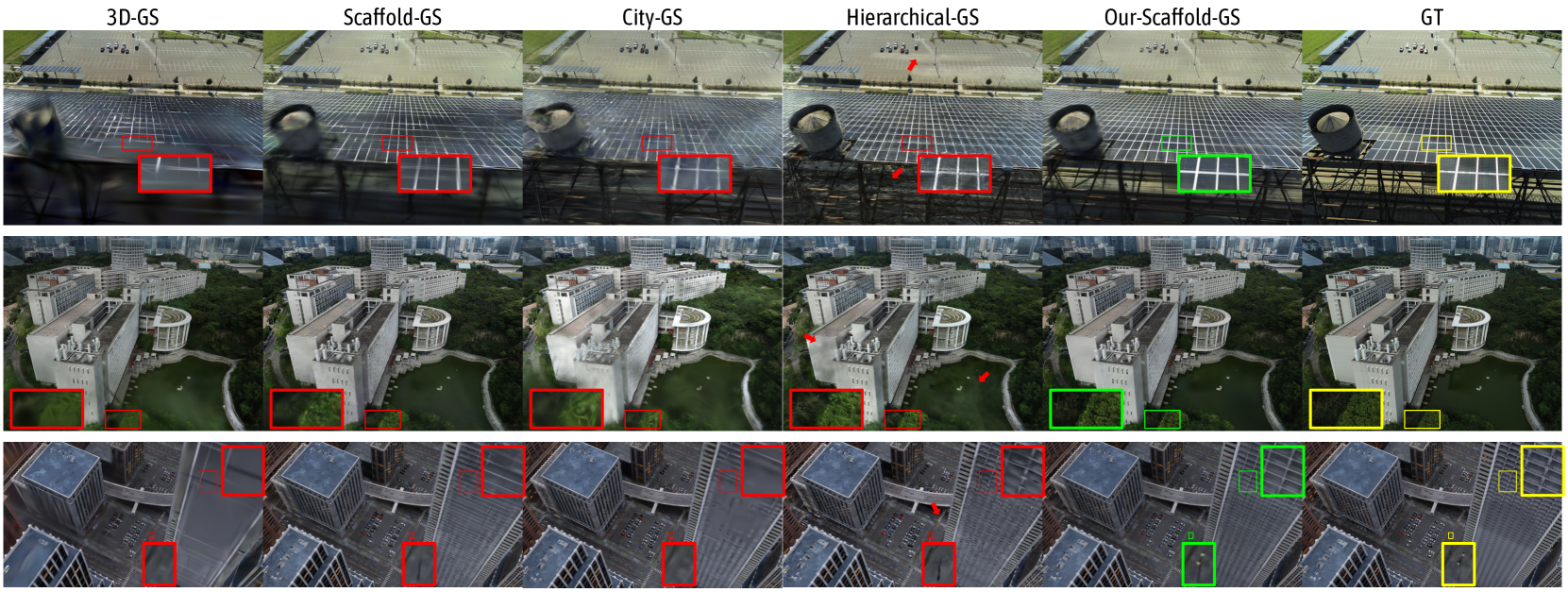
The image is a comparative visual analysis grid, likely from a research paper on 3D Gaussian Splatting (3D-GS) rendering techniques. It presents a side-by-side qualitative comparison of six different methods across three distinct scenes. The primary purpose is to demonstrate the visual fidelity and artifact reduction of a proposed method ("Our-Scaffold-GS") against several baseline techniques and the Ground Truth (GT).
### Components/Axes
* **Structure:** A 3-row by 6-column grid.
* **Columns (Methods):** Each column is labeled at the top with the name of a rendering method. From left to right:
1. `3D-GS`
2. `Scaffold-GS`
3. `City-GS`
4. `Hierarchical-GS`
5. `Our-Scaffold-GS` (The proposed method)
6. `GT` (Ground Truth - the reference real image)
* **Rows (Scenes):** Each row displays a different photographic scene rendered by the six methods.
* **Row 1:** A close-up view of a large, flat solar panel array on a rooftop, with a cylindrical vent structure in the foreground.
* **Row 2:** An aerial view of a modern building complex with a distinctive curved wing, surrounded by trees and a small pond.
* **Row 3:** A top-down aerial view of a dense urban area with multiple rectangular buildings and streets.
* **Annotations:** Colored rectangular boxes are overlaid on specific regions of interest within each image to highlight differences in rendering quality.
* **Red Boxes:** Used on the first four method columns (`3D-GS` to `Hierarchical-GS`). They highlight areas containing visual artifacts, blurring, or distortions.
* **Green Boxes:** Used on the `Our-Scaffold-GS` column. They highlight the same regions as the red boxes, showing improved clarity and correctness.
* **Yellow Boxes:** Used on the `GT` column. They mark the corresponding regions in the ground truth reference image.
* **Red Arrows:** Small red arrows appear in the `Hierarchical-GS` column, pointing to specific, severe artifacts (e.g., floating blobs, incorrect geometry).
### Detailed Analysis
**Scene 1 (Solar Panels):**
* **Trend:** Baseline methods (`3D-GS`, `Scaffold-GS`, `City-GS`) show significant blurring and loss of the fine grid structure on the solar panels, especially in the region marked by the red box. The `Hierarchical-GS` method introduces severe artifacts, with large, distorted blobs floating above the panel surface (indicated by red arrows).
* **Comparison:** `Our-Scaffold-GS` (green box) successfully reconstructs the sharp, regular grid pattern of the solar panels, closely matching the clarity and structure seen in the `GT` (yellow box).
**Scene 2 (Building Complex):**
* **Trend:** The foliage of the trees in the lower-left corner (highlighted by boxes) appears as an indistinct, blurry green mass in the first three baseline methods. `Hierarchical-GS` again shows artifacts, with parts of the tree canopy appearing detached or floating.
* **Comparison:** `Our-Scaffold-GS` renders the tree foliage with much higher detail and correct geometry, preserving the texture and shape visible in the `GT`.
**Scene 3 (Urban Aerial):**
* **Trend:** The facades of the buildings, particularly the windows and structural lines, are blurred and lack definition in the baseline methods. The `Hierarchical-GS` method shows warping and incorrect perspective on building edges.
* **Comparison:** `Our-Scaffold-GS` maintains sharp, straight edges on the buildings and clear definition of window patterns, aligning well with the `GT`.
### Key Observations
1. **Consistent Artifact Pattern:** The first four methods consistently produce visual artifacts: blurring of high-frequency details (grid lines, foliage texture, windows) and, in the case of `Hierarchical-GS`, severe geometric distortions (floating blobs).
2. **Proposed Method Superiority:** `Our-Scaffold-GS` demonstrates a consistent and significant improvement in visual fidelity across all three diverse scenes. It effectively suppresses the artifacts seen in the baselines.
3. **Ground Truth Alignment:** The regions highlighted in green (`Our-Scaffold-GS`) are visually almost indistinguishable from the corresponding regions in yellow (`GT`), indicating high reconstruction accuracy.
4. **Spatial Consistency of Annotations:** The colored boxes are placed in identical spatial locations across each row, enabling direct, pixel-for-pixel comparison of the same scene region rendered by different methods.
### Interpretation
This visual comparison serves as qualitative evidence for the effectiveness of the "Our-Scaffold-GS" method. The data suggests that the proposed technique successfully addresses key failure modes of prior Gaussian Splatting approaches, such as the loss of fine detail and the introduction of floaters or geometric distortions.
The relationship between elements is a direct performance hierarchy: `GT` is the ideal target, `Our-Scaffold-GS` is the closest approximation, and the other methods show varying degrees of degradation. The most significant anomaly is the performance of `Hierarchical-GS`, which, despite being a more complex method, introduces the most visually jarring artifacts in these examples.
From a Peircean investigative perspective, this image is an *icon* (it resembles the scenes) and an *index* (the artifacts point to underlying algorithmic limitations). The consistent improvement of the proposed method across varied scenes (man-made structures, natural foliage, complex geometry) argues for its robustness and generalizability, which is a more persuasive claim than success on a single, cherry-picked example. The use of the Ground Truth as a final column anchors the entire comparison in reality, making the evaluation objective rather than purely relative.