## Heatmap: Category Distribution Across Layers and Heads
### Overview
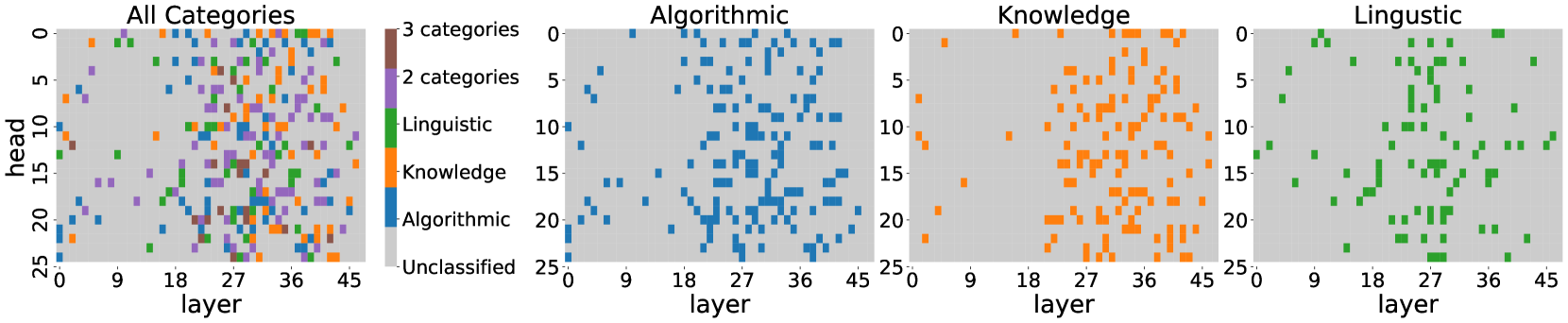
The image presents four heatmaps visualizing the distribution of different categories (Algorithmic, Knowledge, Linguistic, and combinations thereof) across different layers and heads of a model. The first heatmap, "All Categories," shows the combined distribution, while the subsequent heatmaps isolate each individual category. The x-axis represents the layer (from 0 to 45), and the y-axis represents the head (from 0 to 25).
### Components/Axes
* **X-axis (Layer):** Represents the layer number, ranging from 0 to 45, with tick marks at approximately 0, 9, 18, 27, 36, and 45.
* **Y-axis (Head):** Represents the head number, ranging from 0 to 25, with tick marks at approximately 0, 5, 10, 15, 20, and 25.
* **Heatmaps:** Each heatmap is a 2D grid where each cell's color indicates the presence of a specific category.
* **Legend (for "All Categories" heatmap):** Located to the right of the "All Categories" heatmap.
* Brown: "3 categories"
* Purple: "2 categories"
* Green: "Linguistic"
* Orange: "Knowledge"
* Blue: "Algorithmic"
* Gray: "Unclassified" (background color)
### Detailed Analysis
**1. All Categories Heatmap:**
* This heatmap shows a mix of all categories.
* There appears to be a higher concentration of categories in the middle layers (around layer 18-36) and across all heads.
* The distribution seems relatively uniform, with no clear patterns except for the concentration in the middle layers.
* Specific data points are difficult to extract due to the mixed categories, but the overall density is visually apparent.
**2. Algorithmic Heatmap:**
* The "Algorithmic" category (blue) is distributed across all layers and heads, but appears to be more concentrated in the middle layers (18-36) and towards the lower heads (15-25).
* The distribution is somewhat sparse, with many unclassified (gray) cells.
* There is a slight upward trend in density from layer 0 to layer 36, then a slight decrease towards layer 45.
* Example: At layer 9, heads 0, 1, 4, 6, 7, 11, 12, 16, 17, 20, 21, 22, 25 are active.
* Example: At layer 36, heads 0, 1, 2, 3, 4, 5, 6, 7, 8, 9, 10, 11, 12, 13, 14, 15, 16, 17, 18, 19, 20, 21, 22, 23, 24, 25 are active.
**3. Knowledge Heatmap:**
* The "Knowledge" category (orange) is also distributed across all layers and heads, but appears to be more concentrated in the middle layers (18-36).
* The distribution is sparse, with many unclassified (gray) cells.
* There is a slight upward trend in density from layer 0 to layer 36, then a slight decrease towards layer 45.
* Example: At layer 9, heads 7, 13, 17 are active.
* Example: At layer 36, heads 0, 1, 2, 3, 4, 5, 6, 7, 8, 9, 10, 11, 12, 13, 14, 15, 16, 17, 18, 19, 20, 21, 22, 23, 24, 25 are active.
**4. Linguistic Heatmap:**
* The "Linguistic" category (green) is distributed across all layers and heads, but appears to be more concentrated in the middle layers (18-36).
* The distribution is sparse, with many unclassified (gray) cells.
* There is a slight upward trend in density from layer 0 to layer 36, then a slight decrease towards layer 45.
* Example: At layer 9, heads 5, 8, 11, 12, 13, 14, 15, 16, 17, 18, 19, 20, 21, 22, 23, 24, 25 are active.
* Example: At layer 36, heads 0, 1, 2, 3, 4, 5, 6, 7, 8, 9, 10, 11, 12, 13, 14, 15, 16, 17, 18, 19, 20, 21, 22, 23, 24, 25 are active.
### Key Observations
* All three categories (Algorithmic, Knowledge, and Linguistic) are present across all layers and heads, but with varying densities.
* The middle layers (around 18-36) tend to have a higher concentration of all categories.
* The distributions are generally sparse, indicating that many layer-head combinations are not strongly associated with any of these categories.
* The "All Categories" heatmap shows a mix of categories, making it difficult to discern individual patterns without the isolated heatmaps.
### Interpretation
The heatmaps provide insights into how different types of information (Algorithmic, Knowledge, and Linguistic) are processed within the layers and heads of a model. The concentration of all categories in the middle layers suggests that these layers might be crucial for integrating different types of information. The sparse distributions indicate that individual heads are specialized to some extent, with only a subset of heads being strongly associated with each category.
The presence of "2 categories" and "3 categories" combinations in the "All Categories" heatmap suggests that some layer-head combinations are involved in processing multiple types of information simultaneously. This could indicate that these heads are responsible for integrating different aspects of the input.
The data suggests a hierarchical processing structure, where early and late layers may handle specific aspects of the input, while the middle layers integrate these aspects to form a more comprehensive representation. The specific roles of each layer and head would require further investigation, but these heatmaps provide a valuable starting point for understanding the model's internal workings.