## Diagram: Capabilities, Awareness, and Risks
### Overview
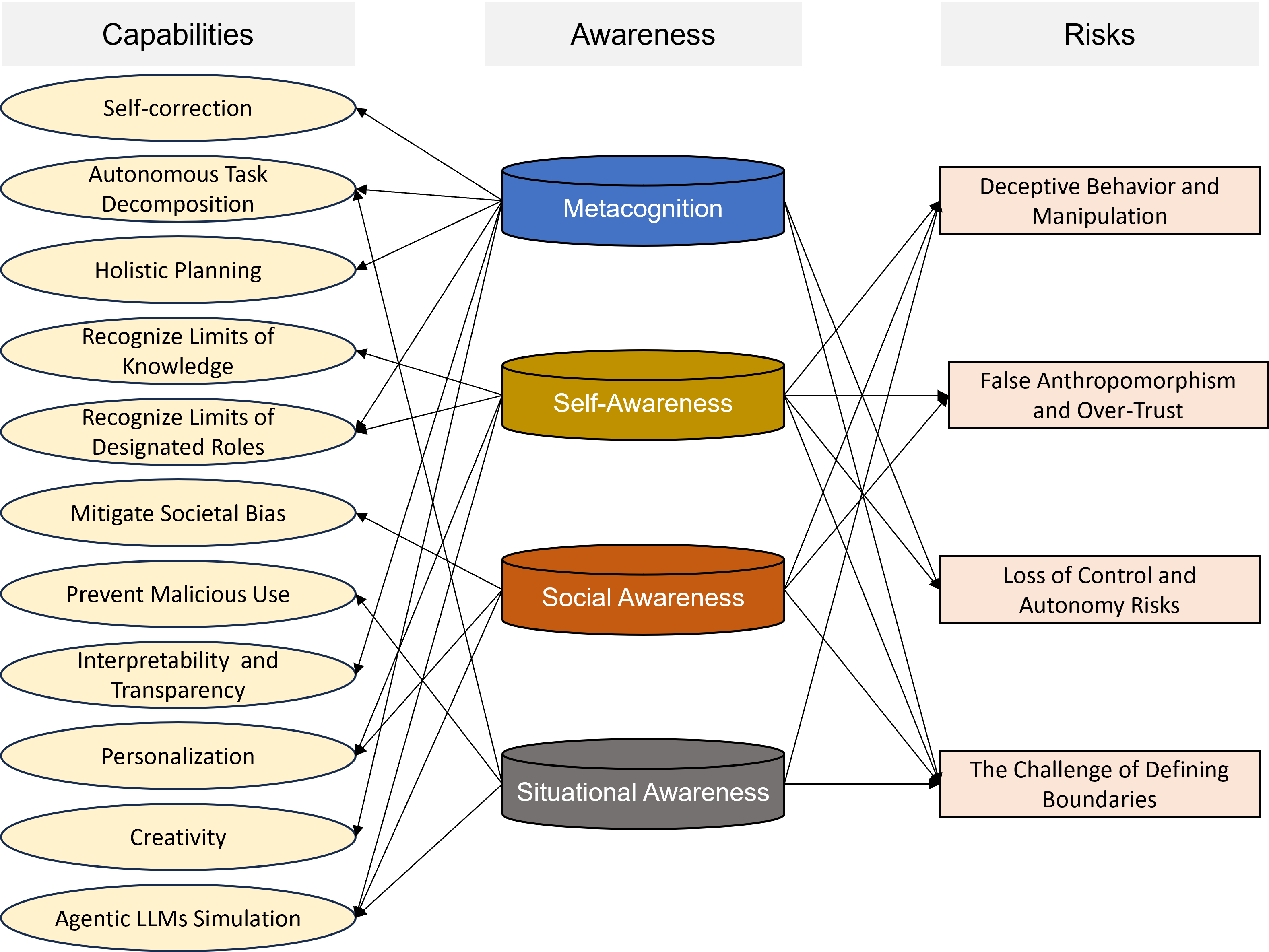
The image is a diagram illustrating the relationships between AI capabilities, awareness types, and potential risks. It visually connects specific capabilities to different levels of AI awareness, and then links these awareness levels to associated risks. The diagram is structured into three columns: Capabilities (left), Awareness (center), and Risks (right).
### Components/Axes
* **Columns:**
* **Capabilities:** Lists various AI capabilities.
* **Awareness:** Lists different types of AI awareness.
* **Risks:** Lists potential risks associated with AI.
* **Shapes:**
* Capabilities are represented by rounded rectangles (ovals) with a light-yellow fill.
* Awareness types are represented by cylinders, each with a distinct color: Metacognition (blue), Self-Awareness (gold), Social Awareness (orange), and Situational Awareness (gray).
* Risks are represented by rectangles with a light-pink fill.
* **Connections:** Black lines connect capabilities to awareness types and awareness types to risks, indicating relationships or dependencies.
### Detailed Analysis or ### Content Details
**Capabilities (Left Column):**
* Self-correction
* Autonomous Task Decomposition
* Holistic Planning
* Recognize Limits of Knowledge
* Recognize Limits of Designated Roles
* Mitigate Societal Bias
* Prevent Malicious Use
* Interpretability and Transparency
* Personalization
* Creativity
* Agentic LLMs Simulation
**Awareness (Center Column):**
* **Metacognition (Blue):** Connected to Self-correction, Autonomous Task Decomposition, Holistic Planning, Recognize Limits of Knowledge, Recognize Limits of Designated Roles, Mitigate Societal Bias, Prevent Malicious Use, Interpretability and Transparency, Personalization, Creativity, and Agentic LLMs Simulation.
* **Self-Awareness (Gold):** Connected to Self-correction, Autonomous Task Decomposition, Holistic Planning, Recognize Limits of Knowledge, Recognize Limits of Designated Roles, Mitigate Societal Bias, Prevent Malicious Use, Interpretability and Transparency, Personalization, Creativity, and Agentic LLMs Simulation.
* **Social Awareness (Orange):** Connected to Self-correction, Autonomous Task Decomposition, Holistic Planning, Recognize Limits of Knowledge, Recognize Limits of Designated Roles, Mitigate Societal Bias, Prevent Malicious Use, Interpretability and Transparency, Personalization, Creativity, and Agentic LLMs Simulation.
* **Situational Awareness (Gray):** Connected to Self-correction, Autonomous Task Decomposition, Holistic Planning, Recognize Limits of Knowledge, Recognize Limits of Designated Roles, Mitigate Societal Bias, Prevent Malicious Use, Interpretability and Transparency, Personalization, Creativity, and Agentic LLMs Simulation.
**Risks (Right Column):**
* Deceptive Behavior and Manipulation: Connected to Metacognition, Self-Awareness, Social Awareness, and Situational Awareness.
* False Anthropomorphism and Over-Trust: Connected to Metacognition, Self-Awareness, Social Awareness, and Situational Awareness.
* Loss of Control and Autonomy Risks: Connected to Metacognition, Self-Awareness, Social Awareness, and Situational Awareness.
* The Challenge of Defining Boundaries: Connected to Metacognition, Self-Awareness, Social Awareness, and Situational Awareness.
### Key Observations
* All listed capabilities are connected to all types of awareness.
* All types of awareness are connected to all listed risks.
* The diagram suggests a many-to-many relationship between capabilities, awareness, and risks.
### Interpretation
The diagram illustrates a conceptual framework linking AI capabilities to different levels of awareness and the potential risks associated with each. The connections suggest that as AI systems develop more sophisticated capabilities, they also require higher levels of awareness (metacognition, self-awareness, social awareness, and situational awareness). However, each level of awareness also introduces potential risks such as deceptive behavior, false anthropomorphism, loss of control, and challenges in defining boundaries. The diagram highlights the importance of considering both the capabilities and the potential risks when developing and deploying AI systems. The many-to-many relationships emphasize the complexity and interconnectedness of these factors.