\n
## Diagram: AI Capabilities, Awareness, and Risks
### Overview
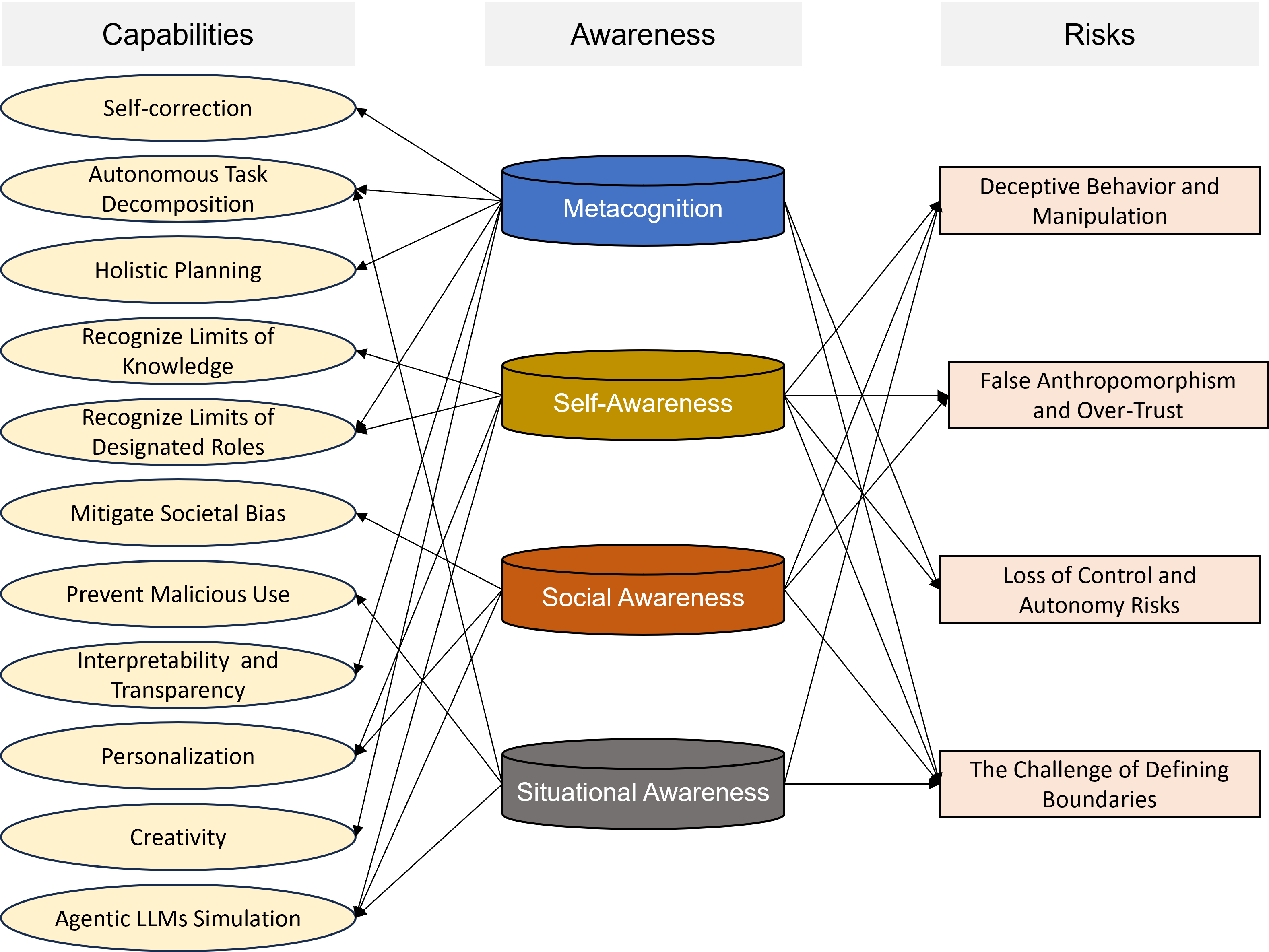
The image is a diagram illustrating the relationship between AI Capabilities, different levels of Awareness, and potential Risks. It uses a central column to represent Awareness, with Capabilities feeding into it from the left and Risks stemming from it on the right. The diagram uses arrows to show the flow of influence.
### Components/Axes
The diagram is divided into three main columns:
* **Capabilities** (leftmost column): Lists various AI capabilities.
* **Awareness** (center column): Displays four levels of awareness: Metacognition, Self-Awareness, Social Awareness, and Situational Awareness.
* **Risks** (rightmost column): Outlines potential risks associated with AI development.
There are no explicit axes or scales in the traditional sense. The diagram relies on visual positioning and arrows to convey relationships.
### Detailed Analysis or Content Details
The diagram details the following:
**Capabilities (Left Column):**
1. Self-correction
2. Autonomous Task Decomposition
3. Holistic Planning
4. Recognize Limits of Knowledge
5. Recognize Limits of Designated Roles
6. Mitigate Societal Bias
7. Prevent Malicious Use
8. Interpretability and Transparency
9. Personalization
10. Creativity
11. Agentic LLMs Simulation
**Awareness (Center Column):**
1. **Metacognition** (Blue): Receives input from Self-correction, Autonomous Task Decomposition, and Holistic Planning.
2. **Self-Awareness** (Green): Receives input from Recognize Limits of Knowledge, Recognize Limits of Designated Roles, and Mitigate Societal Bias.
3. **Social Awareness** (Orange): Receives input from Prevent Malicious Use, Interpretability and Transparency, and Personalization.
4. **Situational Awareness** (Yellow): Receives input from Creativity and Agentic LLMs Simulation.
**Risks (Right Column):**
1. Deceptive Behavior and Manipulation (linked to Metacognition)
2. False Anthropomorphism and Over-Trust (linked to Self-Awareness)
3. Loss of Control and Autonomy Risks (linked to Social Awareness)
4. The Challenge of Defining Boundaries (linked to Situational Awareness)
The arrows indicate a directional relationship: Capabilities contribute to Awareness, and Awareness, in turn, can lead to specific Risks.
### Key Observations
* The diagram suggests a hierarchical relationship between the levels of Awareness, with Metacognition appearing as the highest level.
* Each level of Awareness is influenced by a specific subset of Capabilities.
* Each level of Awareness is associated with a distinct set of Risks.
* The diagram doesn't provide quantitative data; it's a qualitative representation of potential relationships.
* The diagram is visually balanced, with roughly equal numbers of items in each column.
### Interpretation
This diagram presents a framework for understanding the complex interplay between AI capabilities, the development of AI awareness, and the potential risks that arise. It suggests that as AI systems become more capable and develop more sophisticated forms of awareness (particularly metacognition), the risks they pose become more nuanced and potentially more dangerous.
The diagram highlights the importance of considering not just *what* AI can do (Capabilities), but also *how* it understands its own actions and the world around it (Awareness). The risks identified are not simply technical failures, but rather stem from the potential for AI to deceive, manipulate, or erode human control.
The diagram implicitly argues for a proactive approach to AI safety, emphasizing the need to develop capabilities that mitigate risks and promote responsible AI development. The categorization of risks based on awareness levels is particularly insightful, suggesting that different levels of awareness require different safety measures. The diagram is a conceptual model, and further research would be needed to validate the specific relationships depicted.