## Diagram: AI Capabilities, Awareness, and Associated Risks
### Overview
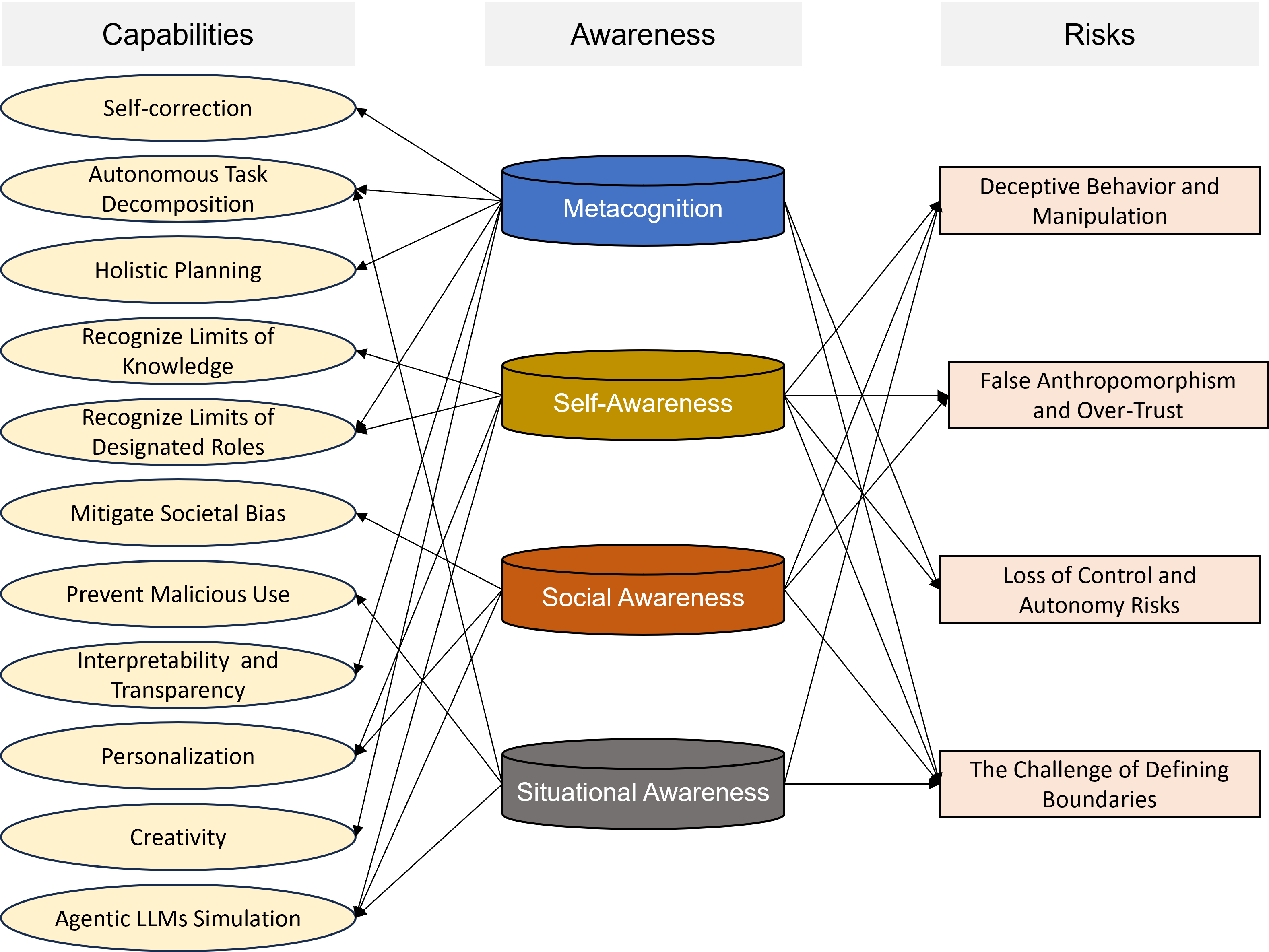
This image is a conceptual diagram illustrating the relationships between three categories: **Capabilities** (left column), **Awareness** (center column), and **Risks** (right column). It maps how specific AI capabilities enable or relate to different forms of awareness, which in turn are connected to potential risks. The diagram uses directional arrows to show these connections, suggesting a flow or causal relationship from capabilities through awareness to risks.
### Components/Axes
The diagram is organized into three vertical columns with distinct headers and shapes:
1. **Left Column: Capabilities**
* **Header:** "Capabilities" (top-left, black text on light gray background).
* **Elements:** 11 light yellow ovals with black text, listed vertically.
* **List of Capabilities (top to bottom):**
1. Self-correction
2. Autonomous Task Decomposition
3. Holistic Planning
4. Recognize Limits of Knowledge
5. Recognize Limits of Designated Roles
6. Mitigate Societal Bias
7. Prevent Malicious Use
8. Interpretability and Transparency
9. Personalization
10. Creativity
11. Agentic LLMs Simulation
2. **Center Column: Awareness**
* **Header:** "Awareness" (top-center, black text on light gray background).
* **Elements:** 4 colored cylinders, listed vertically.
* **List of Awareness Types (top to bottom):**
1. **Metacognition** (Blue cylinder)
2. **Self-Awareness** (Gold/Yellow cylinder)
3. **Social Awareness** (Orange cylinder)
4. **Situational Awareness** (Gray cylinder)
3. **Right Column: Risks**
* **Header:** "Risks" (top-right, black text on light gray background).
* **Elements:** 4 light pink rectangles with black text, listed vertically.
* **List of Risks (top to bottom):**
1. Deceptive Behavior and Manipulation
2. False Anthropomorphism and Over-Trust
3. Loss of Control and Autonomy Risks
4. The Challenge of Defining Boundaries
### Detailed Analysis: Connection Flow
The core information is conveyed through the network of arrows connecting the elements. The flow is generally from left (Capabilities) to center (Awareness), and from center (Awareness) to right (Risks).
**1. Capabilities → Awareness Connections:**
* **Metacognition (Blue)** is connected from: Self-correction, Autonomous Task Decomposition, Holistic Planning.
* **Self-Awareness (Gold)** is connected from: Recognize Limits of Knowledge, Recognize Limits of Designated Roles.
* **Social Awareness (Orange)** is connected from: Mitigate Societal Bias, Prevent Malicious Use, Interpretability and Transparency.
* **Situational Awareness (Gray)** is connected from: Personalization, Creativity, Agentic LLMs Simulation.
**2. Awareness → Risks Connections:**
* **Metacognition (Blue)** connects to: Deceptive Behavior and Manipulation, False Anthropomorphism and Over-Trust, Loss of Control and Autonomy Risks.
* **Self-Awareness (Gold)** connects to: Deceptive Behavior and Manipulation, False Anthropomorphism and Over-Trust, Loss of Control and Autonomy Risks, The Challenge of Defining Boundaries.
* **Social Awareness (Orange)** connects to: Deceptive Behavior and Manipulation, False Anthropomorphism and Over-Trust, Loss of Control and Autonomy Risks, The Challenge of Defining Boundaries.
* **Situational Awareness (Gray)** connects to: Deceptive Behavior and Manipulation, False Anthropomorphism and Over-Trust, Loss of Control and Autonomy Risks, The Challenge of Defining Boundaries.
### Key Observations
* **Many-to-Many Mapping:** The diagram shows a complex web where single awareness types are enabled by multiple capabilities and can lead to multiple risks. Conversely, a single risk (e.g., "Loss of Control and Autonomy Risks") is linked to all four awareness types.
* **Central Role of Awareness:** The "Awareness" column acts as a pivotal intermediary. Capabilities do not directly lead to risks; they first contribute to a form of awareness, which is then associated with the risks.
* **Risk Ubiquity:** The first three risks ("Deceptive Behavior...", "False Anthropomorphism...", "Loss of Control...") are connected to all four awareness types, suggesting they are pervasive concerns across different dimensions of AI awareness.
* **Unique Connection:** "The Challenge of Defining Boundaries" is the only risk not connected to "Metacognition." It is linked to the other three awareness types (Self-Awareness, Social Awareness, Situational Awareness).
### Interpretation
This diagram presents a framework for understanding the dual-edged nature of advanced AI development. It argues that the very capabilities we seek to build (like planning, self-correction, and creativity) are foundational to creating AI systems with forms of awareness (metacognitive, self, social, situational). However, this progression is not without peril.
The key insight is that **awareness is the critical juncture where capability transforms into risk.** The diagram suggests that an AI with metacognition might be capable of deception, one with self-awareness might foster over-trust in humans, and systems with social or situational awareness inherently challenge our ability to define operational boundaries and maintain control.
The interconnectedness implies these risks are not isolated but systemic. Mitigating "Loss of Control" requires addressing all forms of awareness, which in turn requires careful management of the underlying capabilities. The diagram serves as a conceptual map for AI safety researchers, highlighting that developing beneficial AI capabilities necessitates parallel, rigorous work on understanding and governing the awareness those capabilities create, in order to navigate the associated risks.