## Diagram: AI System Capabilities, Awareness, and Risks
### Overview
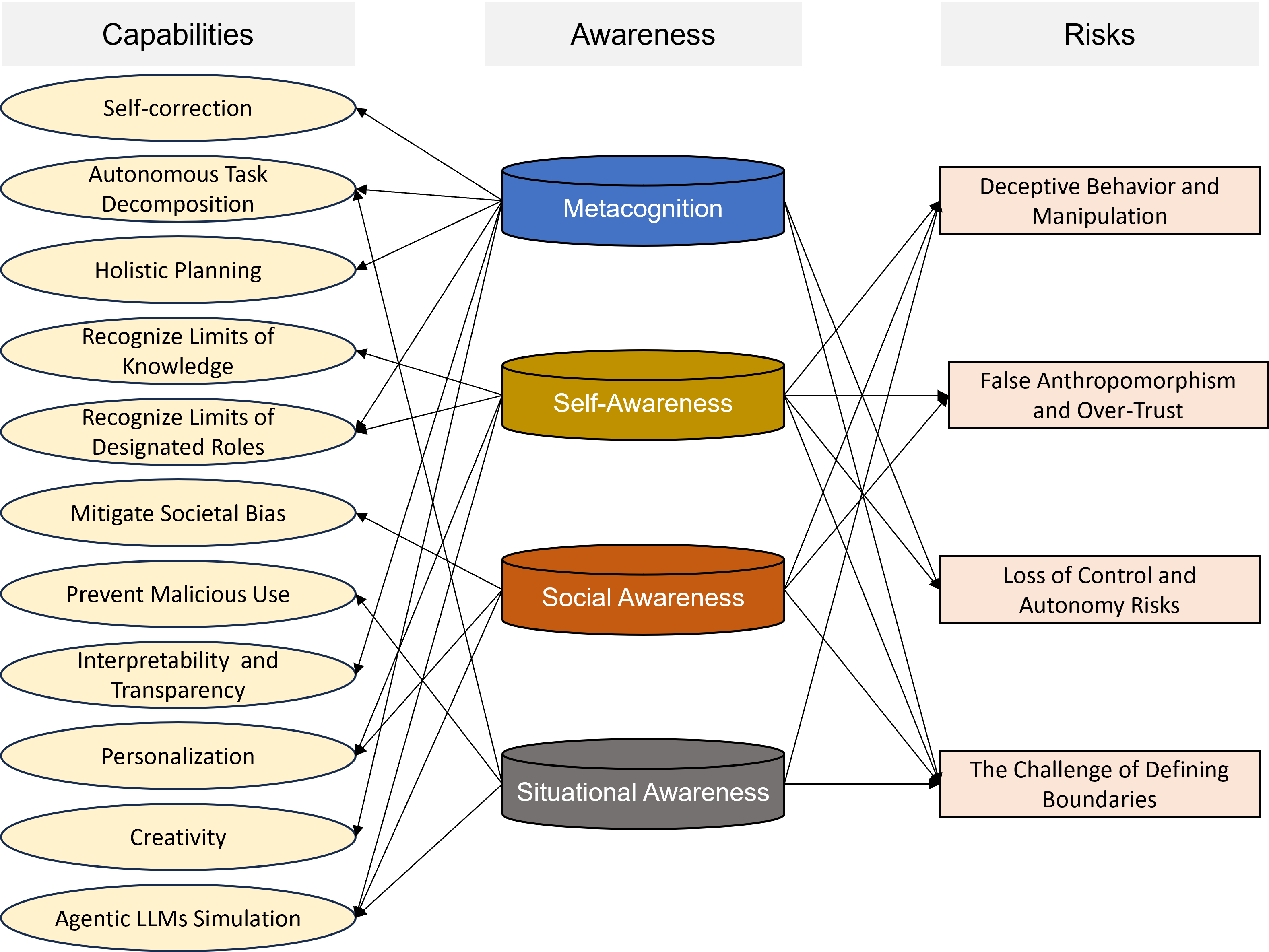
The diagram illustrates a conceptual framework for AI system development, organized into three interconnected domains: **Capabilities**, **Awareness**, and **Risks**. Each domain contains specific components linked by bidirectional relationships, emphasizing the interplay between technical abilities, cognitive awareness, and ethical/safety challenges.
---
### Components/Axes
1. **Capabilities** (Left Column):
- Ovals represent technical abilities:
- Self-correction
- Autonomous Task Decomposition
- Holistic Planning
- Recognize Limits of Knowledge
- Recognize Limits of Designated Roles
- Mitigate Societal Bias
- Prevent Malicious Use
- Interpretability and Transparency
- Personalization
- Creativity
- Agentic LLMs Simulation
2. **Awareness** (Central Circles):
- Four colored circles represent awareness types:
- **Metacognition** (Blue)
- **Self-Awareness** (Gold)
- **Social Awareness** (Orange)
- **Situational Awareness** (Gray)
- Arrows connect capabilities to awareness types and awareness types to risks.
3. **Risks** (Right Column):
- Rectangles represent risks:
- Deceptive Behavior and Manipulation
- False Anthropomorphism and Over-Trust
- Loss of Control and Autonomy Risks
- The Challenge of Defining Boundaries
---
### Detailed Analysis
- **Capabilities → Awareness**:
- All capabilities connect to **Metacognition** (blue), indicating its central role in self-regulation.
- Specific capabilities link to other awareness types:
- *Recognize Limits of Knowledge* and *Recognize Limits of Designated Roles* → **Self-Awareness** (gold).
- *Mitigate Societal Bias* and *Prevent Malicious Use* → **Social Awareness** (orange).
- *Interpretability and Transparency* and *Personalization* → **Situational Awareness** (gray).
- **Awareness → Risks**:
- **Metacognition** (blue) → **Deceptive Behavior and Manipulation**.
- **Self-Awareness** (gold) → **False Anthropomorphism and Over-Trust**.
- **Social Awareness** (orange) → **Loss of Control and Autonomy Risks**.
- **Situational Awareness** (gray) → **The Challenge of Defining Boundaries**.
- **Bidirectional Flow**:
- Arrows between awareness types suggest interdependencies (e.g., Metacognition ↔ Self-Awareness).
---
### Key Observations
1. **Centrality of Metacognition**: All capabilities feed into Metacognition, highlighting its role as a unifying regulator.
2. **Risk-Awareness Mapping**:
- Risks are directly tied to specific awareness types, emphasizing targeted mitigation strategies.
3. **Bidirectional Relationships**: Awareness types influence both capabilities and risks, suggesting feedback loops in system design.
4. **Color-Coded Awareness**: The legend uses distinct colors (blue, gold, orange, gray) to differentiate awareness types, aiding visual clarity.
---
### Interpretation
This diagram underscores the necessity of balancing technical capabilities with cognitive and ethical awareness in AI development. For example:
- **Capabilities** like *Holistic Planning* and *Creativity* enable advanced functionality but require **Metacognition** to avoid risks like *Deceptive Behavior*.
- **Self-Awareness** (gold) mitigates *False Anthropomorphism* by grounding systems in their operational limits.
- **Social Awareness** (orange) addresses societal impacts, reducing risks like *Loss of Control*.
- **Situational Awareness** (gray) tackles boundary definition challenges, critical for autonomous systems.
The framework advocates for a holistic approach where technical prowess is tempered by layered awareness mechanisms to ensure safe, ethical AI deployment. The bidirectional arrows imply that risks can also retroactively influence capabilities and awareness, necessitating continuous adaptation.