## Scatter Plot Grid: Facilitation vs AlE Score by Linguistic Task
### Overview
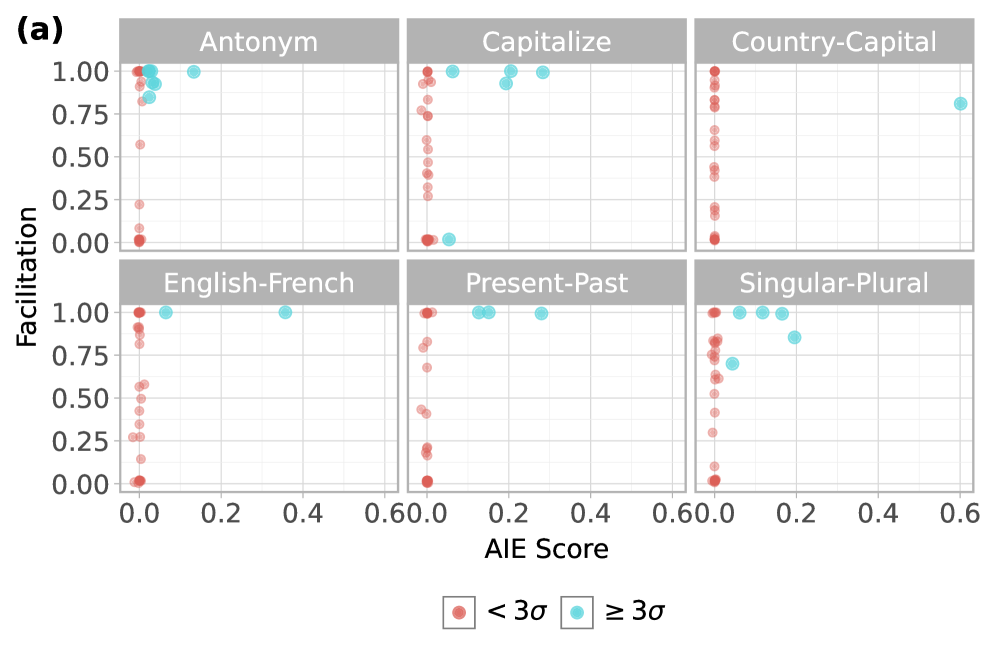
The image displays a 2x3 grid of scatter plots comparing "Facilitation" (y-axis) against "AlE Score" (x-axis) for six linguistic tasks: Antonym, Capitalize, Country-Capital, English-French, Present-Past, and Singular-Plural. Data points are color-coded: red (<3σ) and blue (≥3σ), with a legend at the bottom. Each subplot has a title in a gray header.
### Components/Axes
- **X-axis (AlE Score)**: Ranges from 0.0 to 0.6 in 0.1 increments.
- **Y-axis (Facilitation)**: Ranges from 0.0 to 1.0 in 0.25 increments.
- **Legend**: Located at the bottom center, with red squares labeled "<3σ" and blue squares labeled "≥3σ".
- **Subplot Titles**: Positioned at the top center of each plot in white text on a gray background.
### Detailed Analysis
1. **Antonym**
- Most points cluster near the top-left (AlE ~0.0–0.1, Facilitation ~0.75–1.0).
- A few red points spread diagonally downward to AlE ~0.3, Facilitation ~0.25.
- No blue points in this subplot.
2. **Capitalize**
- Dense vertical cluster of red points along AlE ~0.0–0.1, Facilitation ~0.0–0.75.
- Sparse blue points at AlE ~0.1–0.2, Facilitation ~0.75–1.0.
- One red outlier at AlE ~0.0, Facilitation ~0.0.
3. **Country-Capital**
- Vertical red cluster along AlE ~0.0–0.1, Facilitation ~0.0–0.75.
- Single blue point at AlE ~0.55, Facilitation ~0.75.
4. **English-French**
- Red points form a diagonal band from AlE ~0.0–0.1, Facilitation ~0.25–0.75.
- Two blue points at AlE ~0.1–0.2, Facilitation ~0.75–1.0.
5. **Present-Past**
- Red points cluster near AlE ~0.0–0.1, Facilitation ~0.0–0.5.
- Three blue points at AlE ~0.1–0.2, Facilitation ~0.75–1.0.
6. **Singular-Plural**
- Red points spread across AlE ~0.0–0.1, Facilitation ~0.0–0.75.
- Two blue points: one at AlE ~0.15, Facilitation ~0.75; another at AlE ~0.1, Facilitation ~0.85.
### Key Observations
- **Clustering**: Most tasks show red points concentrated at low AlE scores (<0.2) and moderate Facilitation (<0.75), suggesting lower performance or relevance for higher AlE scores.
- **Blue Points**: Represent higher σ values (≥3σ), indicating statistically significant outliers. These are rare and scattered, often at higher AlE scores (e.g., Country-Capital at AlE ~0.55).
- **Outliers**: The lone blue point in Country-Capital and the two blue points in Singular-Plural stand out as anomalies.
- **Task-Specific Patterns**:
- Antonym and Capitalize show minimal AlE variation, implying stable performance.
- Country-Capital and Singular-Plural exhibit higher AlE scores for blue points, suggesting task-specific challenges.
### Interpretation
The data suggests that linguistic tasks with lower AlE scores (closer to 0.0) generally exhibit higher facilitation, though this varies by task. The presence of blue points (≥3σ) indicates rare but significant deviations, possibly reflecting task-specific cognitive demands or dataset biases. For example:
- **Country-Capital** and **Singular-Plural** show higher AlE scores for significant outliers, hinting at greater complexity or ambiguity in these tasks.
- Tasks like **Antonym** and **Capitalize** demonstrate stability, with most data points clustered tightly, suggesting these are more straightforward for the model.
- The absence of blue points in Antonym and English-French may indicate these tasks lack extreme variability or are less sensitive to AlE score changes.
This pattern aligns with the idea that simpler linguistic tasks (e.g., antonyms, capitalization) are easier to process, while tasks requiring cross-lingual or morphological reasoning (e.g., English-French, Singular-Plural) show more variability and higher AlE scores for significant cases.