## Mathematical Diagram: Saddle Point vs. Minimum on a 2D Surface
### Overview
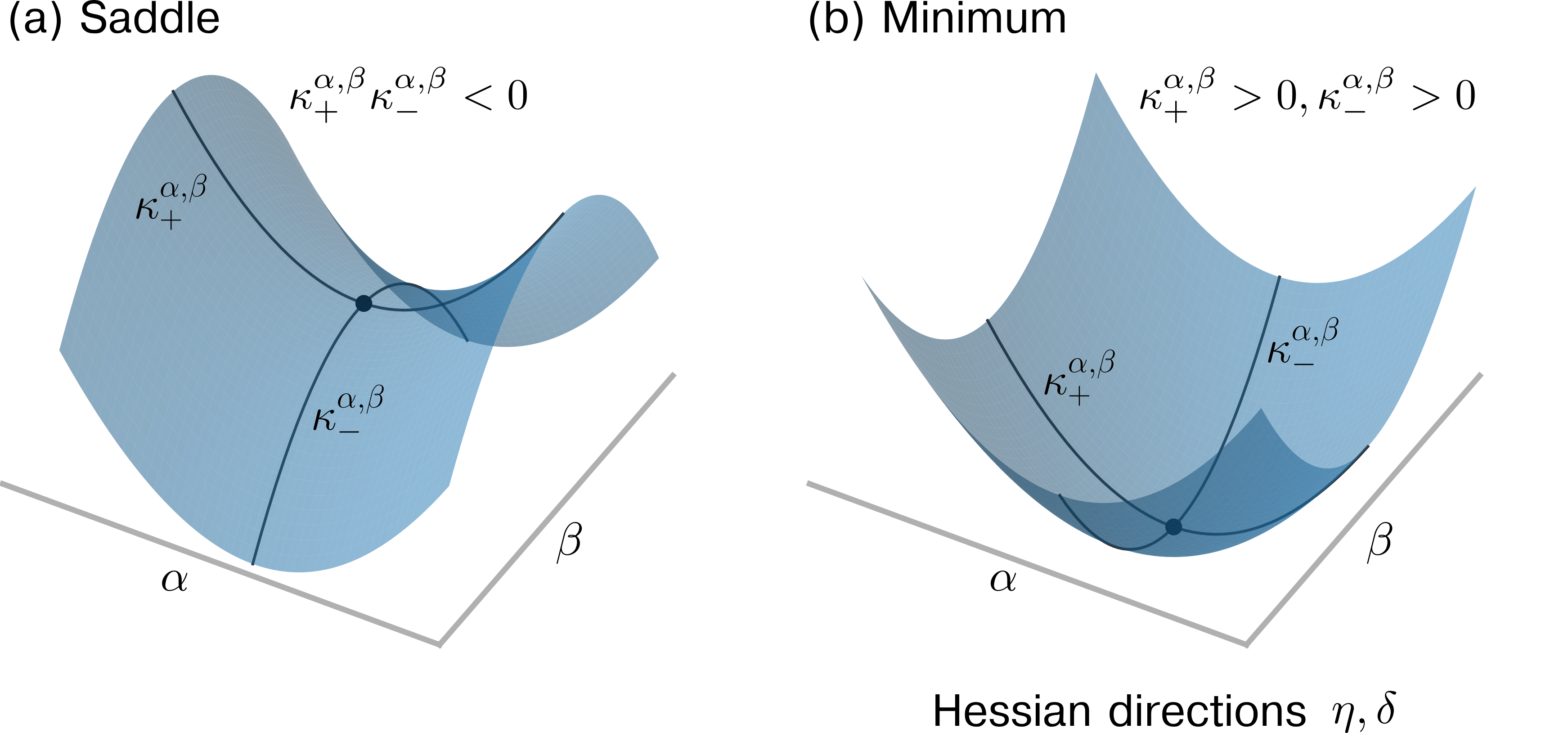
The image displays two side-by-side 3D surface plots illustrating the geometric interpretation of critical points on a two-variable function. The left diagram (a) depicts a saddle point, while the right diagram (b) depicts a local minimum. Both plots are rendered as blue, semi-transparent surfaces with a visible grid pattern, set against a white background. The diagrams are labeled with mathematical notation describing the principal curvatures at the central critical point.
### Components/Axes
**Spatial Layout:**
- The image is divided into two distinct panels.
- **Panel (a) - Left:** Titled "(a) Saddle" in the top-left corner.
- **Panel (b) Right:** Titled "(b) Minimum" in the top-right corner.
- A caption at the bottom center reads: "Hessian directions η, δ".
**Axes (Common to both plots):**
- Each plot features a 3D coordinate system with two horizontal axes.
- The axis extending from the bottom-left towards the center is labeled **α** (alpha).
- The axis extending from the bottom-right towards the center is labeled **β** (beta).
- These axes define the domain plane over which the surface is plotted. The vertical axis (function value) is not explicitly labeled.
**Surface Elements:**
- **Central Point:** A black dot marks the critical point (where the gradient is zero) at the center of each surface.
- **Curves:** Two dark blue curves are drawn on each surface, intersecting at the central point. These represent the paths of principal curvature.
- **Curvature Labels:**
- In both plots, one curve is labeled **κ₊^{α,β}** (kappa-plus, with superscripts α,β).
- The other curve is labeled **κ₋^{α,β}** (kappa-minus, with superscripts α,β).
**Mathematical Annotations:**
- **Panel (a) Saddle:** An equation is placed near the top of the surface: **κ₊^{α,β} κ₋^{α,β} < 0**.
- **Panel (b) Minimum:** An equation is placed near the top of the surface: **κ₊^{α,β} > 0, κ₋^{α,β} > 0**.
### Detailed Analysis
**Diagram (a) - Saddle Point:**
- **Surface Shape:** The surface curves upward along one principal direction and downward along the other, creating a classic saddle or hyperbolic paraboloid shape. The central point is a minimax point.
- **Curvature Relationship:** The annotation **κ₊^{α,β} κ₋^{α,β} < 0** indicates that the two principal curvatures have opposite signs. This is the defining mathematical condition for a saddle point in two dimensions.
- **Curve Behavior:** The curve labeled **κ₊^{α,β}** appears to follow a path where the surface curves upward (convex) from the central point. The curve labeled **κ₋^{α,β}** follows a path where the surface curves downward (concave) from the central point.
**Diagram (b) - Minimum:**
- **Surface Shape:** The surface curves upward in all directions from the central point, forming a bowl or valley shape. The central point is the lowest point in its local neighborhood.
- **Curvature Relationship:** The annotation **κ₊^{α,β} > 0, κ₋^{α,β} > 0** indicates that both principal curvatures are positive. This is the defining mathematical condition for a local minimum in two dimensions.
- **Curve Behavior:** Both curves, **κ₊^{α,β}** and **κ₋^{α,β}**, follow paths where the surface curves upward (convex) away from the central point.
**Bottom Caption:**
- The text **"Hessian directions η, δ"** suggests that the two principal curvature directions (κ₊ and κ₋) correspond to the eigenvectors (η, δ) of the Hessian matrix evaluated at the critical point. The Hessian matrix contains the second partial derivatives of the function.
### Key Observations
1. **Visual Contrast:** The diagrams provide a clear visual contrast between a saddle point (indefinite Hessian) and a minimum (positive definite Hessian).
2. **Geometric Interpretation:** The curves on the surfaces are not arbitrary; they represent the directions of maximum and minimum curvature (principal directions) at the critical point.
3. **Mathematical Notation:** The use of superscripts (α,β) on the curvature symbols (κ) explicitly ties these geometric properties to the coordinate system defined by the α and β axes.
4. **Color and Style:** The consistent use of blue for the surface, black for the critical point and curves, and gray for the axes creates a clean, technical aesthetic focused on conveying mathematical concepts.
### Interpretation
These diagrams are fundamental visualizations in multivariable calculus, optimization theory, and differential geometry. They illustrate how the second derivative test (via the Hessian matrix) classifies critical points.
- **What the data suggests:** The diagrams demonstrate that the sign of the product of the principal curvatures (or equivalently, the determinant of the Hessian) determines the type of critical point. A negative product indicates a saddle point, while two positive curvatures indicate a minimum. (By extension, two negative curvatures would indicate a maximum).
- **How elements relate:** The axes (α, β) define the input space. The surface height represents the function value. The curves (κ₊, κ₋) show the paths of steepest ascent/descent in curvature, which are the eigenvectors of the Hessian. The equations summarize the curvature conditions that define the point's nature.
- **Notable patterns/anomalies:** The key pattern is the direct link between algebraic conditions (signs of κ) and geometric shape. There are no anomalies; the diagrams are canonical representations. The "Hessian directions" caption explicitly connects the geometric principal directions to the algebraic eigenvectors of the second-derivative matrix, unifying the visual and analytical perspectives.
In essence, this image serves as a pedagogical tool to bridge the gap between the abstract algebra of second derivatives and the tangible geometry of surfaces, showing why a saddle point is neither a max nor a min, and how a minimum "holds water" from all directions.