## 3D Function Visualization: Saddle Point vs. Minimum
### Overview
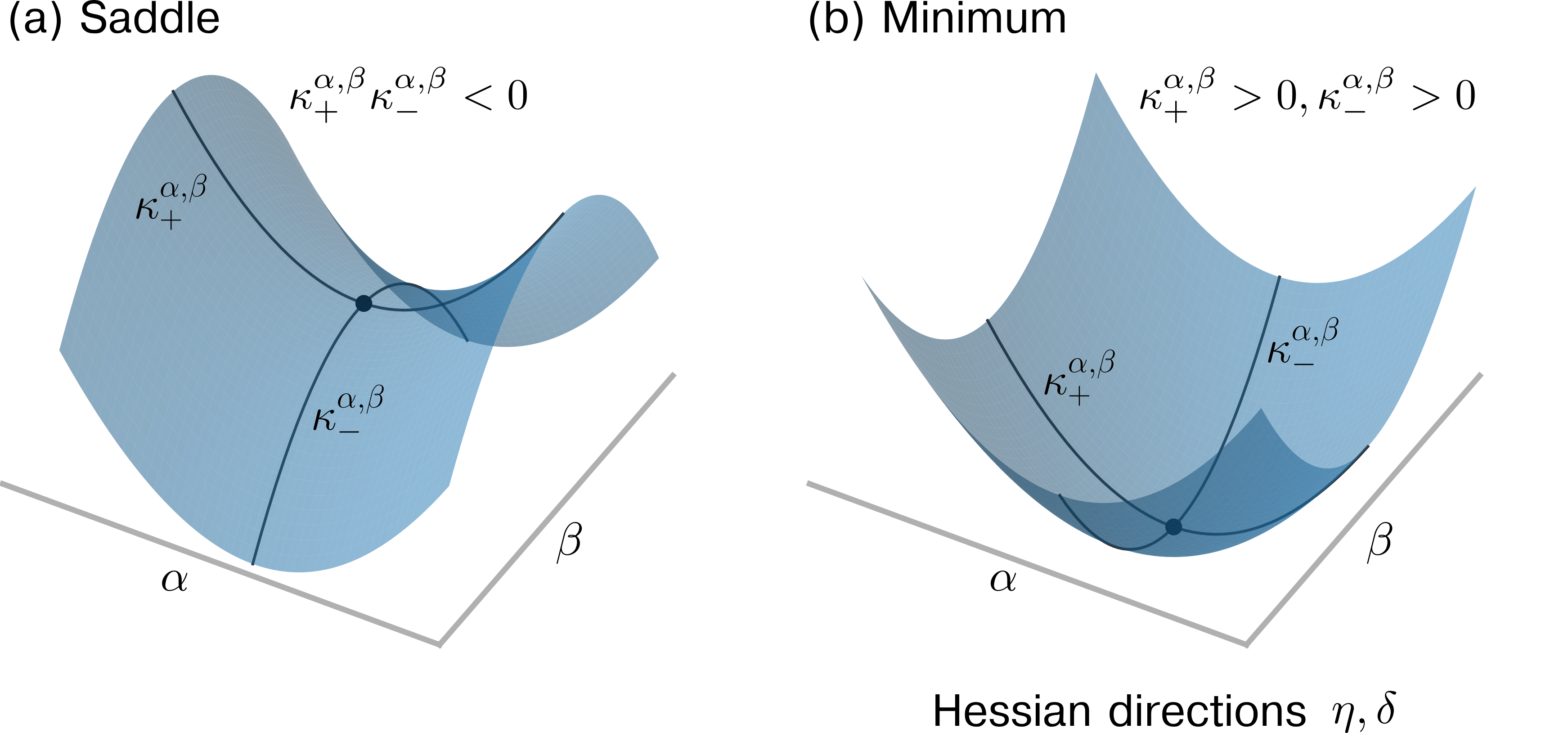
The image contains two 3D surface plots comparing critical points in a multivariable function. Plot (a) shows a saddle point configuration, while plot (b) illustrates a minimum point. Both plots use α and β as independent variables on orthogonal axes, with implicit third-axis values representing function output.
### Components/Axes
- **Axes Labels**:
- Horizontal axes: α (x-axis), β (y-axis)
- Vertical axis: Implicit function value (z-axis)
- **Mathematical Labels**:
- κ+α,β and κ−α,β annotations on both plots
- Hessian directions η, δ labeled at bottom of plot (b)
- **Color Coding**:
- Light blue shading for surface areas
- Dark blue lines for critical point contours
- Black dots marking critical points
### Detailed Analysis
#### Plot (a) Saddle Point
- **Surface Structure**:
- Hyperbolic paraboloid shape with opposing curvature
- Central black dot at intersection of κ+ and κ− contours
- **Mathematical Conditions**:
- κ+α,β < 0 and κ−α,β < 0 (both negative definite)
- Critical point occurs where surface crosses itself
- **Spatial Features**:
- Left side shows upward curvature (α-direction)
- Right side shows downward curvature (β-direction)
#### Plot (b) Minimum
- **Surface Structure**:
- Parabolic bowl shape with single global minimum
- Central black dot at lowest point
- **Mathematical Conditions**:
- κ+α,β > 0 and κ−α,β > 0 (both positive definite)
- Hessian directions η, δ indicate gradient paths
- **Spatial Features**:
- All directions curve upward from central minimum
- Contour lines form concentric ellipses around minimum
### Key Observations
1. **Curvature Sign Relationship**:
- Saddle point (a) shows mixed curvature signs (one positive, one negative)
- Minimum (b) shows uniform positive curvature
2. **Hessian Directionality**:
- Only present in minimum plot (b)
- Arrows point toward minimum along principal axes
3. **Critical Point Identification**:
- Saddle point marked by intersecting surface
- Minimum marked by lowest surface point
4. **Symmetry**:
- Both plots show bilateral symmetry about α=0 and β=0
### Interpretation
The visualization demonstrates fundamental concepts in multivariable calculus:
1. **Saddle Point Significance**:
- Represents unstable equilibrium where function increases in one direction and decreases in another
- Mathematical manifestation of competing gradients
2. **Minimum Characteristics**:
- Stable equilibrium point with positive definite Hessian
- Indicates local/global optimization target
3. **Hessian Geometry**:
- Directions η, δ in plot (b) show paths of steepest descent
- Elliptical contour patterns confirm quadratic approximation validity
4. **Practical Implications**:
- Saddle points often represent transition states in physical systems
- Minima correspond to equilibrium states in optimization problems
- Curvature analysis provides insight into function behavior near critical points
The plots effectively demonstrate how second derivative information (Hessian matrix) determines the nature of critical points through curvature analysis.