## Text Comparison: MATH-SHEPHERD vs. ORM
### Overview
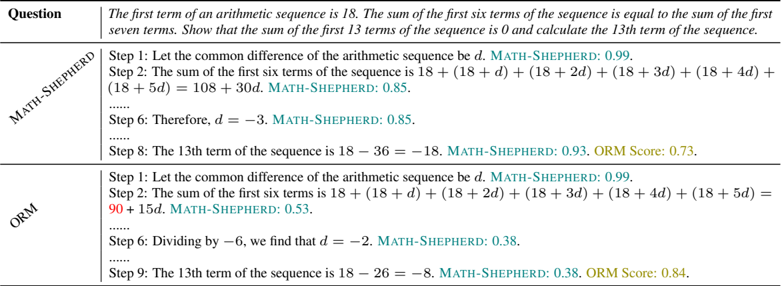
The image presents two different approaches (MATH-SHEPHERD and ORM) to solving a problem related to arithmetic sequences. It shows the steps taken by each method, along with associated scores.
### Components/Axes
* **Question:** The problem statement regarding an arithmetic sequence.
* **MATH-SHEPHERD:** One approach to solving the problem.
* **ORM:** Another approach to solving the problem.
* **Steps:** Numbered steps outlining the solution process for each approach.
* **MATH-SHEPHERD Score:** A score associated with each step in the MATH-SHEPHERD approach.
* **ORM Score:** A score associated with the final answer in the ORM approach.
### Detailed Analysis or ### Content Details
**Question:**
> The first term of an arithmetic sequence is 18. The sum of the first six terms of the sequence is equal to the sum of the first seven terms. Show that the sum of the first 13 terms of the sequence is 0 and calculate the 13th term of the sequence.
**MATH-SHEPHERD Approach:**
* **Step 1:** Let the common difference of the arithmetic sequence be *d*. MATH-SHEPHERD: 0.99
* **Step 2:** The sum of the first six terms of the sequence is 18 + (18 + *d*) + (18 + 2*d*) + (18 + 3*d*) + (18 + 4*d*) + (18 + 5*d*) = 108 + 30*d*. MATH-SHEPHERD: 0.85
* **Step 6:** Therefore, *d* = -3. MATH-SHEPHERD: 0.85
* **Step 8:** The 13th term of the sequence is 18 - 36 = -18. MATH-SHEPHERD: 0.93. ORM Score: 0.73
**ORM Approach:**
* **Step 1:** Let the common difference of the arithmetic sequence be *d*. MATH-SHEPHERD: 0.99
* **Step 2:** The sum of the first six terms is 18 + (18 + *d*) + (18 + 2*d*) + (18 + 3*d*) + (18 + 4*d*) + (18 + 5*d*) = 90 + 15*d*. MATH-SHEPHERD: 0.53
* **Step 6:** Dividing by -6, we find that *d* = -2. MATH-SHEPHERD: 0.38
* **Step 9:** The 13th term of the sequence is 18 - 26 = -8. MATH-SHEPHERD: 0.38. ORM Score: 0.84
### Key Observations
* Both approaches start by defining the common difference as *d*.
* The MATH-SHEPHERD approach arrives at a common difference of -3, while the ORM approach arrives at -2.
* The MATH-SHEPHERD approach calculates the 13th term as -18, while the ORM approach calculates it as -8.
* The MATH-SHEPHERD approach generally has higher MATH-SHEPHERD scores than the ORM approach.
* The ORM approach has an ORM score for the final answer, which is different for each approach.
### Interpretation
The image demonstrates two different methods for solving the same arithmetic sequence problem, resulting in different answers. The MATH-SHEPHERD approach appears to be initially favored based on its higher MATH-SHEPHERD scores in the early steps. However, the ORM approach also provides a score for the final answer, suggesting an independent evaluation of the result. The discrepancy in the final answers and the associated scores highlight potential differences in the solution methodologies or evaluation criteria used by MATH-SHEPHERD and ORM. It is important to note that the ORM score for the MATH-SHEPHERD solution is 0.73, while the ORM score for the ORM solution is 0.84, suggesting that ORM favors its own solution.