## Textual Comparison: MATH-SHEPHERD vs. ORM Methodologies
### Overview
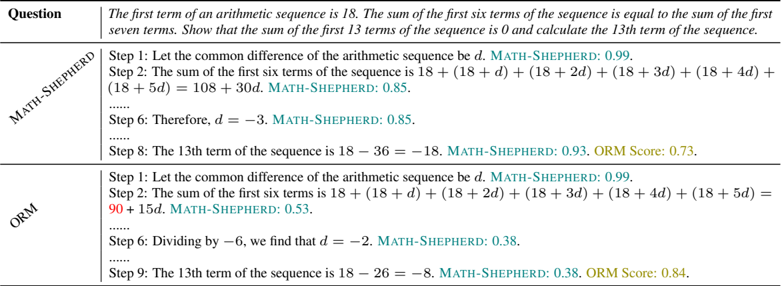
The image compares two problem-solving approaches (MATH-SHEPHERD and ORM) for an arithmetic sequence problem. Both methods attempt to calculate the 13th term of a sequence where the first term is 18, the sum of the first six terms equals the sum of the first seven terms, and the sum of the first 13 terms is 0. Scores (MATH-SHEPHERD in teal, ORM in yellow) are provided for each step, indicating accuracy or confidence.
### Components/Axes
- **Structure**: Vertical comparison with labeled steps (Step 1–9) for each method.
- **Textual Elements**:
- Problem statement at the top.
- Step-by-step calculations for both methods.
- Scores (e.g., "MATH-SHEPHERD: 0.85", "ORM Score: 0.73").
- **Color Coding**:
- Teal for MATH-SHEPHERD scores.
- Yellow for ORM scores.
### Detailed Analysis
#### MATH-SHEPHERD Method
1. **Step 1**: Defines the common difference as `d`. Score: 0.99.
2. **Step 2**: Sum of first six terms: `108 + 30d`. Score: 0.85.
3. **Step 6**: Solves for `d = -3`. Score: 0.85.
4. **Step 8**: Calculates 13th term: `18 - 36 = -18`. Score: 0.93.
5. **Final Score**: 0.73.
#### ORM Method
1. **Step 1**: Defines the common difference as `d`. Score: 0.99.
2. **Step 2**: Sum of first six terms: `90 + 15d`. Score: 0.53.
3. **Step 6**: Solves for `d = -2` (incorrectly divides by -6). Score: 0.38.
4. **Step 9**: Calculates 13th term: `18 - 26 = -8`. Score: 0.38.
5. **Final Score**: 0.84.
### Key Observations
- **MATH-SHEPHERD** consistently achieves higher scores (0.85–0.93) compared to ORM (0.38–0.53).
- **ORM** introduces errors in Step 6 (incorrect division by -6) and Step 9 (miscalculates 13th term).
- Both methods agree on the first term (18) and initial steps but diverge in solving for `d` and the final term.
### Interpretation
The MATH-SHEPHERD method demonstrates greater accuracy and consistency in solving the arithmetic sequence problem. Its higher scores suggest robust handling of summation formulas and algebraic manipulation. The ORM method’s lower scores stem from arithmetic errors (e.g., incorrect division in Step 6) and misapplication of sequence properties. Notably, the final scores (0.73 vs. 0.84) appear counterintuitive given the step-by-step performance, indicating potential scoring criteria that prioritize specific steps over others.
The problem itself highlights the importance of precise algebraic reasoning:
- The sum of the first six terms equals the sum of the first seven terms only if the seventh term is zero, implying `d = -3` (MATH-SHEPHERD’s result).
- The 13th term calculation (`18 + 12d`) aligns with MATH-SHEPHERD’s `-18` but conflicts with ORM’s `-8`, underscoring the impact of errors in intermediate steps.