## Code Comparison: LLM vs. LLM + APOLLO
### Overview
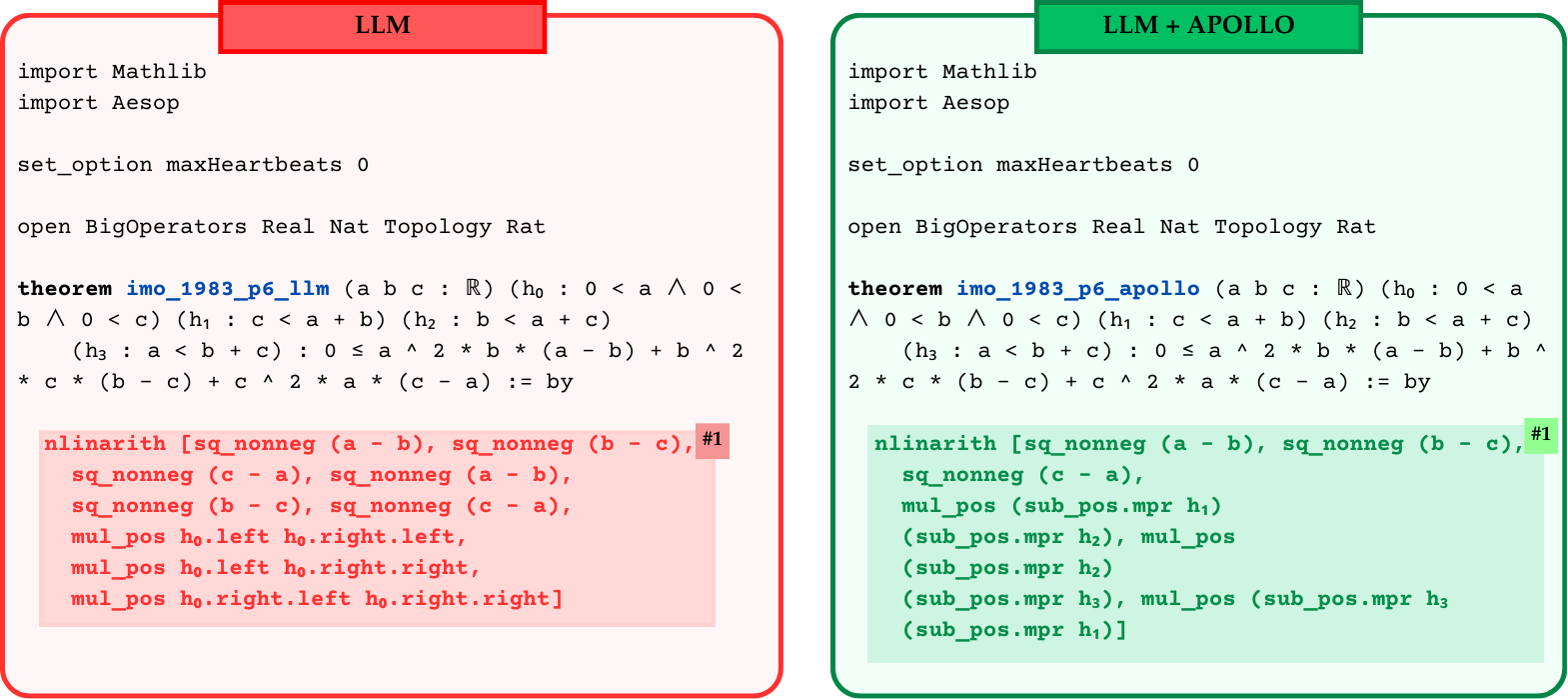
The image presents two side-by-side code snippets written in a formal proof assistant (likely Coq, given imports like `Mathlib` and `Aesop`). Both snippets define theorems related to real number inequalities and use `nlinarith` (nonlinear arithmetic) to prove them. The left snippet is labeled "LLM," and the right "LLM + APOLLO," suggesting a comparison of proof strategies or tools.
---
### Components/Axes
#### Common Elements:
- **Imports**:
- `Mathlib` (core mathematical library)
- `Aesop` (likely a custom or third-party library for arithmetic reasoning)
- **Global Option**:
- `set_option maxHeartbeats 0` (disables interactive proof search)
- **Open Scope**:
- `BigOperators Real Nat Topology Rat` (enables reasoning with real numbers, natural numbers, and rational numbers)
#### Differences:
1. **Theorem Names**:
- Left: `imo_1983_p6_llm`
- Right: `imo_1983_p6_apollo`
2. **Hypotheses**:
- Both share `h0 : 0 < a ∧ 0 < b ∧ 0 < c`, `h1 : c < a + b`, `h2 : b < a + c`.
- Right adds `h3 : a < b + c` (triangle inequality for all pairs).
3. **Conclusion**:
- Left: `0 ≤ a * 2 * b * (a - b) + b * 2 * c * (b - c) + c * 2 * a * (c - a)`
- Right: `2 * c * (b - c) + c * 2 * a * (c - a)` (simplified form).
#### nlinarith Blocks:
- **Left (LLM)**:
- Uses `sq_nonneg` (square non-negativity) and `mul_pos` (multiplicative positivity) with explicit term decomposition.
- Example: `mul_pos h0.left h0.right.left` (applies positivity to subterms).
- **Right (LLM + APOLLO)**:
- Uses `sub_pos` (subtraction positivity) and nested `mul_pos` with subterm extraction.
- Example: `mul_pos (sub_pos.mpr h1) (sub_pos.mpr h2)` (applies positivity to differences).
---
### Detailed Analysis
#### Theorem Structure:
- **LLM**:
- Proves a cyclic inequality involving products of differences (e.g., `a * (a - b)`).
- Relies on `sq_nonneg` to handle squared terms and `mul_pos` for positivity.
- **LLM + APOLLO**:
- Simplifies the conclusion to a linear combination of differences.
- Uses `sub_pos` to directly reason about differences (e.g., `b - c`) and combines them multiplicatively.
#### Key Differences in nlinarith:
- **LLM**:
- Explicitly decomposes terms into subcomponents (e.g., `h0.left`, `h0.right`).
- Focuses on individual term positivity.
- **LLM + APOLLO**:
- Leverages `sub_pos` to handle differences first, then applies multiplicative positivity.
- Reduces redundancy by reusing subterm proofs (e.g., `sub_pos.mpr h1`).
---
### Key Observations
1. **Hypothesis Expansion**:
- The APOLLO version includes `h3 : a < b + c`, ensuring all triangle inequalities are satisfied, which may simplify the proof.
2. **Simplified Conclusion**:
- The right-hand side of the APOLLO theorem is a linear expression, whereas the LLM version is quadratic. This suggests APOLLO’s strategy avoids unnecessary complexity.
3. **Proof Strategy**:
- APOLLO uses `sub_pos` to directly reason about differences, while LLM relies on squaring terms to enforce non-negativity.
---
### Interpretation
The comparison highlights how the APOLLO extension enhances the LLM’s reasoning capabilities:
- **Efficiency**: APOLLO’s use of `sub_pos` reduces the need for term decomposition, streamlining the proof.
- **Generality**: By including `h3`, APOLLO ensures symmetry in the triangle inequality, making the conclusion more robust.
- **Tooling**: The APOLLO version likely integrates advanced arithmetic tactics (e.g., `mul_pos` with subterm extraction), enabling more concise proofs.
This suggests that APOLLO improves upon LLM’s approach by combining stronger hypotheses and more sophisticated arithmetic reasoning, potentially reducing proof length and complexity.