TECHNICAL ASSET FINGERPRINT
e98503a1256c799d0bda26df
Click to view fullscreen
Press ESC or click to close
FOUND IN PAPERS
EXPERT: gemma-3-27b-it-free VERSION 1
RUNTIME: google-free/gemma-3-27b-it
INTEL_VERIFIED
\n
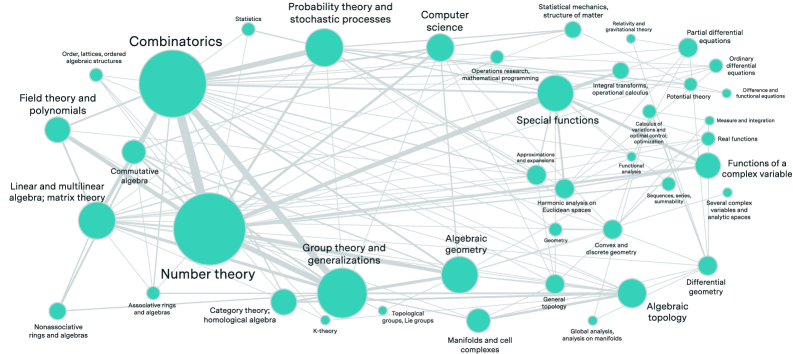
## Network Diagram: Mathematical Fields and Their Relationships
### Overview
The image presents a network diagram illustrating the relationships between various fields of mathematics. The fields are represented as circles (nodes) of varying sizes, and the connections between them are shown as lines (edges). The size of the circle appears to correlate with the prominence or breadth of the field. The diagram is visually complex, with numerous interconnections suggesting overlapping concepts and dependencies.
### Components/Axes
The diagram lacks traditional axes. Instead, it relies on spatial arrangement to convey relationships. The nodes are labeled with the names of mathematical fields. There is no explicit legend, but the visual representation of connections implies a degree of relatedness. The diagram is primarily organized into clusters, with some fields appearing more central than others.
### Detailed Analysis or Content Details
Here's a breakdown of the fields and their apparent connections, moving roughly from left to right and top to bottom:
* **Combinatorics:** Connected to Statistics, Order, lattices, ordered algebraic structure, Field theory and polynomials.
* **Statistics:** Connected to Combinatorics, Probability theory and stochastic processes.
* **Probability theory and stochastic processes:** Connected to Statistics, Computer science, Statistical mechanics, structure of matter.
* **Computer science:** Connected to Probability theory and stochastic processes, Operations research, mathematical programming.
* **Statistical mechanics, structure of matter:** Connected to Probability theory and stochastic processes, Partial differential equations.
* **Partial differential equations:** Connected to Statistical mechanics, structure of matter, Ordinary differential equations.
* **Ordinary differential equations:** Connected to Partial differential equations.
* **Field theory and polynomials:** Connected to Combinatorics, Commutative algebra, Linear and multi linear algebra; matrix theory.
* **Commutative algebra:** Connected to Field theory and polynomials, Number theory.
* **Linear and multi linear algebra; matrix theory:** Connected to Field theory and polynomials.
* **Number theory:** Connected to Commutative algebra, Category theory; homological algebra, Associative rings and algebras.
* **Associative rings and algebras:** Connected to Number theory, Nonassociative rings and algebras.
* **Nonassociative rings and algebras:** Connected to Associative rings and algebras.
* **Category theory; homological algebra:** Connected to Number theory, K-theory.
* **K-theory:** Connected to Category theory; homological algebra, Group theory and generalizations.
* **Group theory and generalizations:** Connected to K-theory, Topological groups, Lie groups, Manifolds and cell complexes.
* **Topological groups, Lie groups:** Connected to Group theory and generalizations.
* **Manifolds and cell complexes:** Connected to Group theory and generalizations, Global analysis, analysis on manifolds.
* **Global analysis, analysis on manifolds:** Connected to Manifolds and cell complexes, Differential geometry.
* **Algebraic geometry:** Connected to Harmonic analysis on Euclidean spaces, Geometry, Convex and discrete geometry.
* **Geometry:** Connected to Algebraic geometry, Convex and discrete geometry, Differential geometry.
* **Convex and discrete geometry:** Connected to Geometry.
* **Differential geometry:** Connected to Geometry, Algebraic topology.
* **Algebraic topology:** Connected to Differential geometry.
* **Special functions:** Connected to Operations research, mathematical programming, Integral transform, operational calculus, Calculus of variations and optimal control, Functional analysis.
* **Operations research, mathematical programming:** Connected to Computer science, Special functions.
* **Integral transform, operational calculus:** Connected to Special functions, Potential theory.
* **Potential theory:** Connected to Integral transform, operational calculus, Measure and integration.
* **Measure and integration:** Connected to Potential theory, Real functions.
* **Real functions:** Connected to Measure and integration, Functions of a complex variable.
* **Functions of a complex variable:** Connected to Real functions, Several complex analytic spaces.
* **Several complex analytic spaces:** Connected to Functions of a complex variable.
* **Harmonic analysis on Euclidean spaces:** Connected to Algebraic geometry, Approximation theory and expansions.
* **Approximation theory and expansions:** Connected to Harmonic analysis on Euclidean spaces, Functional analysis.
* **Functional analysis:** Connected to Approximation theory and expansions, Calculus of variations and optimal control.
* **Calculus of variations and optimal control:** Connected to Functional analysis, Special functions.
* **Sequences, series, summability:** Connected to Functions of a complex variable.
The connections are represented by thin, light-colored lines, creating a dense web across the diagram. The size of the nodes varies significantly, with "Number theory", "Group theory and generalizations", and "Functions of a complex variable" appearing among the largest.
### Key Observations
* **Centrality:** Number theory, Group theory and generalizations, and Functions of a complex variable appear to be central nodes, connected to many other fields.
* **Interconnectedness:** The diagram highlights the interconnected nature of mathematics, with most fields having multiple connections to others.
* **Node Size and Importance:** Larger nodes likely represent broader or more fundamental areas of mathematics.
* **Cluster Formation:** The diagram exhibits clusters of related fields, such as those around algebra, analysis, and topology.
### Interpretation
This diagram visually represents the complex web of relationships within mathematics. It suggests that mathematical fields are not isolated disciplines but rather interconnected areas of study. The size of the nodes likely reflects the breadth and influence of each field, with central nodes serving as foundational areas. The diagram could be used to illustrate the interdisciplinary nature of mathematical research and to guide students in exploring connections between different areas of study. The lack of explicit weighting on the lines suggests all connections are considered equally important, which may be a simplification. The diagram is a high-level overview and doesn't capture the nuances of specific relationships within each field. It's a conceptual map rather than a precise quantitative representation. The diagram is a visualization of mathematical knowledge, and its structure reflects the perceived relationships between different areas of the discipline.
DECODING INTELLIGENCE...