## Network Diagram: Interconnected Mathematical Fields
### Overview
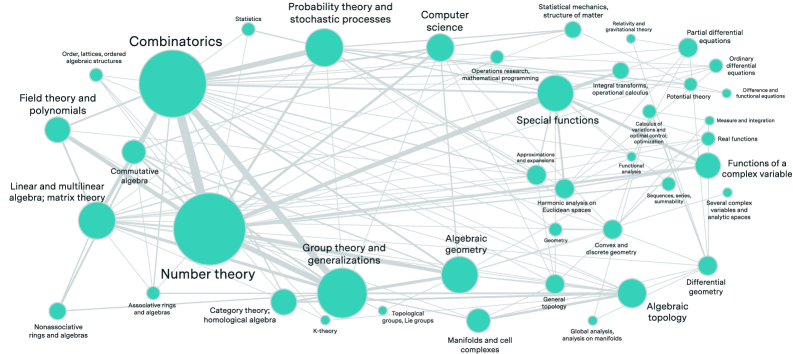
The image is a network diagram illustrating the relationships between various mathematical fields. Nodes represent core disciplines, while edges denote subfields or connections between them. The diagram emphasizes interdisciplinary links, with teal-colored nodes and gray edges forming a dense web of relationships.
### Components/Axes
- **Nodes**: Labeled with mathematical fields (e.g., "Combinatorics," "Number theory," "Algebraic geometry"). Node size appears proportional to connection density (e.g., "Combinatorics" and "Number theory" are the largest nodes).
- **Edges**: Labeled with subfields or specific topics (e.g., "Commutative algebra," "Linear and multilinear algebra; matrix theory," "Group theory and generalizations"). Edges are undirected and connect nodes bidirectionally.
- **Color Coding**:
- Nodes: Teal (#008080) for all fields.
- Edges: Gray (#808080) for all connections.
- **Placement**: Nodes are spatially distributed with no explicit axes. Larger nodes (e.g., "Combinatorics," "Number theory") are centrally positioned, while smaller nodes (e.g., "K-theory," "Topological groups") are peripheral.
### Detailed Analysis
- **Core Fields**:
- **Combinatorics** (largest node) connects to 8+ subfields, including "Order, lattices, ordered algebraic structures" and "Statistics."
- **Number theory** (second-largest node) links to "Commutative algebra," "Associative rings and algebras," and "K-theory."
- **Algebraic geometry** connects to "Manifolds and cell complexes" and "Differential geometry."
- **Subfield Connections**:
- "Commutative algebra" bridges "Number theory" and "Field theory and polynomials."
- "Linear and multilinear algebra; matrix theory" connects "Field theory and polynomials" to "Combinatorics."
- "Group theory and generalizations" links "Number theory" to "Algebraic geometry."
- **Peripheral Fields**:
- "K-theory" and "Topological groups" have fewer connections, primarily to "Number theory" and "Algebraic geometry."
- "Differential equations" and "Partial differential equations" are isolated to the right side, connected only to "Special functions" and "Functions of a complex variable."
### Key Observations
1. **Central Hubs**: "Combinatorics" and "Number theory" act as central hubs, with the most connections.
2. **Interdisciplinary Links**: Fields like "Algebraic geometry" and "Differential geometry" serve as bridges between core disciplines.
3. **Isolation of Applied Fields**: Applied areas like "Differential equations" and "Probability theory" have fewer connections, suggesting less overlap with pure mathematics.
4. **Edge Density**: The diagram contains ~50+ edges, indicating a highly interconnected network.
### Interpretation
This diagram reveals the **interdisciplinary nature of mathematics**, where core fields like combinatorics and number theory are deeply interconnected through specialized subfields. The central positioning of "Combinatorics" and "Number theory" suggests they are foundational to mathematical research, while peripheral fields like "K-theory" and "Differential equations" represent niche areas with limited cross-disciplinary overlap. The dense network implies that mathematical progress often relies on synthesizing knowledge across domains, with hubs like combinatorics enabling breakthroughs in applied fields (e.g., computer science, statistics). The isolation of applied fields highlights a potential gap in interdisciplinary collaboration, suggesting opportunities for future research integration.