\n
## Diagram: LLM Correction and Task Evaluation Flow
### Overview
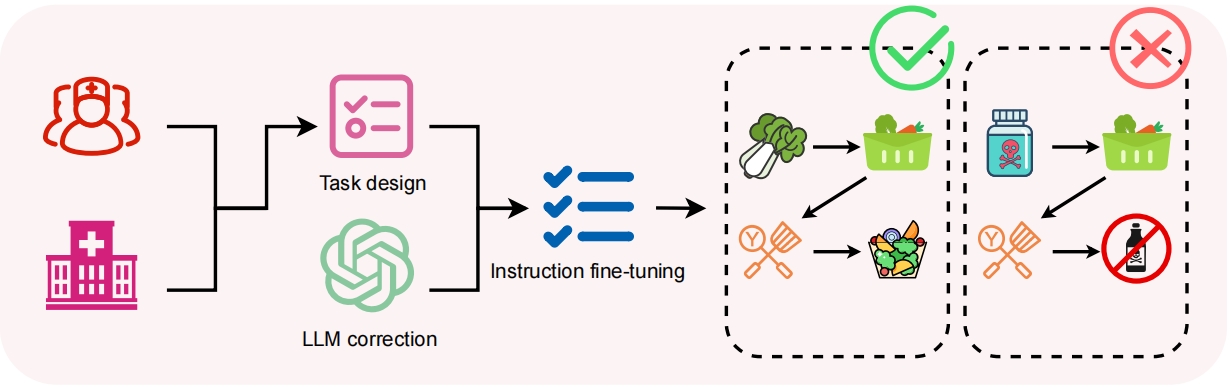
The image depicts a diagram illustrating a process of Large Language Model (LLM) correction and task evaluation. It shows a workflow starting with human input and LLM correction, leading to task design and instruction fine-tuning, and finally, a validation stage with positive and negative examples.
### Components/Axes
The diagram consists of four main sections arranged horizontally:
1. **Human & LLM Correction:** Depicted by a human head icon and a building icon with a plus sign, connected to a swirling green shape labeled "LLM correction".
2. **Task Design & Instruction Fine-tuning:** The LLM correction output feeds into a box labeled "Task design" (with a checklist icon) and then into a series of blue checkmark icons labeled "Instruction fine-tuning".
3. **Evaluation Stage:** A dashed box containing pairs of input-output examples, some marked with a green checkmark (positive) and others with a red 'X' (negative).
4. **Input Examples:** Various icons representing different inputs are used within the evaluation stage (e.g., vegetables, fish, paper, bottle).
There are no explicit axes or scales in this diagram. It's a flow diagram representing a process.
### Detailed Analysis or Content Details
The diagram shows a sequential flow of information:
1. **Initial Input:** The process begins with input from a human (represented by the head icon) and potentially a knowledge base or institution (represented by the building icon).
2. **LLM Correction:** This input is then processed by an LLM correction module (the swirling green shape).
3. **Task Design:** The corrected output is used for "Task design," which appears to involve defining the task and its parameters.
4. **Instruction Fine-tuning:** The task design is then used to "Instruction fine-tuning" the LLM, represented by a series of blue checkmarks.
5. **Evaluation:** The fine-tuned LLM is evaluated using a set of input-output pairs.
* **Positive Examples:**
* Vegetables -> Green box with vegetables inside (checkmark)
* Fish -> Green box with fish inside (checkmark)
* **Negative Examples:**
* Skull & Crossbones -> Green box with skull & crossbones inside (X)
* Paper -> Green box with paper inside (X)
* Bottle -> Green box with bottle inside (X)
* Orange object -> Green box with orange object inside (X)
The green checkmark and red 'X' symbols are positioned in the top-right corner of the evaluation stage, indicating the success or failure of the LLM's output.
### Key Observations
* The diagram emphasizes a cyclical process of correction, design, and evaluation.
* The use of icons for input examples suggests a diverse range of tasks being evaluated.
* The clear distinction between positive and negative examples highlights the importance of accurate evaluation.
* The LLM correction stage is central to the process, suggesting its critical role in improving the LLM's performance.
### Interpretation
This diagram illustrates a methodology for improving the performance of a Large Language Model (LLM) through a process of human feedback, correction, task design, and instruction fine-tuning. The evaluation stage, with its positive and negative examples, is crucial for assessing the LLM's ability to generate appropriate outputs. The diagram suggests a focus on safety and correctness, as evidenced by the inclusion of negative examples like skulls and potentially harmful objects (bottle). The overall process appears to be iterative, with the evaluation results potentially feeding back into the LLM correction and task design stages to further refine the model. The diagram doesn't provide quantitative data, but it visually represents a robust workflow for LLM development and improvement. It is a conceptual illustration of a process, not a presentation of data.