TECHNICAL ASSET FINGERPRINT
e9b8ae51723e87071b9917ea
Click to view fullscreen
Press ESC or click to close
FOUND IN PAPERS
EXPERT: healer-alpha-free VERSION 1
RUNTIME: free/openrouter/healer-alpha
INTEL_VERIFIED
\n
## Diagram: Comparison of Fairness Models in Machine Learning
### Overview
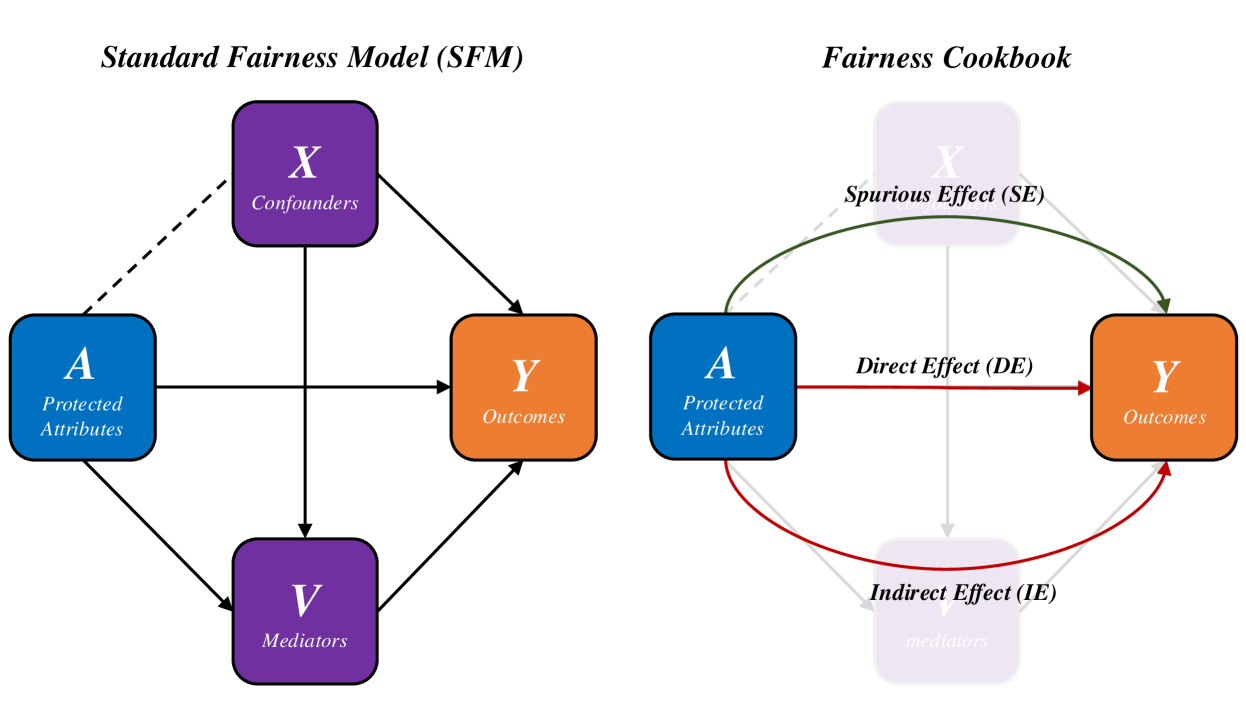
The image presents two side-by-side causal diagrams illustrating different conceptual frameworks for analyzing fairness in machine learning systems. The left diagram is labeled "Standard Fairness Model (SFM)" and the right is labeled "Fairness Cookbook." Both diagrams use nodes (boxes) to represent variables and directed arrows to represent causal or influential relationships. The diagrams aim to decompose the influence of protected attributes on outcomes.
### Components/Axes
**Left Diagram: Standard Fairness Model (SFM)**
* **Nodes (Boxes):**
* **A**: Blue box, labeled "Protected Attributes". Positioned center-left.
* **X**: Purple box, labeled "Confounders". Positioned top-center.
* **V**: Purple box, labeled "Mediators". Positioned bottom-center.
* **Y**: Orange box, labeled "Outcomes". Positioned center-right.
* **Edges (Arrows):**
* Solid black arrow from **A** to **Y** (direct path).
* Solid black arrow from **A** to **V**.
* Solid black arrow from **V** to **Y**.
* Solid black arrow from **X** to **A**.
* Solid black arrow from **X** to **Y**.
* Solid black arrow from **X** to **V**.
* Dashed black line between **A** and **X** (indicating a potential association or unmeasured confounding).
**Right Diagram: Fairness Cookbook**
* **Nodes (Boxes):**
* **A**: Blue box, labeled "Protected Attributes". Positioned center-left.
* **Y**: Orange box, labeled "Outcomes". Positioned center-right.
* **X**: Faded purple box, labeled "X". Positioned top-center. The label "Spurious Effect (SE)" is placed directly below this box.
* **mediators**: Faded purple box, labeled "mediators" (lowercase). Positioned bottom-center. The label "Indirect Effect (IE)" is placed directly above this box.
* **Edges (Arrows) & Labeled Effects:**
* **Direct Effect (DE)**: A solid red arrow pointing directly from **A** to **Y**.
* **Spurious Effect (SE)**: A solid green, curved arrow originating from the area of **A**, arcing over the top, and pointing to **Y**. It passes near the faded **X** node.
* **Indirect Effect (IE)**: A solid red, curved arrow originating from **A**, arcing under the bottom, and pointing to **Y**. It passes through the faded **mediators** node.
* Faded grey arrows show the underlying causal structure from the SFM: from **A** to mediators, from mediators to **Y**, from **X** to **A**, **Y**, and mediators.
### Detailed Analysis
The diagrams visually decompose the total effect of Protected Attributes (**A**) on Outcomes (**Y**) into distinct pathways.
**Standard Fairness Model (SFM):**
This model presents a comprehensive causal graph. The total effect of **A** on **Y** flows through three primary routes:
1. **Direct Path**: A → Y.
2. **Indirect Path via Mediators**: A → V → Y.
3. **Confounded Paths**: The relationship between **A** and **Y** is also influenced by **X** (Confounders), which affects both **A** and **Y** directly, and also affects the mediators **V**. The dashed line between **A** and **X** suggests they may be associated through unmeasured common causes.
**Fairness Cookbook:**
This model simplifies the SFM to highlight three specific effect types relevant for fairness auditing:
1. **Direct Effect (DE)**: Represented by the straight red arrow. This is the effect of **A** on **Y** that is not mediated by any other variable in the model.
2. **Spurious Effect (SE)**: Represented by the green curved arrow. This captures the non-causal association between **A** and **Y** that arises due to common causes (the confounders **X**). It is "spurious" because it does not represent a causal influence of **A** on **Y**.
3. **Indirect Effect (IE)**: Represented by the lower red curved arrow. This is the effect of **A** on **Y** that is channeled through the mediator variables.
The faded nodes for **X** and **mediators** in the Fairness Cookbook indicate that this framework focuses on the *types of effects* rather than the specific intermediate variables.
### Key Observations
1. **Color Coding Consistency**: Blue is consistently used for the Protected Attribute node (**A**), and orange for the Outcome node (**Y**) across both diagrams.
2. **Effect Decomposition**: The Fairness Cookbook explicitly labels and color-codes the three decomposed effects (DE, SE, IE), making the conceptual breakdown clear. The Direct and Indirect effects are both red, while the Spurious effect is green.
3. **Visual Abstraction**: The Fairness Cookbook abstracts away the detailed structure of confounders and mediators (shown as faded boxes) to emphasize the high-level effect categories.
4. **Arrow Semantics**: Solid arrows in the SFM represent hypothesized causal pathways. In the Fairness Cookbook, the solid colored arrows represent the *decomposed effect components*, while the faded grey arrows retain the underlying causal structure for reference.
### Interpretation
These diagrams illustrate a shift in thinking from a purely causal graph representation (SFM) to a framework designed for fairness analysis (Fairness Cookbook).
* **What the data suggests**: The comparison demonstrates that a "fair" model assessment requires disentangling the direct influence of protected attributes (like race or gender) on outcomes from influences that are indirect (through legitimate mediators) or spurious (due to historical bias encoded in confounders).
* **How elements relate**: The Fairness Cookbook is derived from the SFM. It maps the complex web of relationships in the SFM onto three interpretable effect types. The **Direct Effect (DE)** is often the primary focus for detecting algorithmic discrimination. The **Indirect Effect (IE)** can be legitimate (e.g., education mediating the effect of age on income) or problematic. The **Spurious Effect (SE)** highlights how bias can enter a model through confounding variables that are correlated with both the protected attribute and the outcome.
* **Notable implications**: The framework implies that simply removing the protected attribute **A** from a model (a practice known as "fairness through unawareness") is insufficient. This is because the **Spurious Effect (SE)** through confounders **X** and the **Indirect Effect (IE)** through mediators **V** can still allow the influence of **A** to permeate the model's predictions. True fairness auditing requires methods to estimate and account for these distinct pathways, as visualized in the Fairness Cookbook decomposition. The faded nodes suggest that for the purpose of high-level fairness metrics, the specific identity of confounders and mediators may be less important than quantifying the magnitude of the SE, DE, and IE pathways.
DECODING INTELLIGENCE...