## Diagram: Fairness Modeling Frameworks
### Overview
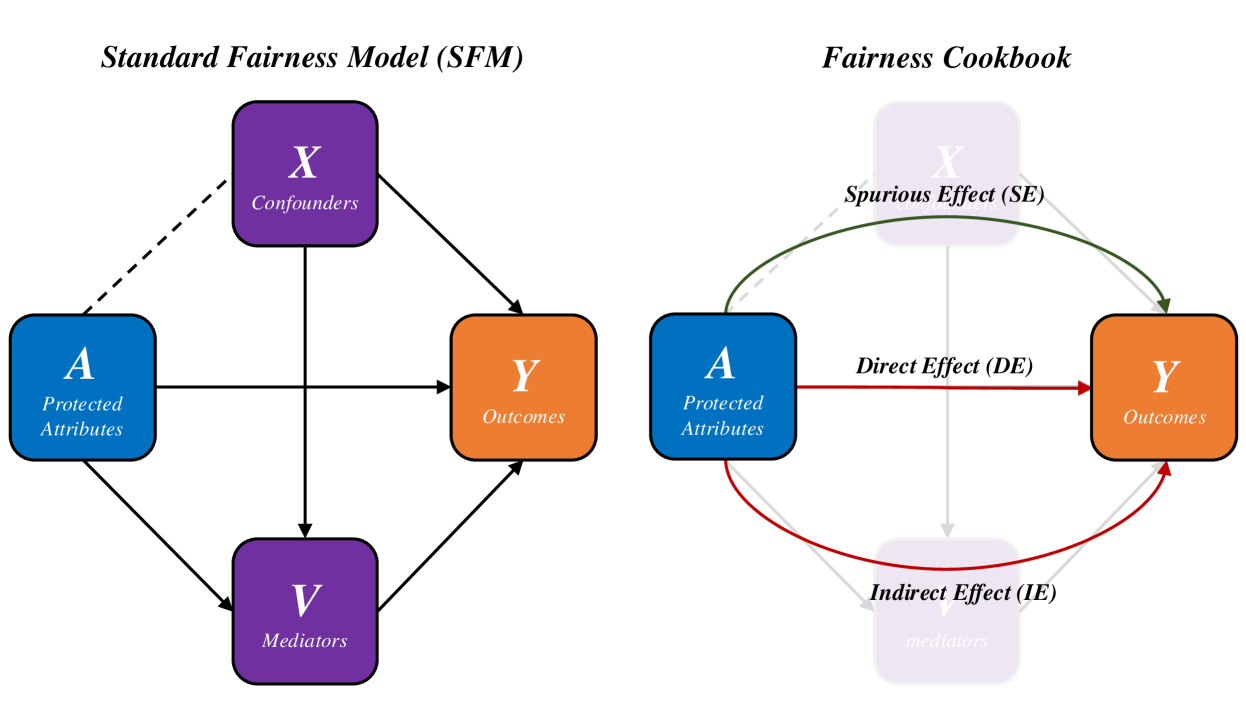
The image presents two interconnected diagrams illustrating fairness modeling concepts:
1. **Standard Fairness Model (SFM)** (left)
2. **Fairness Cookbook** (right)
Both diagrams use color-coded nodes (blue, purple, orange) and directional arrows to represent relationships between variables.
---
### Components/Axes
#### Standard Fairness Model (SFM)
- **Nodes**:
- **A**: Protected Attributes (blue)
- **X**: Confounders (purple)
- **V**: Mediators (purple)
- **Y**: Outcomes (orange)
- **Connections**:
- Dashed lines between **A** ↔ **X** and **A** ↔ **V**
- Solid lines: **V** → **Y**, **X** → **Y**
#### Fairness Cookbook
- **Nodes**:
- **A**: Protected Attributes (blue)
- **Y**: Outcomes (orange)
- **X**: Confounders/Mediators (purple, background)
- **Connections**:
- Red arrow: **A** → **Y** (Direct Effect, DE)
- Green arrow: **Y** → **A** (Spurious Effect, SE)
- Dashed green arrow: **A** → **Y** (Indirect Effect, IE)
---
### Detailed Analysis
#### Standard Fairness Model (SFM)
- **Protected Attributes (A)** influence **Confounders (X)** and **Mediators (V)** via dashed lines, suggesting latent or indirect relationships.
- **Mediators (V)** directly affect **Outcomes (Y)**.
- **Confounders (X)** also directly influence **Outcomes (Y)**, creating potential bias pathways.
#### Fairness Cookbook
- **Direct Effect (DE)**: Explicit causal link from **A** to **Y** (red arrow).
- **Indirect Effect (IE)**: Dashed green arrow from **A** to **Y** via mediators (**X**).
- **Spurious Effect (SE)**: Reverse causal arrow from **Y** to **A** (green), indicating potential feedback loops or measurement errors.
---
### Key Observations
1. **SFM** emphasizes structural relationships between protected attributes, confounders, mediators, and outcomes.
2. **Cookbook** highlights causal pathways (DE/IE) and unintended feedback (SE), critical for bias mitigation.
3. **Mediators (V)** act as intermediaries in both models but are visually deemphasized in the Cookbook.
---
### Interpretation
- The **SFM** provides a foundational framework for understanding how protected attributes propagate through systems via confounders and mediators.
- The **Cookbook** operationalizes fairness by quantifying direct/indirect effects and identifying spurious correlations, which are critical for auditing algorithmic fairness.
- The **Spurious Effect (SE)** in the Cookbook warns against reverse causality assumptions, a common pitfall in fairness audits.
- **Mediators (V)** are central to both models but require explicit modeling to avoid oversimplification of causal pathways.
This dual-diagram approach bridges theoretical fairness concepts (SFM) with practical causal analysis (Cookbook), essential for developing robust fairness-aware algorithms.