## Chart: Timeline of AI Agent Research Papers (2021-2023)
### Overview
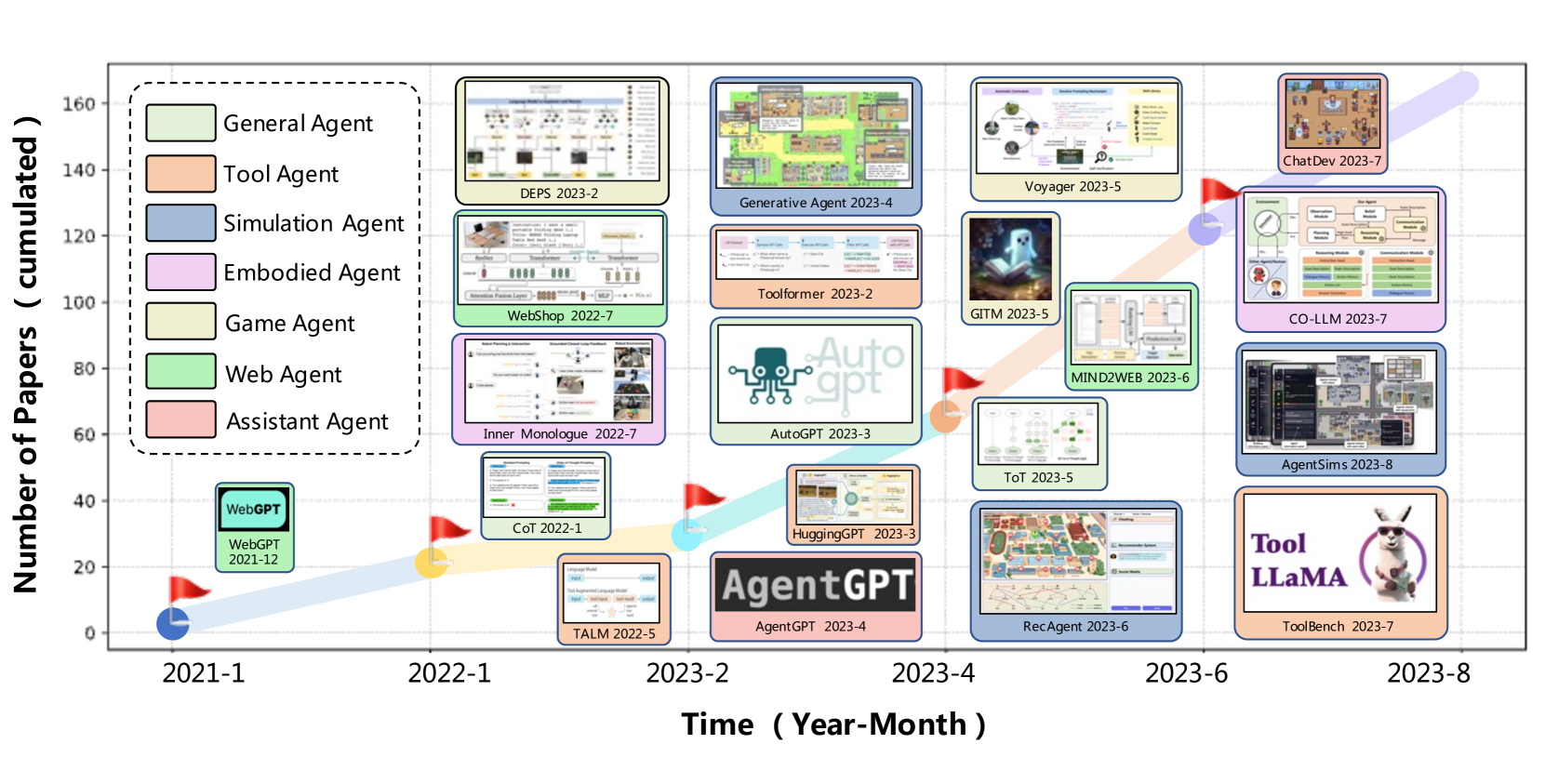
This image is a cumulative timeline chart illustrating the growth of research papers focused on AI Agents from January 2021 to August 2023. The chart uses a scatter-plot style overlay on an upward-sloping trend line to represent the cumulative number of papers published over time. Each data point is represented by a thumbnail image of the respective research paper, color-coded by the type of agent described.
### Components/Axes
* **Y-Axis:** "Number of Papers (cumulated)". The scale ranges from 0 to 160.
* **X-Axis:** "Time (Year-Month)". The scale ranges from 2021-1 to 2023-8.
* **Legend (Top-Left, inside a dashed box):**
* **General Agent:** Pale Green
* **Tool Agent:** Pale Orange
* **Simulation Agent:** Pale Blue
* **Embodied Agent:** Pale Purple
* **Game Agent:** Pale Yellow
* **Web Agent:** Pale Green (Note: Visually identical to General Agent)
* **Assistant Agent:** Pale Pink (Note: No data points in the chart appear to use this color)
* **Trend Line:** A light blue-to-purple gradient line sloping upward from bottom-left to top-right, indicating the cumulative growth of publications.
* **Markers:** Red flag icons are placed at specific intervals along the trend line, likely indicating milestones or checkpoints in the cumulative count.
### Detailed Analysis
The chart displays a clear exponential growth trend. The cumulative count starts at approximately 5 papers in early 2021 and reaches approximately 160 papers by August 2023.
**Chronological Data Points (Approximate Values):**
| Date | Paper Title | Agent Type (Color) | Approx. Cumulative Papers |
| :--- | :--- | :--- | :--- |
| 2021-12 | WebGPT | Web Agent (Green) | ~10 |
| 2022-1 | CoT | Simulation Agent (Blue) | ~20 |
| 2022-5 | TALM | Tool Agent (Orange) | ~25 |
| 2022-7 | WebShop | Web Agent (Green) | ~30 |
| 2022-7 | Inner Monologue | Embodied Agent (Purple) | ~30 |
| 2023-2 | DEPS | Game Agent (Yellow) | ~45 |
| 2023-2 | Toolformer | Tool Agent (Orange) | ~45 |
| 2023-3 | AutoGPT | Web Agent (Green) | ~60 |
| 2023-3 | HuggingGPT | Tool Agent (Orange) | ~60 |
| 2023-4 | AgentGPT | Tool Agent (Orange) | ~70 |
| 2023-4 | Generative Agent | Simulation Agent (Blue) | ~70 |
| 2023-5 | Voyager | Game Agent (Yellow) | ~90 |
| 2023-5 | GITM | Simulation Agent (Blue) | ~90 |
| 2023-5 | ToT | Simulation Agent (Blue) | ~90 |
| 2023-6 | MIND2WEB | Web Agent (Green) | ~120 |
| 2023-6 | RecAgent | Simulation Agent (Blue) | ~120 |
| 2023-7 | ChatDev | Game Agent (Yellow) | ~140 |
| 2023-7 | CO-LLM | Embodied Agent (Purple) | ~140 |
| 2023-7 | ToolBench | Tool Agent (Orange) | ~140 |
| 2023-8 | AgentSims | Simulation Agent (Blue) | ~160 |
### Key Observations
* **Acceleration:** The density of paper publications increases dramatically in 2023. While 2021 and 2022 show sparse, isolated publications, 2023 shows clusters of multiple papers being released in the same month.
* **Dominant Categories:** "Simulation Agents" (Blue) and "Tool Agents" (Orange) are the most frequently represented categories in the latter half of the timeline (2023).
* **Visual Clustering:** The chart groups papers by month, suggesting that the "cumulative" nature of the chart is stepped rather than a smooth curve, though the trend line smooths this out.
* **Legend Ambiguity:** The "General Agent" and "Web Agent" categories share the same pale green color, making it difficult to distinguish between them without reading the specific paper titles.
### Interpretation
The data demonstrates a "Cambrian explosion" of AI Agent research. The transition from 2021 to 2023 marks a shift from foundational concepts (like WebGPT and CoT) to highly specialized applications (like ToolBench, AgentSims, and ChatDev).
The clustering of papers in 2023 suggests that the field reached a critical mass of interest, likely triggered by the release of powerful Large Language Models (LLMs) that enabled the "Agent" paradigm. The prevalence of "Tool" and "Simulation" agents indicates that the research community is heavily focused on moving LLMs from passive text generators to active entities capable of interacting with external software environments (tools) and virtual worlds (simulations). The chart serves as a visual history of the rapid maturation of autonomous AI systems.