\n
## Chart: Agent Landscape Evolution (2021-2023)
### Overview
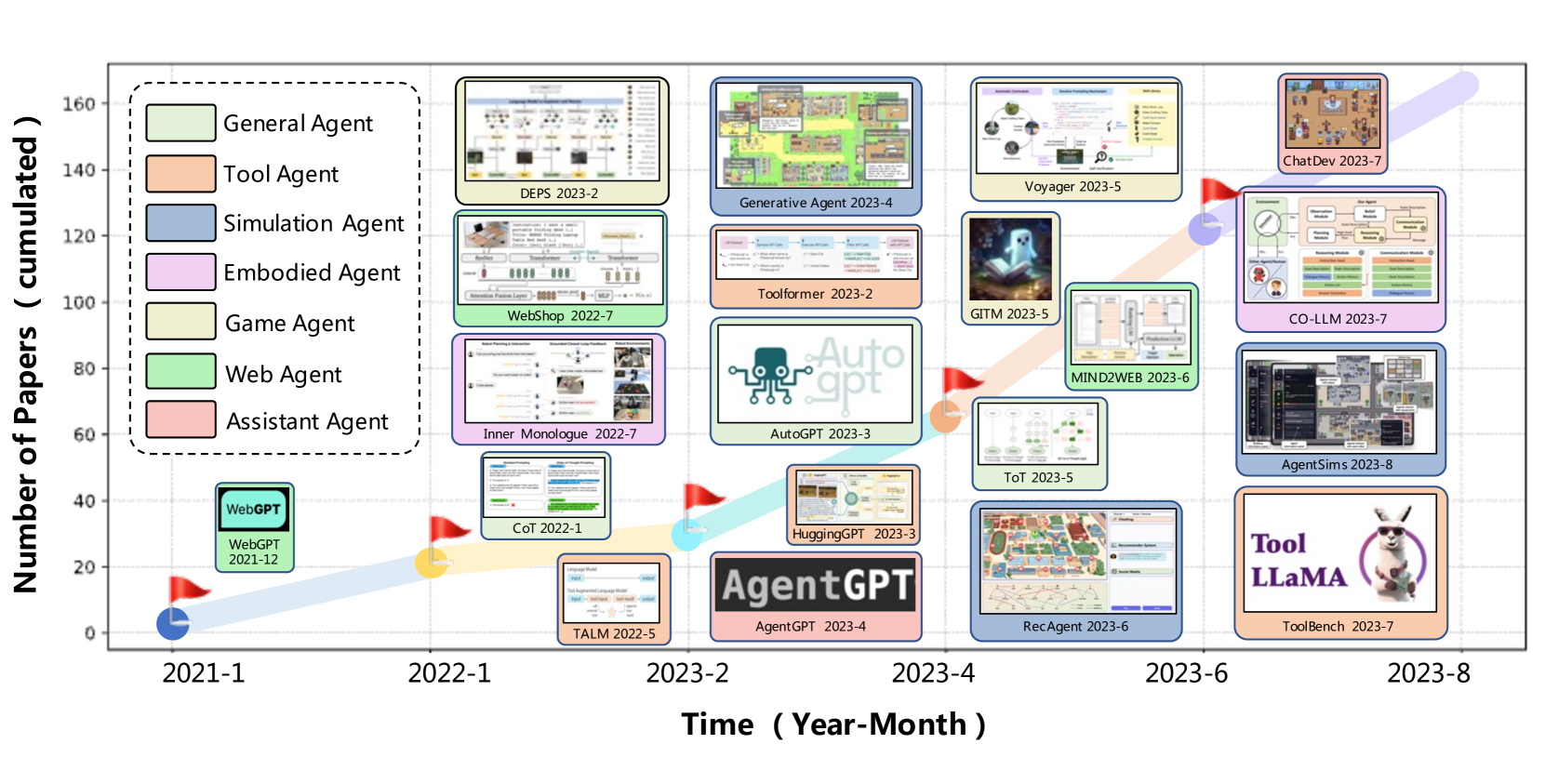
The image presents a time-series chart illustrating the growth in the number of research papers published across different agent categories from 2021-1 to 2023-8. The chart uses colored lines to represent the cumulative number of papers for each agent type, overlaid with representative images of specific projects within each category at different time points. The chart is segmented into agent categories along the y-axis, and time is represented on the x-axis.
### Components/Axes
* **X-axis:** Time (Year-Month), ranging from approximately 2021-1 to 2023-8.
* **Y-axis:** Number of Papers (cumulative), ranging from 0 to 160.
* **Agent Categories (Y-axis labels):**
* Assistant Agent (light blue)
* Web Agent (orange)
* Game Agent (green)
* Embodied Agent (purple)
* Simulation Agent (dark blue)
* Tool Agent (red)
* General Agent (gray)
* **Legend:** Implicitly defined by the line colors and agent category labels on the y-axis.
* **Images:** Representative project images are scattered across the chart, indicating specific projects within each agent category at a given time.
### Detailed Analysis or Content Details
The chart shows the following trends:
* **Assistant Agent (light blue):** Starts at approximately 10 papers in 2021-12 (WebGPT 2021-12), increases slowly to around 20 papers by 2022-1, then plateaus.
* **Web Agent (orange):** Begins around 15 papers in 2021-12 (WebGPT 2021-12), shows a moderate increase to approximately 40 papers by 2022-1, then a steeper increase to around 80 papers by 2023-2, and continues to grow to approximately 120 papers by 2023-8.
* **Game Agent (green):** Starts at approximately 20 papers in 2022-7 (WebShop 2022-7), increases to around 40 papers by 2023-2 (Toolformer 2023-2), and reaches approximately 60 papers by 2023-8.
* **Embodied Agent (purple):** Starts at approximately 30 papers in 2022-7 (WebShop 2022-7), increases to around 60 papers by 2023-2 (Generative Agent 2023-4), and reaches approximately 90 papers by 2023-8.
* **Simulation Agent (dark blue):** Starts at approximately 40 papers in 2022-1 (Inner Monologue 2022-7), increases to around 80 papers by 2023-2 (AutoGPT 2023-3), and reaches approximately 120 papers by 2023-8.
* **Tool Agent (red):** Starts at approximately 50 papers in 2023-2 (DEPS 2023-2), increases rapidly to around 100 papers by 2023-4 (AgentGPT 2023-4), and reaches approximately 140 papers by 2023-8.
* **General Agent (gray):** Starts at approximately 60 papers in 2023-5 (Voyager 2023-5), increases to around 100 papers by 2023-6 (MIND2WEB 2023-6), and reaches approximately 160 papers by 2023-8.
**Specific Project Images and Dates:**
* WebGPT 2021-12
* CoT 2022-1
* TALM 2022-5
* WebShop 2022-7
* Inner Monologue 2022-7
* DEPS 2023-2
* Toolformer 2023-2
* AutoGPT 2023-3
* AgentGPT 2023-4
* Generative Agent 2023-4
* Voyager 2023-5
* RecAgent 2023-6
* GTM 2023-5
* MIND2WEB 2023-6
* HuggingGPT 2023-3
* ToT 2023-5
* ChatDev 2023-7
* CO-LLM 2023-7
* AgentSims 2023-8
* Tool LLaMA
* ToolBench 2023-7
### Key Observations
* The Tool Agent category exhibits the most rapid growth in the number of papers, particularly after 2023-2.
* The Web Agent category shows consistent growth throughout the period.
* The Assistant Agent category shows the least amount of growth.
* The General Agent category shows significant growth in the later part of the period (2023-5 onwards).
* There is a clear trend of increasing research activity in all agent categories over time.
### Interpretation
The chart demonstrates a significant increase in research and development related to intelligent agents between 2021 and 2023. The rapid growth in the Tool Agent category suggests a growing interest in agents capable of utilizing external tools to enhance their capabilities. The consistent growth in the Web Agent category indicates ongoing efforts to improve agents' ability to interact with and navigate the web. The relatively slower growth in the Assistant Agent category might suggest that this area is more mature or that research efforts have shifted towards other agent types. The placement of project images alongside the lines provides a visual timeline of key developments within each category. The overall trend indicates a dynamic and rapidly evolving field with increasing investment in various agent technologies. The chart suggests a shift from basic assistant agents towards more complex agents capable of interacting with the real world (Embodied Agents), simulating environments (Simulation Agents), and utilizing tools (Tool Agents). The emergence of "General Agents" towards the end of the period suggests a move towards more versatile and adaptable AI systems.