## Timeline Chart: Cumulative Publication of AI Agent Research Papers (2021-2023)
### Overview
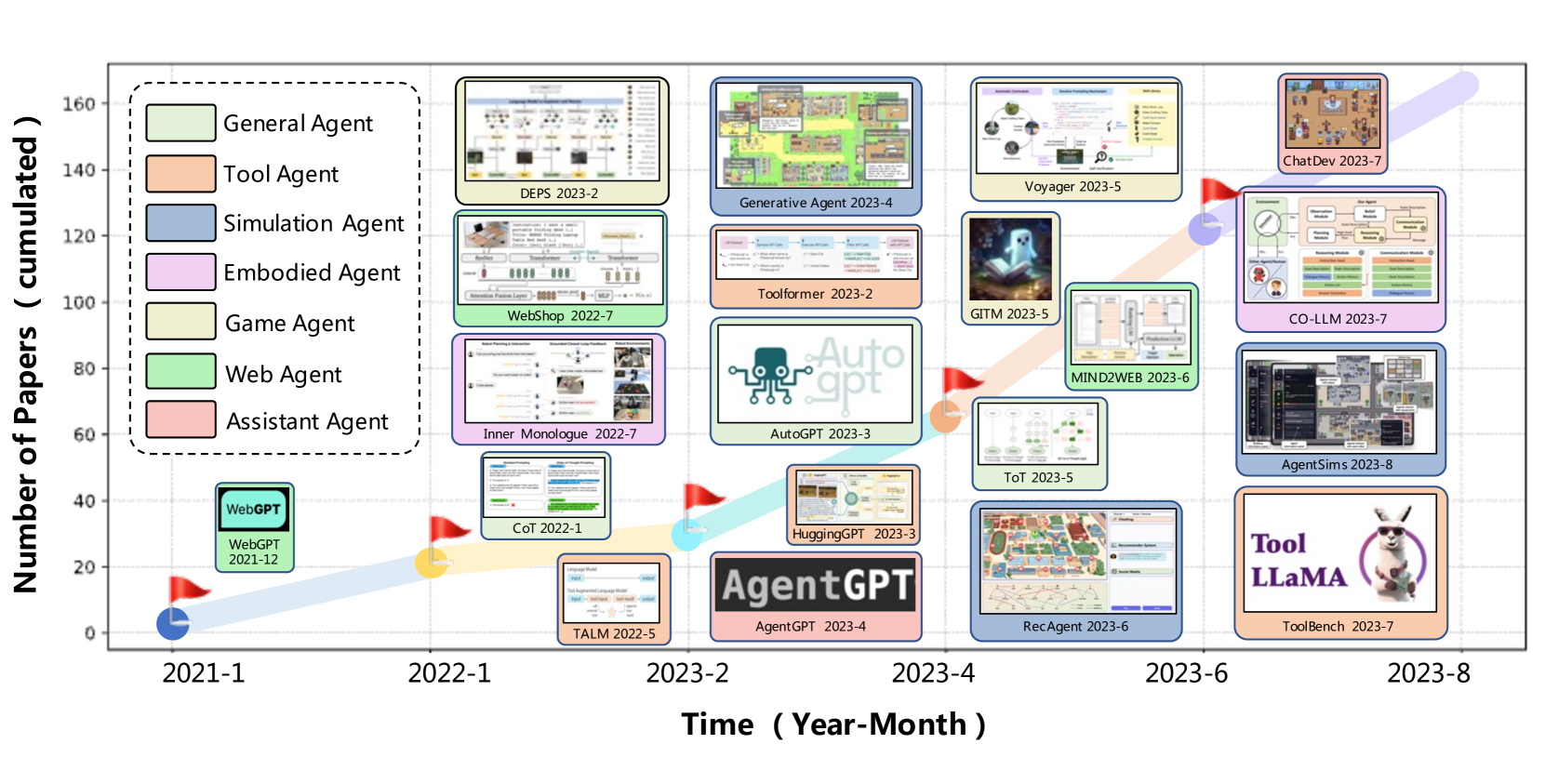
This image is a timeline chart illustrating the cumulative growth in the number of research papers published across seven distinct categories of AI agents from January 2021 to August 2023. The chart plots time on the horizontal axis against the cumulative number of papers on the vertical axis. Key research papers are represented as thumbnail images placed at their respective publication dates, with their titles and dates labeled. A colored, semi-transparent trend line connects the cumulative data points, showing an accelerating upward trajectory.
### Components/Axes
* **Y-Axis (Vertical):** Labeled "Number of Papers (cumulated)". The scale runs from 0 to 160, with major tick marks every 20 units (0, 20, 40, 60, 80, 100, 120, 140, 160).
* **X-Axis (Horizontal):** Labeled "Time (Year-Month)". The timeline is marked with specific points: 2021-1, 2022-1, 2023-2, 2023-4, 2023-6, 2023-8.
* **Legend (Top-Left):** A dashed-border box contains seven color-coded categories of AI agents:
* **General Agent** (Light Green)
* **Tool Agent** (Light Orange)
* **Simulation Agent** (Light Blue)
* **Embodied Agent** (Light Purple)
* **Game Agent** (Light Yellow)
* **Web Agent** (Light Green - a different shade from General Agent)
* **Assistant Agent** (Light Pink)
* **Data Series & Thumbnails:** The chart features 18 labeled paper thumbnails, each placed at its publication date and color-coded according to the legend. A thick, semi-transparent, light blue trend line connects the cumulative data points, starting near 0 in early 2021 and rising to approximately 160 by mid-2023. Small red flags mark specific points along this trend line.
### Detailed Analysis
**Paper Timeline and Categorization (Listed Chronologically):**
1. **WebGPT (2021-12):** Positioned at the far left, near the 0-20 range on the y-axis. Color: **Web Agent** (Light Green).
2. **CoT (2022-1):** Placed shortly after WebGPT. Color: **General Agent** (Light Green).
3. **WebShop (2022-7):** Positioned above CoT. Color: **Web Agent** (Light Green).
4. **Inner Monologue (2022-7):** Placed below WebShop. Color: **Embodied Agent** (Light Purple).
5. **TALM (2022-5):** Positioned lower on the timeline, between CoT and WebShop. Color: **Tool Agent** (Light Orange).
6. **DEPS (2023-2):** Located in the upper-left quadrant. Color: **Simulation Agent** (Light Blue).
7. **Toolformer (2023-2):** Placed to the right of DEPS. Color: **Tool Agent** (Light Orange).
8. **Generative Agent (2023-4):** Positioned above Toolformer. Color: **Simulation Agent** (Light Blue).
9. **AutoGPT (2023-3):** Located below Generative Agent. Color: **General Agent** (Light Green).
10. **AgentGPT (2023-4):** Placed below AutoGPT. Color: **Assistant Agent** (Light Pink).
11. **HuggingGPT (2023-3):** Positioned to the left of AgentGPT. Color: **Assistant Agent** (Light Pink).
12. **GITM (2023-5):** Located in the upper-middle section. Color: **General Agent** (Light Green).
13. **Voyager (2023-5):** Placed above GITM. Color: **Game Agent** (Light Yellow).
14. **ToT (2023-5):** Positioned below GITM. Color: **General Agent** (Light Green).
15. **MIND2WEB (2023-6):** Located to the right of GITM. Color: **Web Agent** (Light Green).
16. **RecAgent (2023-6):** Placed below ToT. Color: **Simulation Agent** (Light Blue).
17. **ChatDev (2023-7):** Positioned in the top-right corner. Color: **General Agent** (Light Green).
18. **CO-LLM (2023-7):** Placed below ChatDev. Color: **Embodied Agent** (Light Purple).
19. **AgentSims (2023-8):** Located below CO-LLM. Color: **Simulation Agent** (Light Blue).
20. **ToolBench (2023-7):** Positioned in the bottom-right corner. Color: **Tool Agent** (Light Orange).
**Cumulative Trend:** The light blue trend line shows a shallow slope from 2021 through early 2022, indicating slow initial growth. The slope steepens significantly from mid-2022 onward, becoming very steep through 2023, demonstrating an exponential increase in published papers. The final data point aligns with approximately 160 cumulative papers by August 2023.
### Key Observations
1. **Exponential Growth:** The field experienced a dramatic acceleration in research output, particularly from the second half of 2022 through 2023.
2. **Category Distribution:** **General Agent** (e.g., CoT, AutoGPT, ToT, GITM, ChatDev) and **Tool Agent** (e.g., TALM, Toolformer, ToolBench) appear most frequently among the highlighted papers. **Simulation Agent** (e.g., DEPS, Generative Agent, RecAgent, AgentSims) also has a strong presence.
3. **Temporal Clustering:** A significant cluster of influential papers (Generative Agent, Toolformer, AutoGPT, AgentGPT, HuggingGPT) emerged in the first half of 2023 (Q1-Q2 2023).
4. **Late Entrants:** **Game Agent** (Voyager) and **Embodied Agent** (Inner Monologue, CO-LLM) categories have fewer highlighted papers but appear in the later stages of the timeline.
### Interpretation
This chart visually documents the "Cambrian explosion" of AI agent research following the widespread adoption of advanced large language models (LLMs). The data suggests a field moving from foundational concepts (like WebGPT and Chain-of-Thought in 2021-2022) to a rapid proliferation of specialized agent architectures and frameworks in 2023.
The dominance of **General** and **Tool** agent papers indicates a primary research focus on creating autonomous systems that can reason and utilize external APIs or software. The rise of **Simulation** agents points to growing interest in creating complex, interactive environments for training and evaluating agents. The clustering of papers in mid-2023 likely reflects a feedback loop where new agent frameworks (like AutoGPT) inspired further research and derivative works.
The chart is not a comprehensive bibliography but a curated timeline of landmark projects. The steep cumulative curve implies that the total volume of research in this domain is growing at an unsustainable pace, potentially leading to a consolidation phase or a shift towards more specialized, application-driven research in the near future. The visual narrative is one of explosive innovation and intense academic and industrial interest in autonomous AI systems.