## Bar Charts: Performance Comparison of Manual Effort vs. APTPU-Gen
### Overview
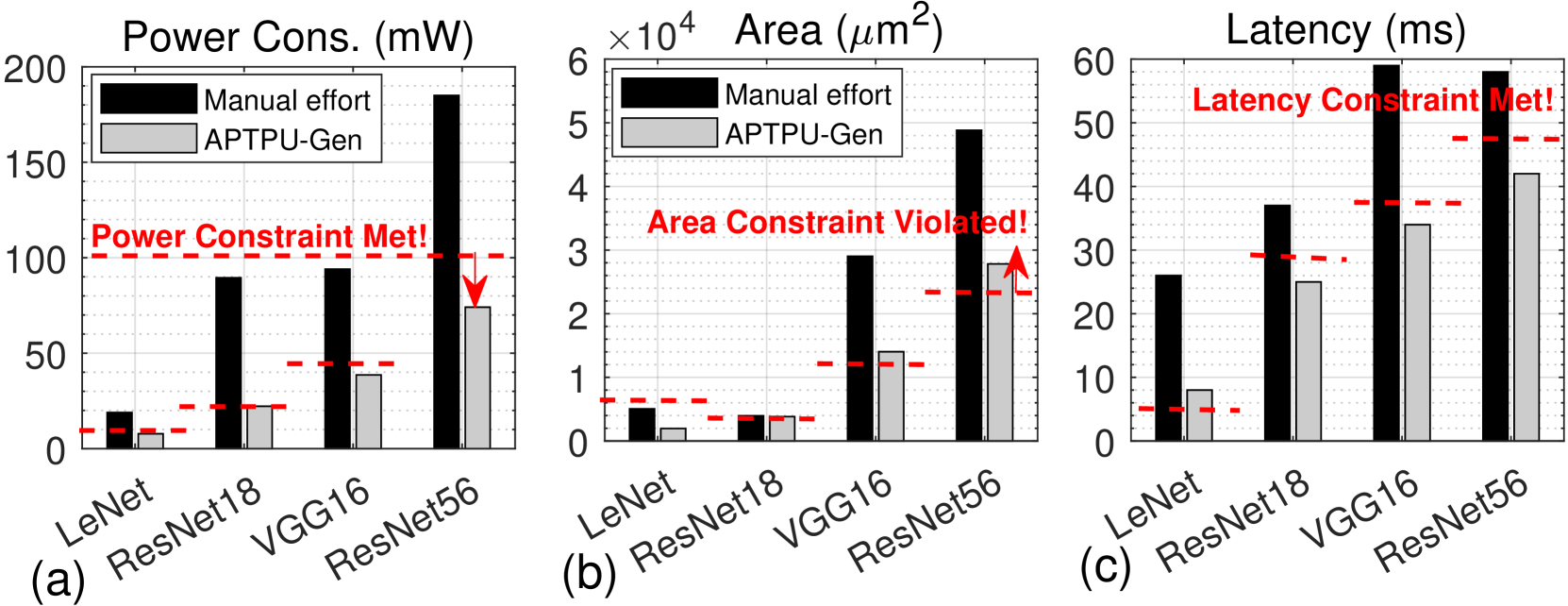
This image displays three grouped bar charts labeled (a), (b), and (c), comparing the performance of two design methodologies—"Manual effort" (black bars) and "APTPU-Gen" (grey bars)—across four neural network models: LeNet, ResNet18, VGG16, and ResNet56. The charts evaluate three metrics: Power Consumption, Area, and Latency. Red dashed lines indicate specific design constraints for each model.
### Components/Axes
* **Common Elements:**
* **X-axis:** Lists the four models: LeNet, ResNet18, VGG16, ResNet56.
* **Legend:** Located at the top-left of each chart. Black box = "Manual effort"; Grey box = "APTPU-Gen".
* **Chart (a) - Power Cons. (mW):**
* **Y-axis:** Power Consumption in milliwatts (mW), ranging from 0 to 200.
* **Annotation:** "Power Constraint Met!" with a red dashed line at 100 mW.
* **Chart (b) - Area ($\mu m^2$):**
* **Y-axis:** Area in square micrometers ($\mu m^2$), ranging from 0 to 6, with a multiplier of $\times 10^4$.
* **Annotation:** "Area Constraint Violated!" with stepped red dashed lines indicating specific constraints per model.
* **Chart (c) - Latency (ms):**
* **Y-axis:** Latency in milliseconds (ms), ranging from 0 to 60.
* **Annotation:** "Latency Constraint Met!" with stepped red dashed lines indicating specific constraints per model.
### Detailed Analysis
#### (a) Power Cons. (mW)
* **Trend:** Power consumption increases as the model complexity increases (from LeNet to ResNet56). In all cases, APTPU-Gen results in significantly lower power consumption than Manual effort.
* **Data Points (Approximate):**
* **LeNet:** Manual ~20 mW, APTPU-Gen ~10 mW.
* **ResNet18:** Manual ~90 mW, APTPU-Gen ~25 mW.
* **VGG16:** Manual ~95 mW, APTPU-Gen ~40 mW.
* **ResNet56:** Manual ~185 mW, APTPU-Gen ~75 mW.
* **Constraint:** The constraint is set at 100 mW. Manual effort violates this at ResNet56. APTPU-Gen remains below the constraint for all models.
#### (b) Area ($\mu m^2$)
* **Trend:** Area usage scales with model complexity. APTPU-Gen consistently produces a smaller area footprint than Manual effort.
* **Data Points (Approximate, $\times 10^4$):**
* **LeNet:** Manual ~0.5, APTPU-Gen ~0.2.
* **ResNet18:** Manual ~0.4, APTPU-Gen ~0.4.
* **VGG16:** Manual ~2.9, APTPU-Gen ~1.4.
* **ResNet56:** Manual ~4.9, APTPU-Gen ~2.8.
* **Constraint:** The constraint lines are stepped. Manual effort violates the constraint at VGG16 and ResNet56. APTPU-Gen remains below the constraint for all models.
#### (c) Latency (ms)
* **Trend:** Latency increases with model complexity. APTPU-Gen consistently achieves lower latency than Manual effort.
* **Data Points (Approximate):**
* **LeNet:** Manual ~26 ms, APTPU-Gen ~8 ms.
* **ResNet18:** Manual ~37 ms, APTPU-Gen ~25 ms.
* **VGG16:** Manual ~60 ms, APTPU-Gen ~34 ms.
* **ResNet56:** Manual ~58 ms, APTPU-Gen ~42 ms.
* **Constraint:** The constraint lines are stepped. Manual effort violates the constraint at VGG16 and ResNet56. APTPU-Gen remains below the constraint for all models.
### Key Observations
* **Consistent Superiority:** APTPU-Gen (grey bars) consistently produces lower values across all three metrics (Power, Area, Latency) compared to Manual effort (black bars) for every model tested.
* **Constraint Violations:** The "Manual effort" approach fails to meet the design constraints for the more complex models (VGG16 and ResNet56) in both Area and Latency, and for ResNet56 in Power.
* **Scaling:** As model complexity increases, the gap between Manual effort and APTPU-Gen generally widens, suggesting that APTPU-Gen is significantly more effective at optimizing larger, more complex neural networks.
### Interpretation
The data demonstrates that "APTPU-Gen" is a highly effective automated optimization tool for hardware design. While "Manual effort" is sufficient for smaller, simpler models like LeNet, it fails to meet performance and resource constraints as the complexity of the neural network increases (e.g., VGG16 and ResNet56). The APTPU-Gen methodology successfully keeps all metrics within the required constraints, indicating it provides a scalable solution for hardware implementation of deep learning models where manual design becomes inefficient or unfeasible.