## Diagram: Stroke Diagnosis Procedure
### Overview
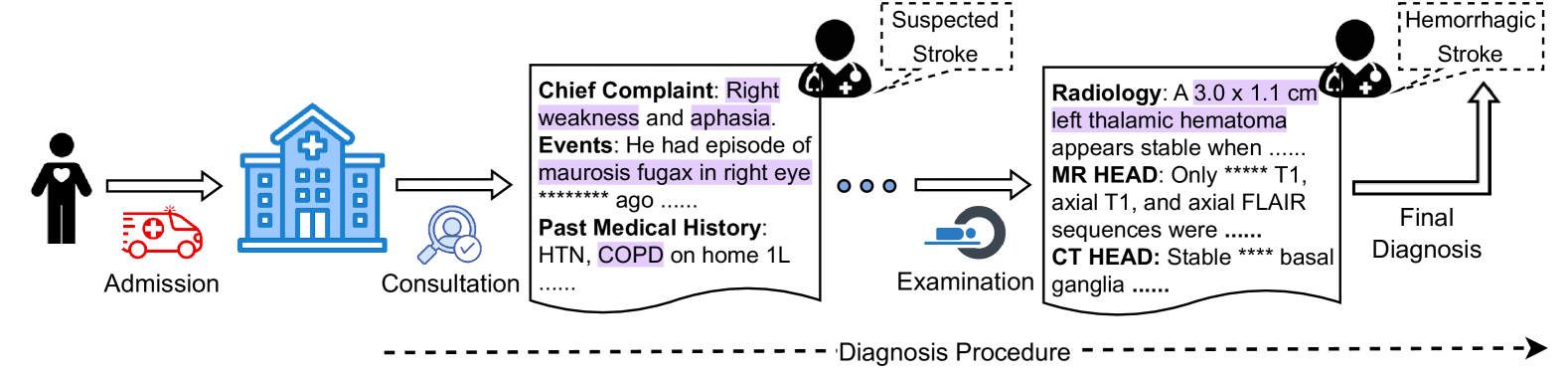
The image is a diagram illustrating the typical steps in diagnosing a stroke, starting from patient admission and ending with a final diagnosis of hemorrhagic stroke. The diagram uses icons and text to represent each stage of the process.
### Components/Axes
* **Stages:** The diagram depicts the following stages in sequence:
* Admission
* Consultation
* Examination
* Final Diagnosis
* **Textual Information:** Each stage is accompanied by relevant textual information, such as chief complaints, medical history, and radiology findings.
* **Icons:** Each stage is represented by an icon.
* **Flow:** The flow of the diagnosis procedure is indicated by arrows.
* **Labels:** "Diagnosis Procedure" is written along a dashed arrow at the bottom of the diagram.
### Detailed Analysis or ### Content Details
1. **Admission:**
* Icon: A person with a heart symbol and an ambulance.
* Text: "Admission"
2. **Consultation:**
* Icon: A hospital building and a magnifying glass over a person icon.
* Text: "Consultation"
3. **Examination:**
* Icon: A doctor icon with a speech bubble labeled "Suspected Stroke".
* Text:
* "Chief Complaint: Right weakness and aphasia."
* "Events: He had episode of maurosis fugax in right eye ******** ago ....."
* "Past Medical History: HTN, COPD on home 1L ....."
4. **Examination:**
* Icon: A CT scan machine.
* Text:
* "Radiology: A 3.0 x 1.1 cm left thalamic hematoma appears stable when ....."
* "MR HEAD: Only ***** T1, axial T1, and axial FLAIR sequences were ....."
* "CT HEAD: Stable **** basal ganglia ....."
5. **Final Diagnosis:**
* Icon: A doctor icon with a speech bubble labeled "Hemorrhagic Stroke".
* Text: "Final Diagnosis"
### Key Observations
* The diagram outlines a sequential process from initial patient admission to a final diagnosis.
* The textual information provides details about the patient's symptoms, medical history, and examination findings.
* The icons visually represent each stage of the diagnosis procedure.
### Interpretation
The diagram illustrates the steps involved in diagnosing a stroke, highlighting the importance of patient history, physical examination, and imaging studies. The progression from "Suspected Stroke" to "Hemorrhagic Stroke" suggests a diagnostic pathway based on the presented information. The diagram emphasizes the role of various medical professionals and diagnostic tools in reaching a final diagnosis.