## Diagram: Proof of Number Theory Problem
### Overview
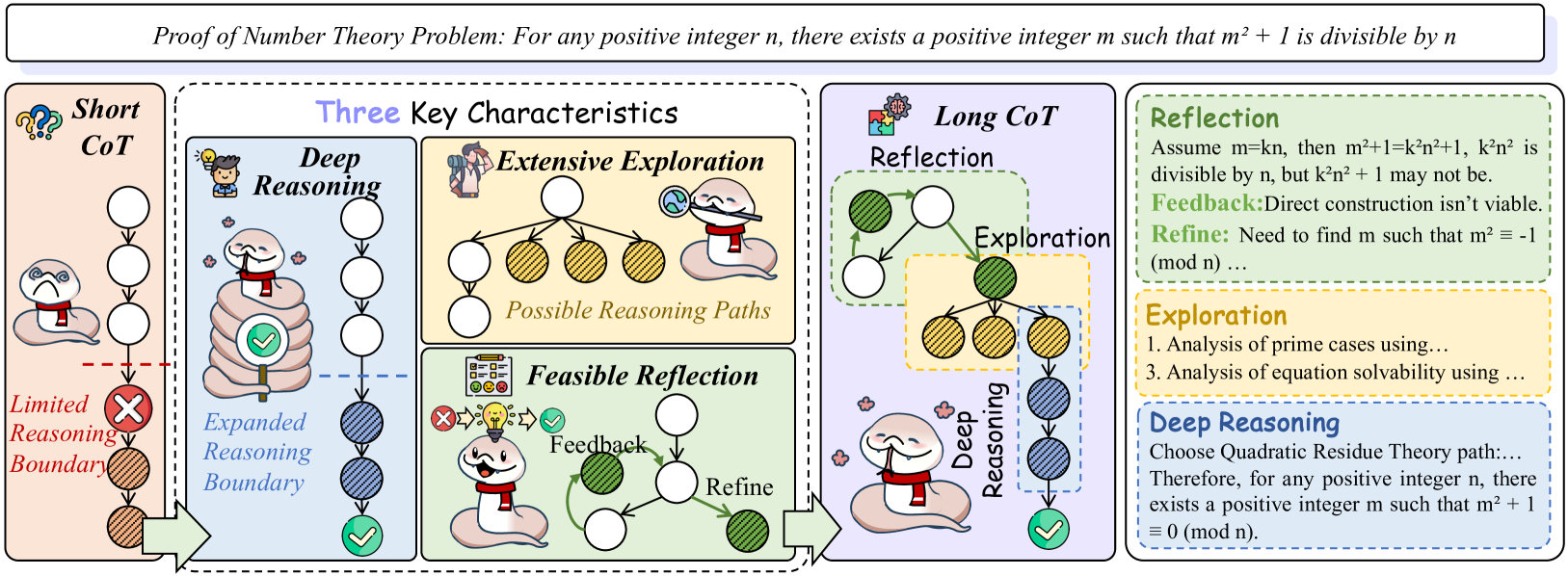
The image is a diagram illustrating the process of solving a number theory problem. It presents three key characteristics: Short Chain of Thought (CoT), Deep Reasoning, and Long CoT, with Extensive Exploration and Feasible Reflection. The diagram uses visual metaphors, such as a snake-like character, to represent the reasoning process.
### Components/Axes
The diagram is divided into three main sections, each representing a different approach to the problem:
1. **Short CoT:**
* Label: "Short CoT"
* Visual: A chain of circles connected by arrows, representing steps in the reasoning process. A snake-like character is present.
* Boundary: "Limited Reasoning Boundary" (red dashed line)
* States: Circles can be empty, have a red "X", or have brown diagonal lines.
2. **Deep Reasoning:**
* Label: "Deep Reasoning"
* Visual: A chain of circles connected by arrows, similar to "Short CoT", but with more steps. A snake-like character is present.
* Boundary: "Expanded Reasoning Boundary" (blue dashed line)
* States: Circles can be empty, have blue diagonal lines, or have a green checkmark.
3. **Long CoT:**
* Label: "Long CoT"
* Sub-sections: "Extensive Exploration" and "Feasible Reflection"
* Visual: A more complex diagram with branching paths and feedback loops. A snake-like character is present.
* Reflection: Text box with the following content:
* "Assume m=kn, then m²+1=k²n²+1, k²n² is divisible by n, but k²n² + 1 may not be."
* "Feedback: Direct construction isn't viable."
* "Refine: Need to find m such that m² ≡ -1 (mod n) ..."
* Exploration: Text box with the following content:
* "1. Analysis of prime cases using..."
* "3. Analysis of equation solvability using..."
* Deep Reasoning: Text box with the following content:
* "Choose Quadratic Residue Theory path:..."
* "Therefore, for any positive integer n, there exists a positive integer m such that m² + 1 ≡ 0 (mod n)."
### Detailed Analysis or ### Content Details
* **Short CoT:** Starts with a question mark icon, followed by a series of empty circles connected by arrows. The chain is cut short by a red dashed line labeled "Limited Reasoning Boundary". The last two circles are filled with brown diagonal lines, and the circle before them has a red "X".
* **Deep Reasoning:** Starts with a lightbulb icon, followed by a series of empty circles connected by arrows. The chain continues past the "Expanded Reasoning Boundary" (blue dashed line). The last two circles are filled with blue diagonal lines, and the final circle has a green checkmark.
* **Extensive Exploration:** Features a branching structure, with one initial circle leading to four circles filled with brown diagonal lines. The label is "Possible Reasoning Paths".
* **Feasible Reflection:** Shows a feedback loop. A circle labeled "Feedback" leads to another circle, which then leads to a circle labeled "Refine". The "Feedback" and "Refine" circles are filled with green diagonal lines.
* **Reflection (Long CoT):** Provides a mathematical argument and identifies a need to refine the approach.
* **Exploration (Long CoT):** Suggests analyzing prime cases and equation solvability.
* **Deep Reasoning (Long CoT):** Indicates the use of Quadratic Residue Theory to arrive at the solution.
### Key Observations
* The diagram contrasts the "Short CoT" approach, which is limited and unsuccessful (indicated by the red "X"), with the "Deep Reasoning" approach, which is more successful (indicated by the green checkmark).
* The "Long CoT" approach combines "Extensive Exploration" and "Feasible Reflection" to guide the reasoning process.
* The use of visual metaphors (snake-like character, lightbulb, question mark) makes the diagram more engaging and easier to understand.
### Interpretation
The diagram illustrates the importance of deep reasoning, extensive exploration, and reflection in solving complex problems. It suggests that a short, limited approach may not be sufficient, and that a more thorough and iterative process is often necessary. The "Long CoT" approach, with its emphasis on exploration and reflection, represents a more sophisticated and potentially more successful strategy. The final "Deep Reasoning" step in the "Long CoT" section highlights the importance of choosing the right theoretical framework to arrive at a solution. The diagram effectively communicates the problem-solving process in a visual and intuitive way.