\n
## Diagram: Proof of Number Theory Problem - Reasoning Pathways
### Overview
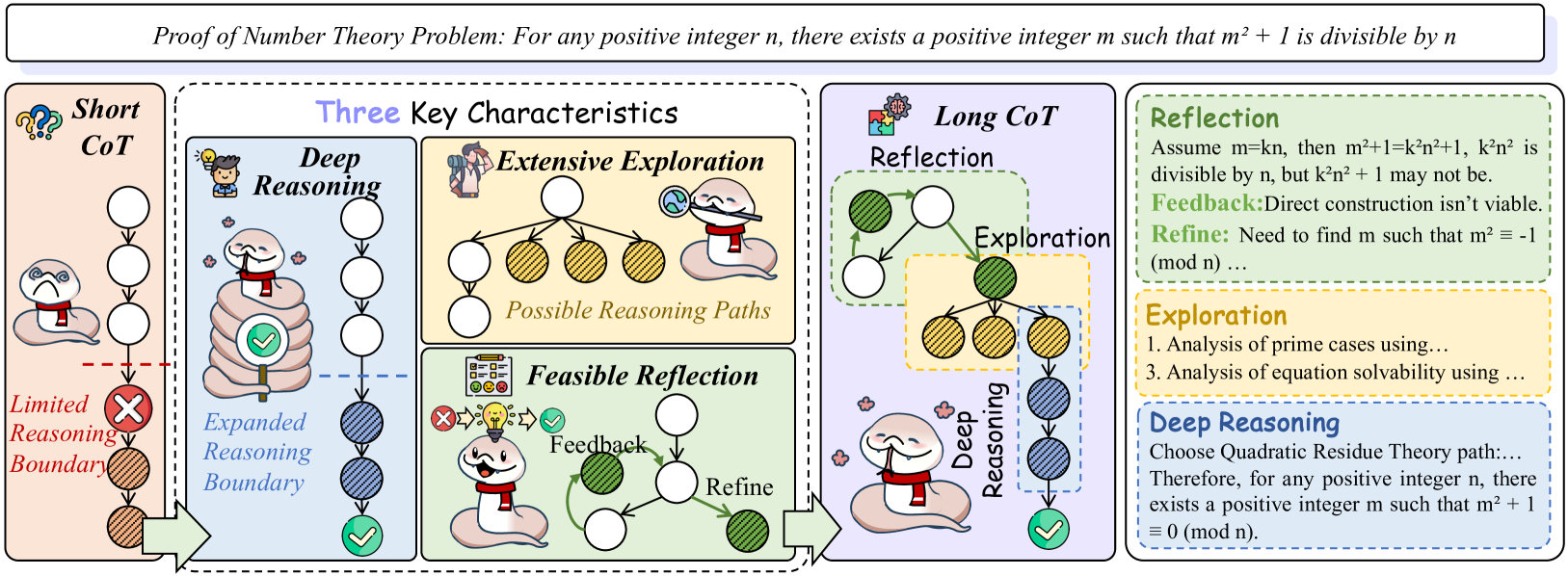
The image is a diagram illustrating different reasoning pathways for solving a number theory problem: "For any positive integer n, there exists a positive integer m such that m² + 1 is divisible by n". It contrasts "Short CoT" (Chain of Thought) with "Long CoT", highlighting three key characteristics: Deep Reasoning, Extensive Exploration, and Feasible Reflection. The diagram uses node-and-arrow representations to show the flow of reasoning, with cartoonish figures representing the "reasoner" at different stages.
### Components/Axes
The diagram is divided into four main sections, arranged horizontally:
1. **Short CoT:** Located on the far left. Includes labels "Short CoT", "Deep Reasoning", "Limited Reasoning Boundary", and "Expanded Reasoning Boundary".
2. **Three Key Characteristics:** Occupies the central portion, divided into three sub-sections: "Extensive Exploration", "Feasible Reflection", and a combined "Deep Reasoning" section.
3. **Long CoT:** Positioned on the right side. Includes labels "Long CoT", "Reflection", "Exploration", and "Deep Reasoning".
4. **Reflection/Exploration/Deep Reasoning Text Blocks:** Located on the far right, providing textual descriptions of each stage.
The diagram uses arrows to indicate the flow of reasoning. Checkmarks and "X" symbols denote success and failure, respectively. Cartoon figures are used to represent the "reasoner" in different states (thinking, exploring, reflecting).
### Detailed Analysis or Content Details
**Short CoT:**
* A single reasoning path is shown, starting with "Deep Reasoning" and leading to "Expanded Reasoning Boundary".
* A "Limited Reasoning Boundary" is depicted with a red "X" symbol, indicating a failed attempt.
* The "Expanded Reasoning Boundary" is marked with a green checkmark, suggesting a successful expansion of reasoning.
**Three Key Characteristics:**
* **Extensive Exploration:** Shows a network of interconnected nodes ("Possible Reasoning Paths") with a figure exploring the paths.
* **Feasible Reflection:** Depicts a figure reflecting on a path, receiving "Feedback", and then "Refining" the approach.
* **Deep Reasoning:** A single path with a figure and a checkmark.
**Long CoT:**
* The reasoning path starts with "Reflection", moves to "Exploration", and then to "Deep Reasoning", ending with a checkmark.
* The "Exploration" stage is represented by multiple nodes.
**Reflection/Exploration/Deep Reasoning Text Blocks:**
* **Reflection:** "Assume m=kn, then m²+1=k²n²+1, k²n² is divisible by n, but k²n²+1 may not be." "Feedback: Direct construction isn't viable." "Refine: Need to find m such that m² = -1 (mod n) ..."
* **Exploration:** "1. Analysis of prime cases using..." "3. Analysis of equation solvability using..."
* **Deep Reasoning:** "Choose Quadratic Residue Theory path..." "Therefore, for any positive integer n, there exists a positive integer m such that m²+1 ≡ 0 (mod n)."
### Key Observations
* The diagram visually contrasts the "Short CoT" with the "Long CoT", suggesting that the latter involves more extensive exploration and reflection.
* The "Three Key Characteristics" (Deep Reasoning, Extensive Exploration, Feasible Reflection) are presented as essential components of the "Long CoT" approach.
* The text blocks provide specific mathematical insights into the reasoning process.
* The use of checkmarks and "X" symbols indicates the success or failure of different reasoning steps.
### Interpretation
The diagram illustrates a problem-solving approach in number theory, specifically focusing on the process of finding a proof. It suggests that a "Short CoT" might be limited by its initial reasoning boundary, while a "Long CoT" – characterized by deep reasoning, extensive exploration, and feasible reflection – is more likely to succeed. The diagram emphasizes the iterative nature of the problem-solving process, with feedback and refinement playing crucial roles. The text blocks provide a glimpse into the mathematical reasoning involved, highlighting the use of modular arithmetic and quadratic residue theory. The diagram is not presenting data in a quantitative sense, but rather a qualitative representation of a cognitive process. It's a visual metaphor for the steps involved in mathematical proof construction. The diagram suggests that successful problem-solving requires not just deep reasoning, but also a willingness to explore multiple paths and refine one's approach based on feedback.