TECHNICAL ASSET FINGERPRINT
ea3f021f2d15bab2d6c4b64f
Click to view fullscreen
Press ESC or click to close
FOUND IN PAPERS
EXPERT: healer-alpha-free VERSION 1
RUNTIME: free/openrouter/healer-alpha
INTEL_VERIFIED
## Diagram: Reasoning Approaches for a Number Theory Proof
### Overview
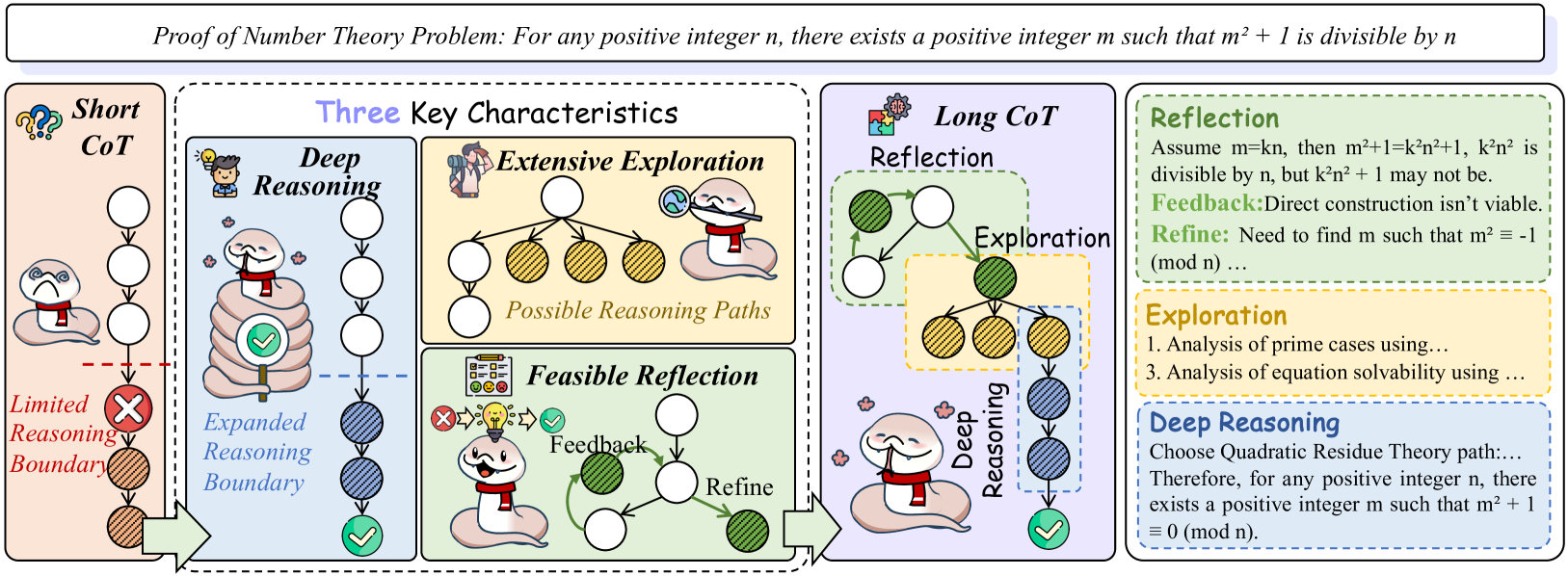
This image is a conceptual diagram illustrating different reasoning methodologies for solving a specific mathematical proof problem. It contrasts a limited "Short Chain of Thought (CoT)" approach with a more robust "Long CoT" approach, which is built upon three key characteristics: Deep Reasoning, Extensive Exploration, and Feasible Reflection. The diagram uses a combination of flowcharts, cartoon characters (stylized seals), and text boxes to explain the processes.
### Components/Axes
The diagram is organized into three main vertical sections, flowing from left to right:
1. **Left Section: "Short CoT"**
* **Label:** "Short CoT" (top-left).
* **Visual:** A simple, linear flowchart of circles (nodes) connected by downward arrows.
* **Outcome:** The flow ends at a red circle with a white "X", labeled "Limited Reasoning Boundary" in red text. This indicates failure or a dead end.
2. **Central Section: "Three Key Characteristics"**
* **Main Title:** "Three Key Characteristics" (centered at top).
* **Sub-components (three boxes):**
* **Top-Left Box: "Deep Reasoning"**
* **Label:** "Deep Reasoning".
* **Visual:** A more complex, multi-path flowchart. A character is shown at the top. The flow splits and converges, ending at a green circle with a white checkmark. A dashed blue line separates an upper "Expanded Reasoning Boundary" from the lower successful path.
* **Top-Right Box: "Extensive Exploration"**
* **Label:** "Extensive Exploration".
* **Visual:** A tree diagram with a root node branching into three child nodes (colored with yellow diagonal stripes). A character with a magnifying glass observes. The text "Possible Reasoning Paths" is written below the tree.
* **Bottom Box: "Feasible Reflection"**
* **Label:** "Feasible Reflection".
* **Visual:** A cyclical diagram showing a process of "Feedback" and "Refine". It starts with a red "X", moves through a green checkmark node, and loops back. A character is shown thinking with a lightbulb.
3. **Right Section: "Long CoT" and Proof Details**
* **Left Part: "Long CoT" Flowchart**
* **Label:** "Long CoT" (top).
* **Visual:** An integrated flowchart combining the three characteristics. It shows a sequence: **Reflection** (green hatched circle) -> **Exploration** (yellow striped circles) -> **Deep Reasoning** (blue hatched circles), ending with a green checkmark. The words "Reflection", "Exploration", and "Deep Reasoning" are placed next to their respective stages.
* **Right Part: Text Box with Mathematical Reasoning**
* This box contains the transcribed text of the reasoning process. It is divided into three colored sections corresponding to the stages in the adjacent flowchart.
### Detailed Analysis / Content Details
**Transcription of the Mathematical Text Box (Rightmost Element):**
* **Green Section (Reflection):**
* "Assume m=kn, then m²+1=k²n²+1, k²n² is divisible by n, but k²n² + 1 may not be."
* "Feedback: Direct construction isn't viable."
* "Refine: Need to find m such that m² ≡ -1 (mod n) ..."
* **Yellow Section (Exploration):**
* "1. Analysis of prime cases using..."
* "3. Analysis of equation solvability using ..." (Note: The numbering jumps from 1 to 3; point 2 is not visible in this excerpt).
* **Blue Section (Deep Reasoning):**
* "Choose Quadratic Residue Theory path:..."
* "Therefore, for any positive integer n, there exists a positive integer m such that m² + 1 ≡ 0 (mod n)."
**Visual Metaphors and Flow:**
* The cartoon seal characters are used consistently to represent the "reasoner" at different stages of the process.
* **Color/Pattern Coding:**
* **Green (solid/hatched):** Associated with "Reflection" and successful outcomes (checkmarks).
* **Yellow (striped):** Associated with "Exploration" and possible paths.
* **Blue (hatched):** Associated with "Deep Reasoning" and the final proof steps.
* **Red:** Associated with failure or limitations (the "X" in Short CoT and the starting point in Feasible Reflection).
* **Spatial Grounding:** The legend (color/pattern coding) is consistently applied across the "Three Key Characteristics" boxes and the integrated "Long CoT" flowchart. The text box on the far right uses the same color scheme for its section headers, creating a direct visual link between the abstract process and the concrete mathematical steps.
### Key Observations
1. **Progression of Complexity:** The diagram clearly shows a progression from a simple, linear, and ultimately failing model (Short CoT) to a complex, iterative, and successful model (Long CoT).
2. **Integration is Key:** The "Long CoT" is not just a longer sequence; it is the deliberate integration of the three core characteristics (Reflection, Exploration, Deep Reasoning) shown in the central panel.
3. **Mathematical Content:** The text box provides a genuine, albeit abbreviated, glimpse into the proof strategy for the stated number theory problem. It moves from a failed initial assumption (direct construction) to a refined modular arithmetic approach, mentions exploratory analysis (prime cases, solvability), and concludes with a specific theoretical path (Quadratic Residue Theory).
4. **Visual Storytelling:** The use of characters, flowcharts, and color creates a narrative about the problem-solving journey, making an abstract concept more accessible.
### Interpretation
This diagram serves as a pedagogical or conceptual model for advanced problem-solving, using a number theory proof as its concrete example. It argues that tackling complex problems requires more than a straightforward, step-by-step approach (Short CoT). Instead, success depends on a cyclical and integrated methodology that includes:
* **Reflection:** Critically evaluating initial assumptions and feedback to refine the approach.
* **Exploration:** Actively generating and considering multiple potential solution paths.
* **Deep Reasoning:** Applying sophisticated theoretical knowledge to construct a rigorous final proof.
The underlying message is that robust reasoning is non-linear, involves backtracking and refinement, and leverages both creative exploration and deep domain expertise. The specific mathematical problem is used to ground these abstract reasoning characteristics in a tangible context, demonstrating how each characteristic manifests in an actual proof attempt. The diagram essentially maps a metacognitive strategy onto a technical domain.
DECODING INTELLIGENCE...