## Flowchart: Proof of Number Theory Problem
### Overview
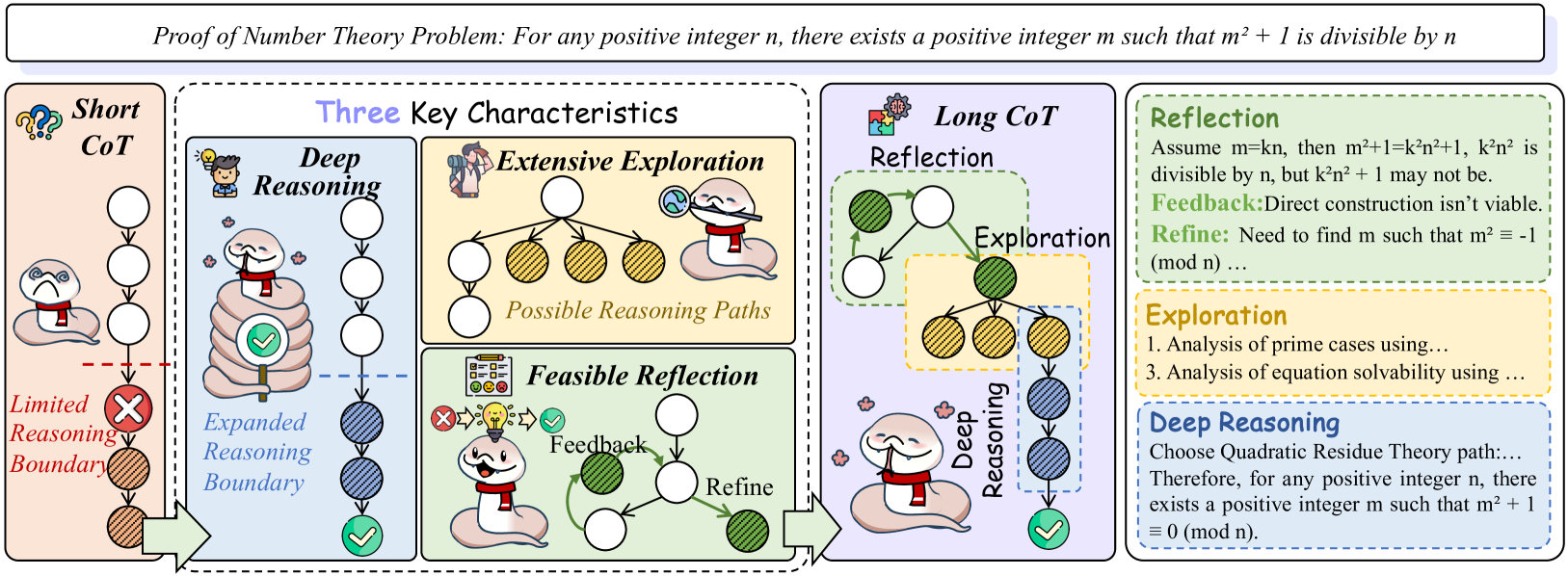
The image is a flowchart illustrating a structured approach to solving a number theory problem: "For any positive integer n, there exists a positive integer m such that m² + 1 is divisible by n." The diagram is divided into four main sections, each representing a reasoning strategy or characteristic, with annotations and visual metaphors (e.g., cartoon snakes, checkmarks, and arrows).
---
### Components/Axes
1. **Left Section: "Short CoT"**
- Label: "Short CoT" (Chain of Thought)
- Sub-components:
- "Limited Reasoning Boundary" (marked with a red "X")
- Visual: A snake with a red scarf, progressing through three white circles (steps).
2. **Center Section: "Three Key Characteristics"**
- Sub-sections:
- **Deep Reasoning**:
- "Expanded Reasoning Boundary" (green checkmark)
- Visual: A snake with a magnifying glass, progressing through three white circles.
- **Extensive Exploration**:
- "Possible Reasoning Paths" (branching yellow circles)
- Visual: A snake with a globe, connected to multiple yellow nodes.
- **Feasible Reflection**:
- "Feedback" (green checkmark) and "Refine" (green checkmark)
- Visual: A snake with a lightbulb, connected to a feedback loop.
3. **Right Section: "Long CoT"**
- Sub-sections:
- **Reflection**:
- Text: "Assume m=kn, then m²+1=k²n²+1. k²n² is divisible by n, but k²n² + 1 may not be."
- Text: "Feedback: Direct construction isn’t viable. Refine: Need to find m such that m² ≡ -1 (mod n)."
- Visual: A snake with a puzzle piece, connected to a green feedback loop.
- **Exploration**:
- Text: "1. Analysis of prime cases using... 3. Analysis of equation solvability using..."
- Visual: A snake with a magnifying glass, connected to blue nodes.
- **Deep Reasoning**:
- Text: "Choose Quadratic Residue Theory path: Therefore, for any positive integer n, there exists a positive integer m such that m² + 1 ≡ 0 (mod n)."
- Visual: A snake with a red scarf, progressing through a green checkmark.
4. **Rightmost Panel: Problem Statement**
- Text: "Proof of Number Theory Problem: For any positive integer n, there exists a positive integer m such that m² + 1 is divisible by n."
---
### Detailed Analysis
- **Flow Direction**:
- The diagram progresses from left (short reasoning) to right (long reasoning), with arrows indicating logical flow.
- Feedback loops (green circles) connect "Feasible Reflection" and "Reflection" sections, emphasizing iterative refinement.
- **Textual Content**:
- Mathematical equations and logical steps are embedded in the "Reflection" and "Deep Reasoning" sections.
- Key terms: "Quadratic Residue Theory," "mod n," "divisible by n," and "equation solvability."
- **Visual Metaphors**:
- Snakes represent reasoning agents, with scarves and accessories symbolizing different strategies (e.g., red scarf for "Short CoT," magnifying glass for "Exploration").
- Checkmarks (green) and Xs (red) denote success/failure of reasoning paths.
---
### Key Observations
1. **Progression of Reasoning**:
- "Short CoT" fails due to limited reasoning boundaries, while "Deep Reasoning" succeeds with expanded boundaries and feedback.
- "Extensive Exploration" introduces multiple paths, but "Feasible Reflection" ensures refinement.
2. **Mathematical Focus**:
- The problem hinges on modular arithmetic and quadratic residues, with explicit steps to transition from direct construction to theoretical exploration.
3. **Iterative Process**:
- Feedback loops highlight the importance of revising assumptions (e.g., "m=kn" leads to a dead end, prompting refinement).
---
### Interpretation
The diagram illustrates a structured, iterative approach to solving a number theory problem. It emphasizes:
- **Depth over breadth**: "Deep Reasoning" and "Long CoT" sections prioritize theoretical exploration (e.g., quadratic residues) over superficial analysis.
- **Adaptability**: Feedback mechanisms (e.g., "Refine") address the limitations of initial assumptions (e.g., "m=kn").
- **Mathematical rigor**: The problem is framed as a proof, requiring logical steps (e.g., "Analysis of prime cases") and theoretical frameworks (e.g., Quadratic Residue Theory).
The flowchart underscores that solving such problems demands moving beyond direct computation to abstract reasoning, with reflection and exploration as critical components. The use of visual metaphors (snakes, checkmarks) simplifies complex logical flows, making the process accessible while maintaining technical precision.