## Flowchart: Tangle Diagrams and Transformations
### Overview
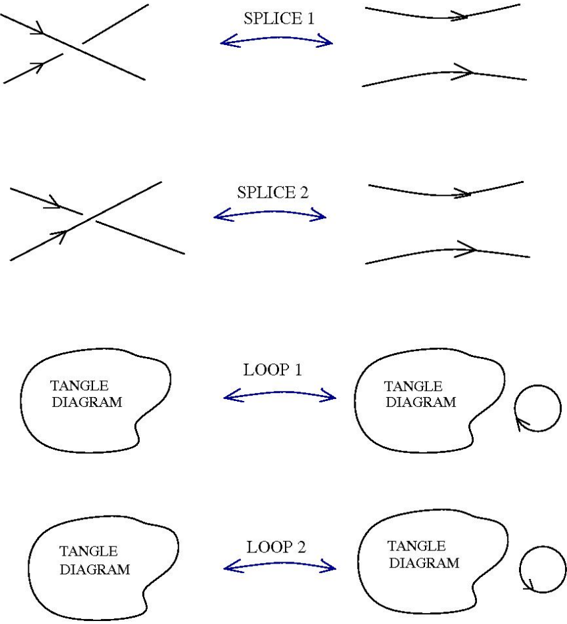
The image depicts a flowchart illustrating transformations between tangle diagrams and their simplified or modified forms. It includes labeled components ("SPLICE 1", "SPLICE 2", "LOOP 1", "LOOP 2") and directional arrows indicating processes.
### Components/Axes
- **Labels**:
- "SPLICE 1" and "SPLICE 2" (top section).
- "LOOP 1" and "LOOP 2" (bottom section).
- "TANGLE DIAGRAM" (input for both loops).
- **Arrows**:
- Blue bidirectional arrows between "TANGLE DIAGRAM" and "LOOP 1"/"LOOP 2".
- Unidirectional arrows within "SPLICE 1" and "SPLICE 2" (e.g., crossing lines transforming into parallel lines).
- **Diagrams**:
- "TANGLE DIAGRAM" (left side, abstract knot-like structure).
- "LOOP 1" and "LOOP 2" (right side, with "LOOP 2" containing an additional circular loop).
### Detailed Analysis
1. **SPLICE 1**:
- Two crossing lines (arrows) transform into two parallel lines via a splice operation.
- Arrows indicate the direction of simplification.
2. **SPLICE 2**:
- Similar to SPLICE 1 but with a different crossing configuration.
- Resulting parallel lines are oriented differently (e.g., upward vs. downward).
3. **LOOP 1**:
- A tangle diagram (input) transforms into a single-loop structure.
- Arrows suggest the process of closing the tangle into a loop.
4. **LOOP 2**:
- Similar to LOOP 1 but includes an additional circular loop appended to the primary loop.
- The extra loop is drawn separately but connected to the main loop.
### Key Observations
- **Simplification vs. Complexity**:
- Splices reduce complexity (crossing lines → parallel lines).
- Loops increase complexity by forming closed structures.
- **Asymmetry in LOOP 2**:
- The additional loop in LOOP 2 is distinct from LOOP 1, suggesting a secondary transformation step.
- **Directionality**:
- Arrows in splices point toward parallel lines, while loop arrows point from tangle diagrams to their looped forms.
### Interpretation
The diagram likely represents a mathematical or topological process where tangle diagrams (complex knot-like structures) are simplified via splicing or modified into loops. The asymmetry in LOOP 2 implies a hierarchical or multi-step transformation, where an initial loop is further elaborated. This could model concepts in knot theory, polymer chemistry, or network simplification algorithms. The absence of numerical data suggests a focus on structural relationships rather than quantitative analysis.