\n
## Bar Chart: Energy per Operation for Different Processor Types
### Overview
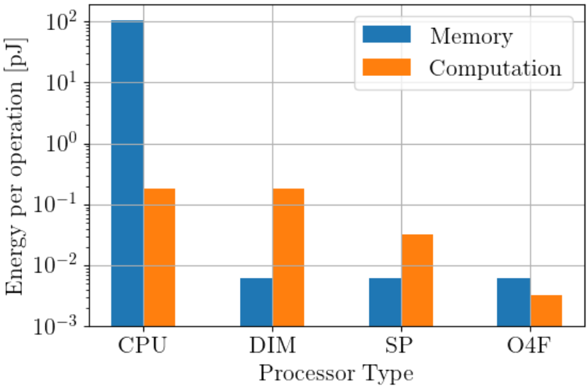
This bar chart compares the energy consumption per operation for four different processor types: CPU, DIM, SP, and O4F. The energy is measured in picojoules (pJ) and is broken down into two components: Memory and Computation. The chart uses a logarithmic y-axis to accommodate the wide range of energy values.
### Components/Axes
* **X-axis:** Processor Type (CPU, DIM, SP, O4F) - Categorical variable.
* **Y-axis:** Energy per operation [pJ] - Logarithmic scale, ranging from 10^-3 to 10^2.
* **Legend:**
* Blue: Memory
* Orange: Computation
* **Gridlines:** Present, aiding in value estimation.
### Detailed Analysis
The chart consists of paired bars for each processor type, representing Memory and Computation energy consumption.
**CPU:**
* Memory: The blue bar for CPU is approximately 10^2 pJ (around 100 pJ).
* Computation: The orange bar for CPU is approximately 0.1 pJ.
**DIM:**
* Memory: The blue bar for DIM is approximately 0.02 pJ.
* Computation: The orange bar for DIM is approximately 0.15 pJ.
**SP:**
* Memory: The blue bar for SP is approximately 0.01 pJ.
* Computation: The orange bar for SP is approximately 0.05 pJ.
**O4F:**
* Memory: The blue bar for O4F is approximately 0.01 pJ.
* Computation: The orange bar for O4F is approximately 0.005 pJ.
**Trends:**
* For all processor types, the energy consumption for Memory is significantly higher than for Computation.
* The energy consumption for Memory decreases as the processor type changes from CPU to DIM, SP, and O4F.
* The energy consumption for Computation also decreases, but to a lesser extent, as the processor type changes.
### Key Observations
* The CPU consumes the most energy per operation, particularly for Memory access.
* The O4F processor has the lowest energy consumption for both Memory and Computation.
* The difference in energy consumption between Memory and Computation is substantial across all processor types.
* The logarithmic scale is crucial for visualizing the large differences in energy consumption.
### Interpretation
The data suggests that the type of processor significantly impacts energy consumption per operation. CPUs, while powerful, are energy-intensive, especially regarding memory access. Specialized processors like DIM, SP, and O4F demonstrate significantly lower energy consumption, indicating potential benefits in energy-efficient computing. The large disparity between Memory and Computation energy consumption highlights the importance of optimizing memory access patterns to reduce overall energy usage. The trend of decreasing energy consumption as processor type changes suggests that advancements in processor design and architecture are leading to more energy-efficient computing solutions. The logarithmic scale emphasizes the order-of-magnitude differences in energy consumption, making it clear that the energy savings achieved with specialized processors are substantial. This data could be used to inform decisions about processor selection for applications where energy efficiency is a critical concern.