## Diagram: Three-Stage Knowledge Integration Process
### Overview
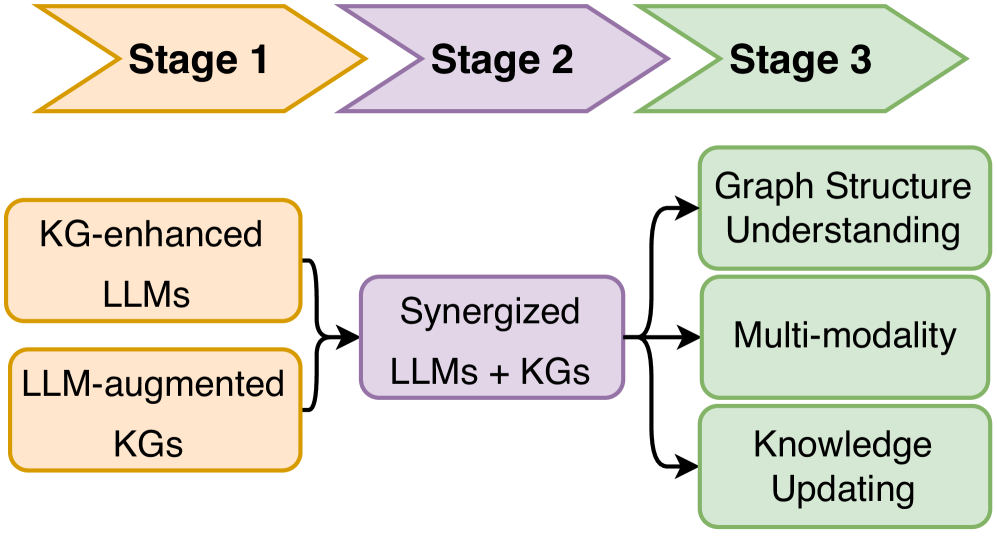
The diagram illustrates a three-stage pipeline for integrating knowledge graphs (KGs) and large language models (LLMs). It uses color-coded stages (orange, purple, green) with directional arrows to show the flow of components and processes. The stages progress from foundational enhancements to synergistic integration and finally to applied outcomes.
### Components/Axes
- **Stage 1 (Orange)**:
- **KG-enhanced LLMs**: A component where knowledge graphs augment large language models.
- **LLM-augmented KGs**: A component where large language models enhance knowledge graphs.
- Both components feed into **Stage 2** via black arrows.
- **Stage 2 (Purple)**:
- **Synergized LLMs + KGs**: A merged output of Stage 1 components, represented as a single purple rectangle.
- Arrows from Stage 2 point to **Stage 3**.
- **Stage 3 (Green)**:
- **Graph Structure Understanding**: A component focused on analyzing KG topology.
- **Multi-modality**: A component integrating diverse data types (e.g., text, images).
- **Knowledge Updating**: A component for dynamic KG refinement.
- All three components are connected to Stage 2 via black arrows.
### Detailed Analysis
- **Stage 1**:
- Two parallel processes:
1. **KG-enhanced LLMs** (orange box) improves LLMs using KG data.
2. **LLM-augmented KGs** (orange box) enriches KGs with LLM outputs.
- Both outputs converge into Stage 2.
- **Stage 2**:
- **Synergized LLMs + KGs** (purple box) represents the fusion of enhanced LLMs and KGs, creating a hybrid system.
- **Stage 3**:
- Three downstream applications:
1. **Graph Structure Understanding** (green box): Analyzes KG relationships.
2. **Multi-modality** (green box): Combines heterogeneous data sources.
3. **Knowledge Updating** (green box): Maintains KG relevance through iterative refinement.
### Key Observations
- **Color Coding**: Stages are distinctly color-coded (orange → purple → green) to emphasize progression.
- **Flow Direction**: Arrows unidirectionally move from left to right, indicating a sequential process.
- **Component Relationships**:
- Stage 1 components are prerequisites for Stage 2.
- Stage 2 output enables all three Stage 3 components.
- **Symmetry**: Stage 1 and Stage 3 each have two and three components, respectively, suggesting a balance between foundational and applied phases.
### Interpretation
This diagram represents a knowledge integration framework where:
1. **Stage 1** focuses on bidirectional enhancement: KGs improve LLMs, and LLMs refine KGs.
2. **Stage 2** synthesizes these enhancements into a unified system, enabling advanced capabilities.
3. **Stage 3** applies the synergized system to three critical tasks:
- **Graph Structure Understanding**: Essential for tasks like ontology alignment or subgraph matching.
- **Multi-modality**: Critical for cross-modal AI systems (e.g., vision-language models).
- **Knowledge Updating**: Addresses the challenge of maintaining fresh, accurate KGs in dynamic domains.
The process emphasizes iterative improvement, where foundational enhancements (Stage 1) enable scalable, adaptive solutions (Stage 3). The absence of feedback loops suggests a linear pipeline, though real-world implementations might require cyclical updates between stages.