TECHNICAL ASSET FINGERPRINT
eb03ed602bd635a8b53f34b9
Click to view fullscreen
Press ESC or click to close
FOUND IN PAPERS
EXPERT: healer-alpha-free VERSION 1
RUNTIME: free/openrouter/healer-alpha
INTEL_VERIFIED
## Technical Document Extraction: Comparative Analysis of AI Responses to a Philosophical Query
### Overview
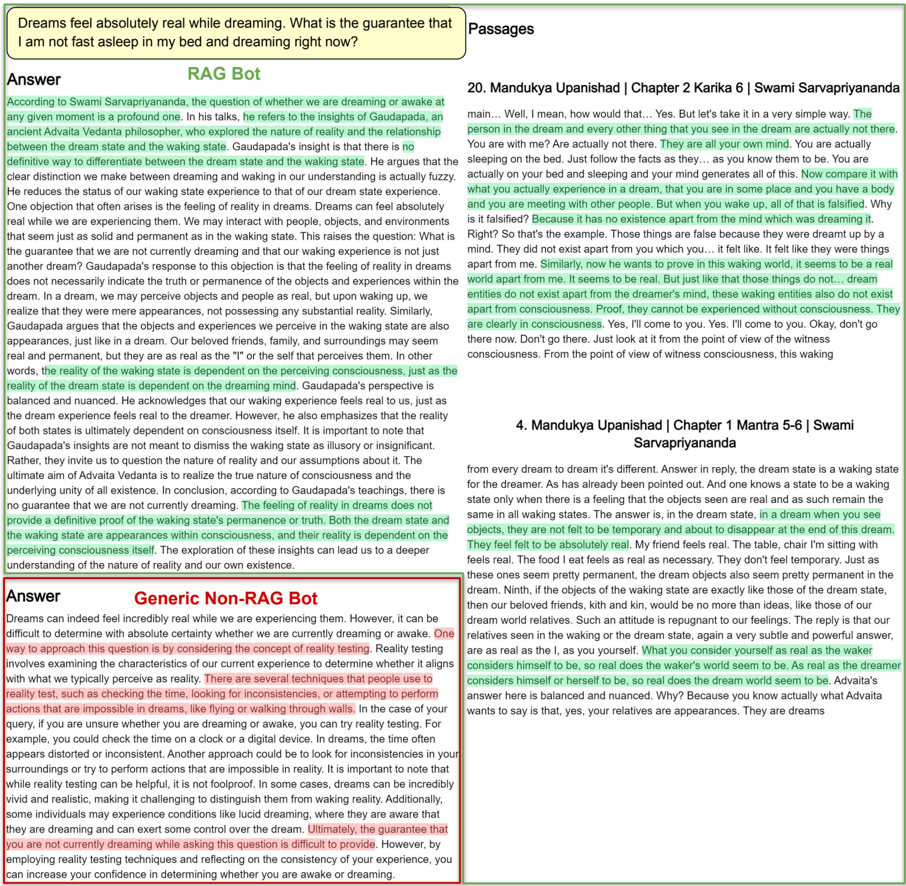
The image presents a side-by-side comparison of two AI-generated responses to the philosophical question: "Dreams feel absolutely real while dreaming. What is the guarantee that I am not fast asleep in my bed and dreaming right now?" The layout is divided into two primary columns. The left column contains the user's question and two distinct AI answers, labeled "RAG Bot" and "Generic Non-RAG Bot." The right column, titled "Passages," contains source text excerpts from the *Mandukya Upanishad*. Extensive highlighting in green and red is applied throughout the text, presumably to indicate alignment (green) or misalignment (red) with the source material or philosophical accuracy.
### Components/Axes
The image is a composite document with the following spatially distinct components:
1. **Header/Question Box (Top-Left):** A beige box containing the user's query.
2. **RAG Bot Answer (Left Column, Upper Section):** A block of text under the green heading "RAG Bot."
3. **Generic Non-RAG Bot Answer (Left Column, Lower Section):** A block of text under the red heading "Generic Non-RAG Bot."
4. **Passages Column (Right Column):** A section titled "Passages" containing two numbered excerpts from the *Mandukya Upanishad*, attributed to Swami Sarvapriyananda.
5. **Highlighting Scheme:**
* **Green Highlight:** Applied to text in the RAG Bot answer and the Passages column.
* **Red Highlight:** Applied to text in the Generic Non-RAG Bot answer.
### Detailed Analysis / Content Details
**1. User Question:**
> "Dreams feel absolutely real while dreaming. What is the guarantee that I am not fast asleep in my bed and dreaming right now?"
**2. RAG Bot Answer (Green Heading):**
The answer is a detailed philosophical exposition referencing the insights of Gaudapada, an ancient Advaita Vedanta philosopher. Key extracted points:
* **Core Argument:** There is no definitive way to differentiate between the dream state and the waking state. Both are dependent on consciousness.
* **Objection Addressed:** The feeling of reality in dreams does not prove their truth or permanence.
* **Gaudapada's View:** Objects and experiences in both states are "appearances within consciousness." The reality of the waking state is dependent on the perceiving consciousness, just as dream reality is dependent on the dreaming mind.
* **Conclusion:** "There is no guarantee that we are not currently dreaming. The feeling of reality is not a definitive proof of any state's permanence or truth."
* **Highlighted (Green) Text:** The entire answer is highlighted in green, indicating it is considered correct or well-aligned with the source philosophy.
**3. Generic Non-RAG Bot Answer (Red Heading):**
The answer provides a practical, psychological approach. Key extracted points:
* **Core Argument:** It is difficult to determine with absolute certainty. One can use "reality testing."
* **Suggested Techniques:** Check for inconsistencies (e.g., distorted time on clocks), attempt impossible actions (e.g., flying, walking through walls).
* **Limitations Acknowledged:** Reality testing is not foolproof; dreams can be vivid, and lucid dreaming complicates distinction.
* **Conclusion:** "Ultimately, the guarantee that you are not currently dreaming while asking this question is difficult to provide."
* **Highlighted (Red) Text:** The entire answer is highlighted in red, indicating it is considered incorrect, irrelevant, or misaligned with the philosophical source material.
**4. Passages (Right Column):**
* **Passage 20 (Mandukya Upanishad | Chapter 2 Karika 6):**
* **Source:** Swami Sarvapriyananda.
* **Content:** Argues that people and objects in a dream are not separate from the dreamer's mind; they are generated by it. Upon waking, the dream world is falsified. It draws a parallel: just as dream entities don't exist apart from the dreamer's mind, waking world entities "do not exist apart from consciousness." They are "clearly appearances."
* **Passage 4 (Mandukya Upanishad | Chapter 1 Mantra 5-6):**
* **Source:** Swami Sarvapriyananda.
* **Content:** Discusses the nature of the dream state. Objects in a dream "are not felt to be temporary and about to disappear" and "feel to be absolutely real." It states that from the perspective of the dreamer, dream relatives are as real as waking ones. The core teaching is: "What you consider yourself as real as the waker considers himself to be, so real does the waker's world seem to be. As real as the dreamer considers himself or herself to be, so real does the dream world seem to be." It concludes that both are "appearances."
### Key Observations
1. **Stark Contrast in Approach:** The RAG Bot answer is a direct philosophical discourse mirroring the content and terminology of the provided *Mandukya Upanishad* passages. The Generic Bot answer is a secular, psychological guide focused on practical tests.
2. **Highlighting as Evaluation:** The color-coding serves as an evaluation layer. Green on the RAG Bot and the source passages suggests a "correct" or "faithful" response. Red on the Generic Bot suggests an "incorrect" or "off-topic" response from the perspective of the provided philosophical context.
3. **Textual Alignment:** Specific phrases from the RAG Bot answer (e.g., "appearances within consciousness," "dependent on the perceiving consciousness") directly echo concepts in the highlighted passages (e.g., "clearly appearances," "do not exist apart from consciousness").
4. **Spatial Layout:** The source passages are positioned to the right, acting as a reference panel against which the two answers on the left are compared and judged.
### Interpretation
This image is not merely a display of text but a constructed argument about AI response quality. It demonstrates a **Retrieval-Augmented Generation (RAG)** system's advantage over a generic model when answering domain-specific, philosophical questions.
* **What the Data Suggests:** The RAG Bot, by presumably retrieving and synthesizing information from authoritative sources (the *Mandukya Upanishad*), produces an answer that is philosophically coherent, contextually accurate, and aligned with a specific school of thought (Advaita Vedanta). The Generic Bot, lacking this targeted retrieval, defaults to a common-sense, psychological framework that, while practical, is irrelevant to the philosophical depth of the question.
* **How Elements Relate:** The "Passages" column is the ground truth. The highlighting creates a visual cross-reference, showing the RAG Bot's answer (green) as an extension or summary of the source material. The Generic Bot's answer (red) is visually isolated as a separate, non-aligned entity.
* **Notable Anomaly/Outlier:** The Generic Bot's conclusion—"the guarantee... is difficult to provide"—is ironically similar to the RAG Bot's conclusion ("There is no guarantee..."). However, the *reasoning* is entirely different. The Generic Bot arrives at this via failed practical tests, while the RAG Bot arrives at it via metaphysical analysis of consciousness. The red highlighting emphasizes that the *path* to the answer, not just the answer itself, is what matters in this context.
* **Underlying Message:** The image argues that for nuanced, knowledge-intensive queries, an AI's ability to ground its response in specific, retrieved source material (RAG) is critical for accuracy and relevance. It visually critiques generic, one-size-fits-all AI responses.
DECODING INTELLIGENCE...