## Screenshot: Conversation Between User and AI Models on Dream Reality
### Overview
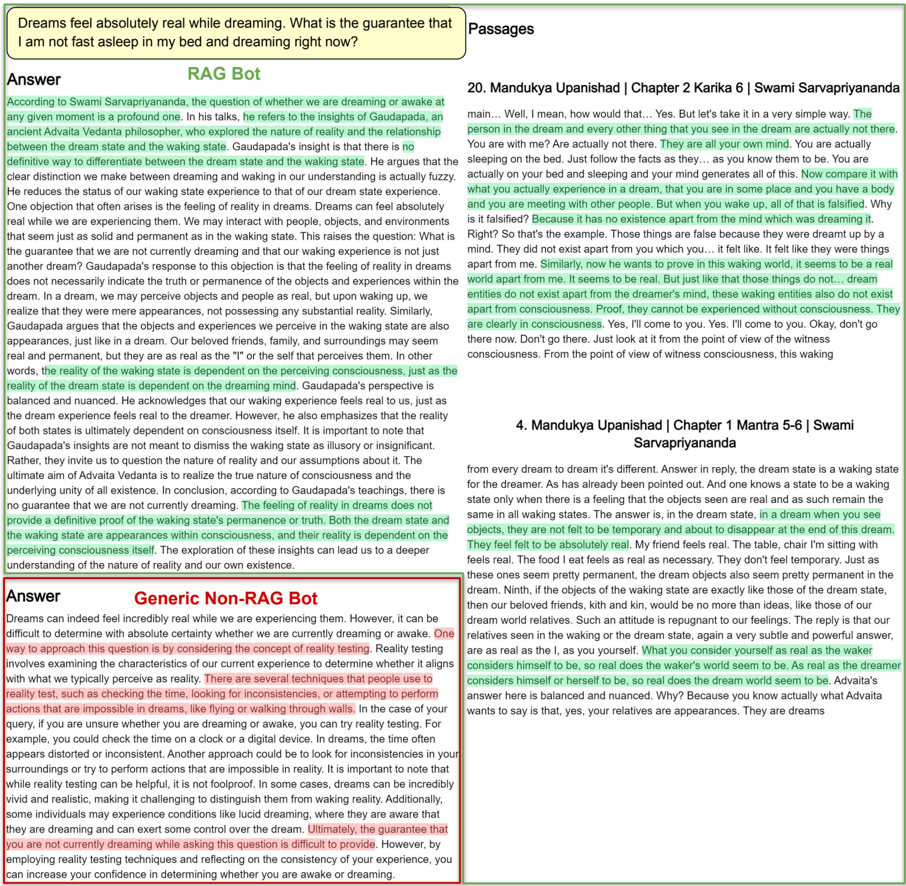
The image shows a text-based conversation where a user asks about the reality of dreams versus waking states, referencing Swami Sarvapriyananda and Vedanta philosophy. Two AI models respond: "RAG Bot" and "Generic Non-RAG Bot." The conversation includes quoted passages from the *Mandukya Upanishad* (Chapters 1 and 2) and *Sarvapriyananda*'s teachings.
---
### Components/Axes
- **User Question**: "Dreams feel absolutely real while dreaming. What is the guarantee that I am not fast asleep in my bed and dreaming right now?"
- **RAG Bot Answer**: A detailed philosophical explanation referencing Vedanta, consciousness, and the nature of reality.
- **Generic Non-RAG Bot Answer**: A shorter response discussing empirical testing and lucid dreaming.
- **Passages**: Quoted text from *Mandukya Upanishad* (Chapters 1 and 2) and *Sarvapriyananda*'s commentary.
---
### Detailed Analysis
#### User Question
- Directly asks about the ontological certainty of dreams vs. waking states, invoking skepticism about perception.
#### RAG Bot Answer
- **Key Themes**:
- Vedanta philosophy: Distinction between *waking state* (reality) and *dream state* (illusion).
- Consciousness as the ultimate reality: "The feeling of reality in dreams does not provide a guarantee of permanence or truth."
- Reference to Swami Sarvapriyananda’s teachings on the impermanence of dream objects.
- Highlighted text: "The reality of the waking state is dependent on the perceiving consciousness, just as the reality of the dream state is dependent on the dreaming mind."
#### Generic Non-RAG Bot Answer
- **Key Themes**:
- Empirical testing: Suggests reality testing (e.g., checking clocks, performing actions) to distinguish dreams from waking states.
- Acknowledges limitations: "Dreams can be incredibly vivid and realistic."
- Highlights the role of consciousness: "The dream world seems real because the dreamer considers themselves real."
#### Passages
1. **Chapter 2 Karika 6 (Mandukya Upanishad)**:
- Discusses the nature of the dream state: "The person in the dream... is actually not there. You are actually not there. They are all your own mind."
- Emphasizes the illusory nature of dream objects: "These waking entities do not exist apart from consciousness."
2. **Chapter 1 Mantra 5-6 (Mandukya Upanishad)**:
- Describes the dream state as a "waking state for the dreamer," where objects are "not felt to be temporary or about to disappear."
- Highlights the relationship between the dreamer and dream objects: "The dream world seems real because the dreamer considers themselves real."
---
### Key Observations
- **Philosophical vs. Empirical Approaches**:
- RAG Bot focuses on metaphysical distinctions (Vedanta), while the Generic Non-RAG Bot emphasizes practical testing.
- **Consciousness as Central**:
- Both answers tie reality to consciousness, but RAG Bot frames it as an absolute truth, whereas the Generic Bot treats it as a perceptual construct.
- **Quoted Text Highlights**:
- The passages stress the impermanence of dream objects and the dreamer’s subjective experience.
---
### Interpretation
The conversation contrasts two perspectives on reality:
1. **RAG Bot’s Vedantic View**: Reality is rooted in consciousness. Dreams are illusions because their objects lack permanence and are products of the mind. The waking state is "real" only insofar as it is experienced by the conscious self.
2. **Generic Non-RAG Bot’s Pragmatic View**: Reality can be tested empirically (e.g., through inconsistencies in dream logic). However, it acknowledges the difficulty of distinguishing dreams from waking states due to their subjective nature.
The quoted passages from the *Mandukya Upanishad* reinforce the idea that both dreams and waking states are mental constructs, with the ultimate reality lying beyond both. Swami Sarvapriyananda’s teachings further clarify that the dream state is a "waking state for the dreamer," where objects feel real but are ultimately ephemeral.
The dialogue underscores a tension between philosophical certainty (RAG Bot) and empirical uncertainty (Generic Bot), reflecting broader debates in epistemology about the nature of perception and reality.