## Diagrams: Vector Components with Vertical Acceleration
### Overview
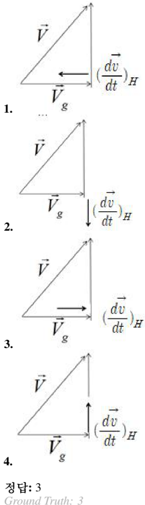
The image contains four labeled diagrams (1–4) depicting vector relationships involving velocity vectors ($\vec{V}$), gravitational velocity ($\vec{V}_g$), and a vertical acceleration component ($\frac{d\vec{v}}{dt}_H$). Each diagram shows a right triangle formed by $\vec{V}$, $\vec{V}_g$, and $\frac{d\vec{v}}{dt}_H$, with directional arrows indicating vector orientations.
### Components/Axes
- **Vectors**:
- $\vec{V}$: Hypotenuse of the triangle, representing total velocity.
- $\vec{V}_g$: Horizontal leg, representing gravitational velocity.
- $\frac{d\vec{v}}{dt}_H$: Vertical leg, representing the vertical component of acceleration.
- **Labels**:
- All diagrams share identical labels ($\vec{V}$, $\vec{V}_g$, $\frac{d\vec{v}}{dt}_H$).
- No numerical values or scales are provided.
- **Legend**:
- No explicit legend is present.
### Detailed Analysis
1. **Diagram 1**:
- $\frac{d\vec{v}}{dt}_H$ points **rightward** (horizontal direction).
- $\vec{V}$ slopes upward from $\vec{V}_g$.
2. **Diagram 2**:
- $\frac{d\vec{v}}{dt}_H$ points **downward** (vertical direction).
- $\vec{V}$ slopes upward from $\vec{V}_g$.
3. **Diagram 3**:
- $\frac{d\vec{v}}{dt}_H$ points **leftward** (horizontal direction).
- $\vec{V}$ slopes upward from $\vec{V}_g$.
4. **Diagram 4**:
- $\frac{d\vec{v}}{dt}_H$ points **upward** (vertical direction).
- $\vec{V}$ slopes upward from $\vec{V}_g$.
### Key Observations
- The vertical acceleration component ($\frac{d\vec{v}}{dt}_H$) varies in direction across diagrams: right (1), down (2), left (3), and up (4).
- $\vec{V}$ consistently slopes upward relative to $\vec{V}_g$ in all cases.
- **Ground Truth**: The annotation "정답: 3" (Korean for "Answer: 3") and "Ground Truth: 3" explicitly identifies Diagram 3 as the correct representation.
### Interpretation
The diagrams likely illustrate scenarios where the vertical acceleration component ($\frac{d\vec{v}}{dt}_H$) changes direction due to external factors (e.g., rotational motion, non-inertial frames, or directional forces). Diagram 3’s leftward $\frac{d\vec{v}}{dt}_H$ suggests a specific context where acceleration opposes the horizontal velocity ($\vec{V}_g$), possibly indicating a centripetal force or directional constraint. The consistency of $\vec{V}$’s upward slope implies that gravitational velocity ($\vec{V}_g$) remains dominant in the horizontal direction across all cases.
The ground truth designation of Diagram 3 highlights its relevance to the problem’s physical or mathematical conditions, such as a specific coordinate system or force application scenario.