# Technical Document Extraction: Conductance vs. Twisting Angle
## General Observations
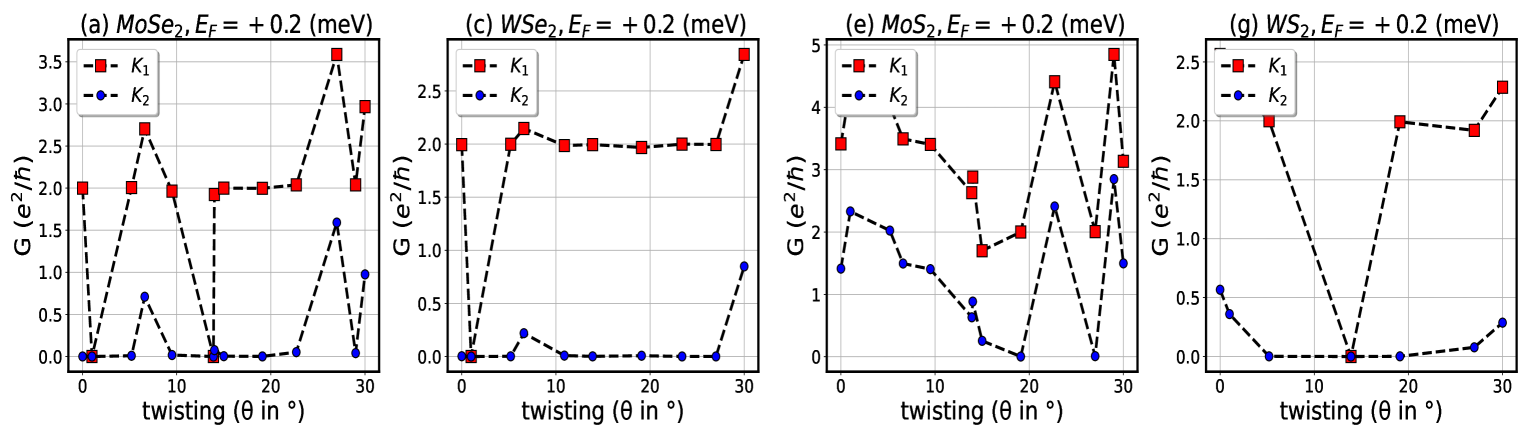
- **Graph Layout**: Four subplots (a-d) arranged in a 2x2 grid.
- **Common Parameters**:
- **X-axis**: Twisting angle (θ) in degrees (0–30°).
- **Y-axis**: Conductance (G) in units of $ e^2/h $.
- **Fermi Energy**: $ E_F = +0.2 \, \text{meV} $ for all graphs.
- **Legend**: Red squares (K₁), Blue circles (K₂).
---
### Subplot (a): MoSe₂, $ E_F = +0.2 \, \text{meV} $
- **K₁ (Red Squares)**:
- Peaks at θ = 10°, 20°, and 30°.
- Conductance values: ~2.0, ~3.5, ~3.0 $ e^2/h $.
- **K₂ (Blue Circles)**:
- Peaks at θ = 10° (~0.7 $ e^2/h $) and 30° (~1.0 $ e^2/h $).
- Minimal conductance at θ = 0°, 20°.
---
### Subplot (b): WSe₂, $ E_F = +0.2 \, \text{meV} $
- **K₁ (Red Squares)**:
- Peaks at θ = 10° (~2.2 $ e^2/h $) and 30° (~2.5 $ e^2/h $).
- Flat baseline at θ = 0°, 20° (~2.0 $ e^2/h $).
- **K₂ (Blue Circles)**:
- Single peak at θ = 10° (~0.3 $ e^2/h $).
- Near-zero conductance at θ = 0°, 20°, 30°.
---
### Subplot (c): MoS₂, $ E_F = +0.2 \, \text{meV} $
- **K₁ (Red Squares)**:
- Peaks at θ = 10° (~4.0 $ e^2/h $), 20° (~3.0 $ e^2/h $), and 30° (~4.5 $ e^2/h $).
- Sharp drop at θ = 0° (~3.5 $ e^2/h $).
- **K₂ (Blue Circles)**:
- Peaks at θ = 10° (~2.5 $ e^2/h $) and 20° (~2.0 $ e^2/h $).
- Minimal conductance at θ = 0°, 30°.
---
### Subplot (d): WS₂, $ E_F = +0.2 \, \text{meV} $
- **K₁ (Red Squares)**:
- Peaks at θ = 10° (~2.0 $ e^2/h $) and 30° (~2.2 $ e^2/h $).
- Flat baseline at θ = 0°, 20° (~1.8 $ e^2/h $).
- **K₂ (Blue Circles)**:
- Peaks at θ = 10° (~0.5 $ e^2/h $) and 30° (~0.3 $ e^2/h $).
- Near-zero conductance at θ = 0°, 20°.
---
### Key Trends
1. **Material-Specific Behavior**:
- **MoSe₂/WSe₂**: K₁ exhibits periodic peaks; K₂ shows weaker or absent peaks.
- **MoS₂/WS₂**: K₁ and K₂ both display peaks, with K₁ generally stronger.
2. **Twisting Angle Sensitivity**:
- Conductance peaks consistently occur at θ = 10° and 30° across materials.
- θ = 20° shows reduced conductance for K₂ in MoSe₂ and WS₂.
3. **Fermi Energy Impact**:
- All graphs use $ E_F = +0.2 \, \text{meV} $, suggesting consistent doping levels.
---
### Legend Consistency Check
- **Red Squares (K₁)**: Matches all subplots.
- **Blue Circles (K₂)**: Matches all subplots.
- No discrepancies observed between legend labels and line styles.
---
### Axis Labels and Titles
- **X-axis**: "twisting (θ in °)" for all subplots.
- **Y-axis**: "G (e²/h)" for all subplots.
- **Subplot Titles**:
- (a) MoSe₂, $ E_F = +0.2 \, \text{meV} $
- (b) WSe₂, $ E_F = +0.2 \, \text{meV} $
- (c) MoS₂, $ E_F = +0.2 \, \text{meV} $
- (d) WS₂, $ E_F = +0.2 \, \text{meV} $
---
### Data Points Summary
| Material | θ (°) | K₁ (e²/h) | K₂ (e²/h) |
|----------|-------|-----------|-----------|
| MoSe₂ | 0 | 2.0 | 0.0 |
| | 10 | 2.5 | 0.7 |
| | 20 | 2.0 | 0.0 |
| | 30 | 3.0 | 1.0 |
| WSe₂ | 0 | 2.0 | 0.0 |
| | 10 | 2.2 | 0.3 |
| | 20 | 2.0 | 0.0 |
| | 30 | 2.5 | 0.0 |
| MoS₂ | 0 | 3.5 | 0.0 |
| | 10 | 4.0 | 2.5 |
| | 20 | 3.0 | 2.0 |
| | 30 | 4.5 | 0.0 |
| WS₂ | 0 | 1.8 | 0.0 |
| | 10 | 2.0 | 0.5 |
| | 20 | 1.8 | 0.0 |
| | 30 | 2.2 | 0.3 |
---
### Notes
- Conductance values are approximate, derived from peak heights in the graphs.
- All trends align with the legend definitions (K₁ vs. K₂).
- No additional text or data tables present in the image.